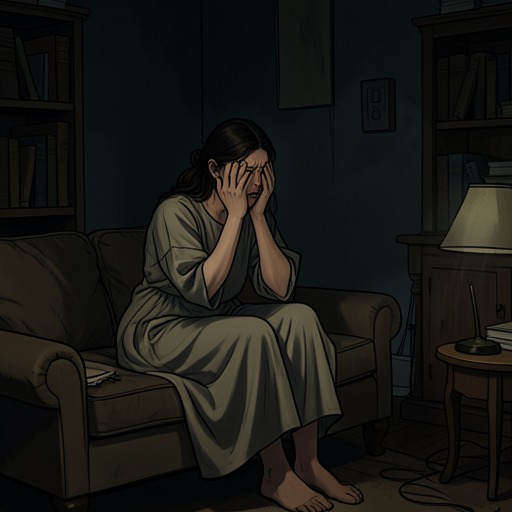
Rosemary’s pregnancy-related illness
Rosemary's BabyRosemary Woodhouse’s pregnancy-related illness is a prolonged episode of abdominal pain, exhaustion, and disputed weight loss that narrows her daily life and tests the authority of Abraham Sapirstein, her obstetrician. What he initially explains as a normal physical change grows worse rather than subsiding; the eventual onset of labor at the Bramford gives the pain a consequence that neither his early reassurance nor the household’s soothing assurances had prepared Rosemary Woodhouse for.
Onset and Initial Diagnosis
The illness begins after Rosemary Woodhouse develops sharp abdominal pains and calls Abraham Sapirstein. He examines her and attributes the pain to normal expansion of her pelvis, predicting that it will disappear within a day or two and advising ordinary doses of aspirin in the meantime. Rosemary Woodhouse is relieved but raises the possibility of an ectopic pregnancy. Abraham Sapirstein responds skeptically, reminding her that she had agreed not to read books. His certainty rests on his assessment that nothing is wrong, while her concern is treated as a reason to correct her reading rather than to investigate further.
The predicted improvement does not come. Within two days the pain is worse, and it continues to intensify. Rosemary Woodhouse experiences brief intervals of relative relief, but the pain returns; aspirin helps little. Although Abraham Sapirstein permits her to take two aspirin, she limits herself to one because she fears taking too many. The discrepancy is important to the illness’s course: a reassuring explanation and a treatment plan are in place, but neither brings the relief he predicted.
The pain also enters Rosemary Woodhouse’s sleep. She dreams of being cornered by large spiders in the bathroom and of struggling with a small black bush rooted in the living-room rug. She wakes tired and in sharper pain. These dreams do not supply a medical explanation, but they give the illness a presence beyond waking hours, drawing ordinary rooms into the anxious experience of pregnancy.
Worsening Symptoms and a Shrinking Routine
Abraham Sapirstein continues to describe the condition as something that happens sometimes and insists that it will stop. He asks whether Rosemary Woodhouse has lied about her age, adding that the problem usually affects older women whose joints are less flexible. His statements keep the pain within a reassuring account of pregnancy, even as Rosemary Woodhouse’s experience contradicts his forecast. The illness settles into a constant presence, without meaningful respite. She sleeps only a few hours a night and continues to take less aspirin than he has allowed.
Her ordinary activities fall away one by one. She no longer goes out with Joan or Elise, attends sculpture class, or shops. She orders groceries by telephone and remains in the apartment, where she makes nursery curtains and begins reading The Decline and Fall of the Roman Empire. Minnie Castevet and Roman Castevet sometimes visit in the afternoon to talk and ask whether she needs anything; Minnie Castevet also brings her pregnancy drink each day. These visits take place within a restricted domestic routine, not as a replacement for effective relief from the pain.
The illness changes the household’s social plans as well. Rosemary Woodhouse had intended to host a Thanksgiving dinner for friends who, like her and Guy Woodhouse, had no family nearby. Because of the continuing pain and her worry about the baby, she cancels it, and she and Guy Woodhouse go instead to dinner at Minnie Castevet and Roman Castevet’s home. By the time Guy Woodhouse’s pilot is finished, he spends most of his time at home. He helps with cleaning and plays time-limit Scrabble with Rosemary Woodhouse, but he also answers the telephone and makes excuses when calls are for her. The novel thus shows the illness not only through symptoms, but through the growing limits on Rosemary Woodhouse’s movement and contact with others.
Appearance, Reassurance, and Doubt
The physical cost of the illness becomes a point of disagreement. Edward Hutchins sees Rosemary Woodhouse and tells her that she looks terrible, has lost a great deal of weight, and has dark circles around her eyes. Rosemary Woodhouse disputes his estimate: she says she has lost only three pounds and a small additional amount, considers a little loss normal in the first months of pregnancy, and expects to gain weight later. She adds that Guy Woodhouse finally threw away the bathroom scale because it frightened her. The competing estimates leave the degree of weight loss unsettled, but the exchange makes visible how far her appearance has alarmed someone outside the household.
Guy Woodhouse rejects Edward Hutchins’s concern and tells Rosemary Woodhouse that she looks well, redirecting his criticism toward her haircut. Abraham Sapirstein likewise continues to tell her that the pain will stop. Against these reassurances, Edward Hutchins’s observation gives Rosemary Woodhouse’s distress an outside witness. The disagreement is not simply over appearance: it reflects a wider conflict between what Rosemary Woodhouse is living through and the assurances offered by people around her.
That conflict becomes explicit when friends ask whether Abraham Sapirstein is giving her medicine or any other treatment. Rosemary Woodhouse answers that he is giving her nothing. She nevertheless defends him as a good, well-known doctor who has appeared on Open End. Elise urges her to see Dr. Hill, saying that pain of this kind is a warning that something is wrong; Tiger also objects to the continued lack of help. Their concern contrasts with Rosemary Woodhouse’s trust in Abraham Sapirstein’s reputation. The episode presents medical authority as socially persuasive even when the patient’s persistent suffering and the absence of relief give others reason to question the care.
Labor and the Meaning of the Illness
The illness culminates in a change that Abraham Sapirstein recognizes only when Rosemary Woodhouse is already in labor. Guy Woodhouse, Mr. Fountain, Abraham Sapirstein, and other members of the group enter the room while Rosemary Woodhouse is trying to reach help. They describe an injection as a mild sedative and say they are her friends. Rosemary Woodhouse resists their intervention and attempts to call out, but they prevent her from reaching assistance and hold her while Abraham Sapirstein approaches with the injection. When a contraction comes, he examines her and announces that she is in labor; the others pass the news beyond the room. He then gives her the injection.
The setting compounds the reversal. Rosemary Woodhouse had expected to give birth at Doctors Hospital, with its equipment, nurses, and clean facilities; instead, labor has begun at the Bramford, where her movements are controlled by the people around her. The scene does not establish that the earlier pain was caused by the later events, but it does show how little the reassuring diagnosis prepared her for the actual course of the pregnancy. The person who had been told to wait for the pain to pass is now in labor, and the medical professional who had minimized her suffering is present as part of an intervention she has not chosen.
The broader setting gives the illness a Gothic domestic frame without explaining it medically. Rosemary Woodhouse and Guy Woodhouse moved into the Bramford after waiting for an apartment there: an old, large building whose elaborate apartments had attracted them. Earlier, Rosemary Woodhouse had encountered the unsettling basement laundry and remembered that a dead baby had been found there. That memory gives the apartment a pregnancy-related history shadowed by uncertainty, while the later confinement during labor makes the home itself a place where ordinary expectations of privacy and safety fail. The illness’s significance lies in this convergence: persistent pain is repeatedly answered with reassurance, Rosemary Woodhouse’s daily world contracts around it, and its final transition into labor occurs in a place and under circumstances she had not expected.