Rosemary's Forced Home Birth
Rosemary's BabyRosemary’s forced home birth turns the promise of medical protection into a means of control: Guy and Abraham Sapirstein take her away from the hospital she expected to reach, and the child’s birth is followed by an account of his death that Rosemary refuses to believe. The event brings the novel’s conflict over pregnancy, medical authority, and Rosemary’s ability to make decisions about her own body into a single, irreversible crisis.
Background and Stakes
Before labor begins, Rosemary has reason to question the care she is receiving. Her pregnancy is painful, but when friends ask whether Sapirstein is giving her medicine or other treatment, she says he is doing nothing. Her friends consider the pain a warning and urge her to seek another opinion from Dr. Hill. Rosemary defends Sapirstein as a reputable physician, yet the exchange makes visible the difference between his standing and her experience of care: his authority is affirmed while her suffering continues without treatment.
Guy resists even the possibility of a second opinion. He objects that it would be unfair to Sapirstein and says Rosemary should let Sapirstein decide who examines her. Rosemary answers that the question is what is fair to her, but Guy refuses to let her consult Dr. Hill independently. The argument gives the later birth a history: the people controlling Rosemary’s medical arrangements have already treated her request for another perspective as a breach of loyalty to the doctor, rather than a decision she can make for herself.
The episode also follows an earlier rupture in Rosemary and Guy’s marriage. After an encounter that left her feeling that Guy had treated her as a body rather than as a whole person, she wondered whether his words and feelings matched and whether his acting made him difficult to read. The birth does not resolve that uncertainty. Instead, Guy’s assurances during the crisis sit uneasily beside his participation in decisions Rosemary has not chosen.
Confinement and the Onset of Labor
Rosemary expects to deliver at Doctors Hospital, with its equipment, nurses, and sterile facilities. Instead, Guy and Sapirstein arrive with others and tell her to go quietly with them. Sapirstein threatens that if she continues speaking about witches, they will take her to a mental hospital, where the facilities for delivery will be inferior. Guy says that no one will hurt her; Sapirstein adds that the baby will not be hurt. Their language presents compliance as protection, even as they restrict Rosemary’s options and decide where she will give birth.
When Rosemary hears that the group intends to calm her with a sedative, she tries to resist and call for help. Guy and another man restrain her while Sapirstein approaches with an injection. Then a severe contraction interrupts the attempt to sedate her. Sapirstein recognizes that she is in labor, and the others relay the news. He gives her an injection after that recognition; the scene does not present it as a treatment Rosemary requested or consented to. The difference between the stated plan and what happens is consequential: the group has brought her home to quiet her, but the onset of labor changes their immediate purpose to managing a delivery there.
The planned hospital destination remains present as a counterpoint throughout the scene. Rosemary is held as contractions continue, and Guy tells the operator to cancel the arrangements. Sapirstein gives her another injection. The narration moves through disconnected perceptions and brief interruptions rather than presenting the delivery as an orderly sequence of care. That fragmentation conveys Rosemary’s reduced ability to direct what is happening without requiring the scene to explain away the practical stakes: the hospital she expected is no longer the destination, and the people around her control the medication and circumstances of the birth.
Birth and the Account of the Baby’s Death
After the contractions, Rosemary remembers that it is over and asks whether the baby is all right. Guy says that he is, and when she asks what the child is, she learns that she has given birth to a boy. Her brief questions mark a shift from the physical ordeal to the question that will govern everything afterward: where the child is and what has happened to him.
Sapirstein tells Rosemary that there were complications, but that they will not affect future births. He then says that the baby is dead. He attributes the outcome to the baby’s position and claims that there was not time to get Rosemary to the hospital; attempting anything at home, he says, would have endangered her. Guy supports this explanation, speaking of having other children once she has recovered. Sapirstein further describes the baby as healthy and the loss as a rare mishap. The explanation offers a medically framed account while also directing attention toward future pregnancies rather than Rosemary’s immediate questions about the child.
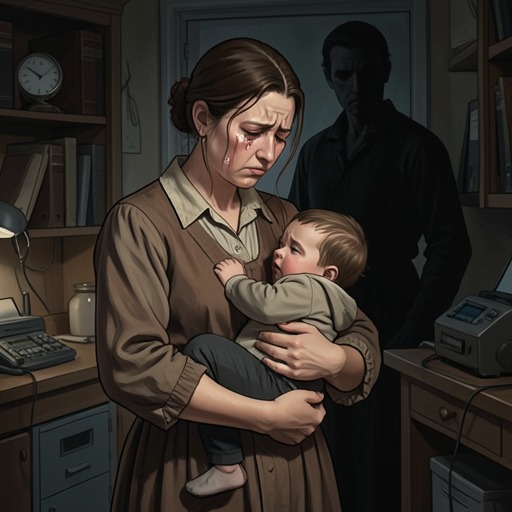
Rosemary does not accept what they tell her. She says that they are lying and insists that the baby did not die but was taken. She accuses Guy and Sapirstein of being witches. Guy holds her down, and Sapirstein gives her another injection. Afterward, Guy describes her as having been out of her mind and attributes her behavior to a kind of prepartum hysteria. His account casts her refusal to believe the men around her as illness, while her own explanation identifies them as the people concealing the child’s fate. The event leaves their opposing versions unresolved within the delivery scene.
Consequences and Significance
The birth joins physical vulnerability to the restriction of choice. Rosemary’s friends had questioned the absence of treatment and advised her to see another doctor; Guy had blocked that second opinion; and, when labor begins, the same husband and physician determine where she will deliver and what medication she receives. The scene does not treat reassurance as equivalent to consent. Guy’s promises that she and the baby will be safe accompany the cancellation of the hospital plan and the suppression of Rosemary’s attempt to seek help.
The episode also makes the conflict over credibility part of the event’s aftermath. Sapirstein’s professional authority and Guy’s close relationship to Rosemary lend force to their story that the baby died. Their explanation is reinforced by labeling Rosemary’s accusations as madness. Yet the novel has shown Rosemary learning to doubt the gap between Guy’s assurances and his actions; here, that doubt becomes a direct refusal of the account both men give her. The birth therefore changes not only her circumstances but the terms on which she can understand and respond to them: she is a mother told that her child is dead, while believing that those who claim to protect her have taken him.