Satan worship
Rosemary's BabySatan worship is the concealed religious system that Rosemary Woodhouse pieces together behind the apparently neighborly life surrounding her. At first it is a possibility she resists; later, Roman Castevet announces its central claim in public: Satan fathered Rosemary’s son, whose name, according to him, is Adrian. The doctrine makes the child the focus of a promised new era, but Rosemary’s insistence on calling him Andrew John Woodhouse gives the revelation an unresolved counterpoint: the coven may proclaim its religious meaning, yet it cannot wholly dictate the name by which his mother addresses him.
Belief and Recognition
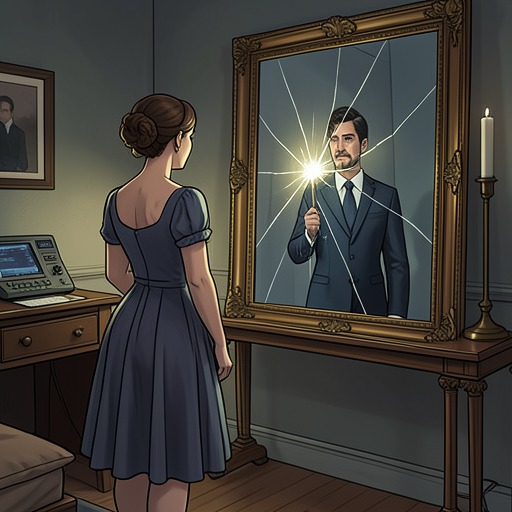
The idea takes shape for Rosemary through a book about witchcraft, not through a direct explanation from the people around her. The volume’s underlined passages refer to belief in fresh blood and to black candles, details that lead her back to Minnie Castevet’s candles during a power failure and to the herbs and charms associated with Minnie. The book’s title, All Of Them Witches, is an anagram, a clue left by Edward Hutchins that Rosemary eventually treats as a means of identifying the people around her. The evidence comes in fragments: an object remembered, a warning reconsidered, and a name rearranged. Her reading does not make her certain at once, but gives form to suspicions that previously seemed impossible to accept.
Rosemary’s reconstruction also draws on the history of Adrian Marcato, whom she identifies as Roman Castevet’s father. She reads that Marcato claimed to have called forth Satan and was attacked by a mob outside the Bramford, and she sees the persecution described in the book as central to Roman’s inheritance. In her explanation to Guy Woodhouse, Marcato’s death in a stable on Corfu, after being refused a hotel room, makes him seem to Rosemary like a martyr. She reasons that a son might preserve the faith for which his father suffered. Guy counters that the events belong to an earlier time, but Rosemary points to the book’s account of covens across Europe, the Americas, and Australia, and argues that thirty-three years would not have been enough to make them disappear. Her belief is presented as an inference built from history and circumstance, not as knowledge she has possessed from the beginning.
Ritual, Objects, and Ordinary Life
The practices Rosemary associates with Satan worship are described through a mixture of remembered images and mundane social details. A frightening dream places Minnie, Laura-Louise, Roman, Guy, and others in a ceremonial gathering, with Roman dressed in black and tracing designs while the group chants. Later, at Laura-Louise’s farewell party for Roman and Minnie, Rosemary hears a recorder and recalls the dream’s music. Yet the gathering itself consists of cookies, fruit punch, conversation about tornadoes and civil rights, and a farewell gift of a transistor radio. The ordinary character of the guests makes it harder for Rosemary to sustain her interpretation: they remind her of older relatives from Omaha, not figures she can readily imagine as participants in witchcraft.
That contrast is part of how the hidden religion operates in the story. Social visits and hospitality coexist with signs Rosemary has learned to read differently: Minnie’s herbs and charms, the black candles, and the group’s music and chanting. Her earlier dream cannot simply settle what is happening; at the farewell party, she reminds herself that it was a dream and questions whether the people she saw could truly have behaved as it depicted. The narrative thus places ritual suspicion beside the evidence of ordinary manners, leaving Rosemary to negotiate between what she has seen or read and what her neighbors appear to be.
The book also gives Rosemary a specific account of the coven’s beliefs about ritual materials. She tells Guy that its members use blood because they believe it has power, and that they assign particular power to the blood and flesh of an unbaptized baby. This is Rosemary’s description of what she has read, and it explains why her pregnancy changes the stakes of her suspicions. The question of belief is no longer only whether a group of neighbors follows an old religion; it is whether that religion has made her child part of its purposes.
The Child and the Coven’s Claim
The coven’s doctrine becomes explicit when Roman explains the child’s parentage. He says that Satan, rather than Guy, is the father, and presents the birth as the answer to wrongs committed against Satan’s followers by those who worship God. He then gives the child the name Adrian and describes him as destined to overthrow powerful institutions, destroy temples, and avenge the burned and tortured. The revelation changes the meaning of the story’s earlier clues: the historical Marcato, the coven, and Rosemary’s pregnancy are gathered into a single religious claim.
The group’s response turns that claim into a collective declaration. Roman calls for Satan and Adrian to be hailed, and the assembled coven repeats the acclamations. When Minnie announces that the child has the beginnings of horns, Roman declares that God is dead and proclaims the first year of a new era. His language makes the birth not merely a family event but the beginning of a new religious chronology. The promised transformation is voiced as a reversal of established power: those who were persecuted are to be avenged, and the God worshipers’ order is declared finished. These are the coven’s proclamations, not an independently confirmed account of what the future will bring.
Naming and Narrative Significance
The final exchange exposes a limit within the coven’s performance of authority. Roman calls the child Adrian and names Rosemary as his mother in the group’s acclamation. The others repeat the tribute to her, including Guy, while Laura-Louise moves her lips without speaking. Rosemary, however, looks up from the bassinet and says that the child is Andrew John Woodhouse. Her answer does not erase what Roman has announced, but it refuses to let his religious title wholly replace the name she gives her son.
Satan worship therefore functions both as a belief system and as a contest over interpretation. Its meanings are assembled from old records, remembered objects, gatherings, and the coven’s words; at the climax, the group tries to secure those meanings through repeated acclamation and a new calendar. Rosemary’s response returns the conflict to the intimate act of naming. The story leaves the coven’s claims intact as claims while making clear that its victory is not complete at the level of language: the mother still names the child in her own terms.