Tannis-root charm
Rosemary's BabyThe Tannis-root charm is a small silver pendant whose supposed promise of good luck becomes entangled with loss, unease, and Rosemary Woodhouse’s fear for her pregnancy. Passed from Theresa Gionoffrio to Rosemary through Minnie Castevet, the charm is at once an intimate personal object and an unexplained presence: Rosemary recoils from its smell, puts it away, and later retrieves it when she feels she needs protection.
Form and promised protection
Theresa first shows the charm while proposing that she and Rosemary make a habit of coming downstairs together. She draws a silver neckchain from beneath her blouse and displays a filigree ball a little less than an inch in diameter. The smallness and delicacy of its silverwork contrast with the material pressed inside: a greenish-brown, spongy substance visible through the openwork. Rosemary notices its bitter smell and draws back, although she also admires the object’s appearance.
Theresa says Minnie gave it to her two days earlier and claims it is three hundred years old. She explains that Minnie grew the substance inside it in a small greenhouse and that the charm is supposed to bring good luck. Her cheerful laughter and hope that it works give the object the air of a friendly, personal gift. But the charm’s unpleasant odor is present from its first appearance, making its promised protection inseparable from a sensory warning Rosemary cannot ignore.
From Theresa to Rosemary
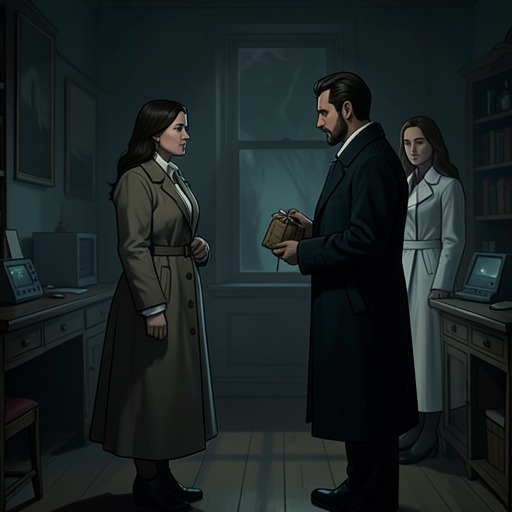
When Minnie visits Rosemary with Laura-Louise McBurney, she gives Rosemary a small packet of pink tissue paper as a housewarming present, saying it is from her and Roman Castevet. Inside is the same silver ball and its clustered neckchain. Rosemary recognizes it as Theresa’s and again pulls her head away from its smell. Minnie describes it as more than three hundred years old, then identifies the green substance as tannis root and repeats that it brings good luck.
The transfer leaves Rosemary uncertain about what happened to the object after Theresa’s death. She wonders whether to tell Minnie that Theresa had already shown it to her, but the opportunity slips away. When she later shows the charm to Guy Woodhouse, she says that it had belonged to Theresa, that the Castevets gave it to her, and that the police must have returned it. Guy offers a different possibility: Theresa may not have been wearing it. Rosemary believes she was, remembering Theresa’s pride in the gift. The story does not settle the charm’s exact route back to Minnie; instead, Rosemary’s account and her insistence on Theresa’s attachment preserve the uncertainty around its transfer.
Rosemary’s resistance to the odor
Rosemary does not wear the charm when Minnie gives it to her. She tells Guy that the filling is called tannis root and holds out the pendant for him to smell. He shrugs off the odor as not especially unpleasant, but Rosemary’s response is stronger: she puts the chain and ball in a tin Louis Sherry box containing odds and ends, then shuts the box inside a vanity drawer. The storage turns the charm into something she wants out of sight as well as off her body.
That separation does not contain the smell. Later, the whole bedroom seems to Rosemary to reek of tannis root, and the bitter, prickly odor has reached the bathroom. She wraps the charm tightly in three layers of aluminum foil, twisting the ends closed, and sprays the air with deodorant. Her plan is to wait for its strength to fade; if the smell persists, she says she will throw it away and tell Minnie she lost it. The elaborate wrapping and the threat of disposal show how thoroughly a supposedly fortunate gift has become an unwanted intrusion in the apartment.
Retrieval during pregnancy
The charm’s meaning changes when Rosemary lies awake thinking about the dangers that might threaten her developing pregnancy. She worries about accidents and illness, imagines the eight months ahead, and wishes she could pray and ask God for safe passage. In that moment, she remembers the good-luck charm and moves from thinking it foolish to feeling that she needs it around her neck.
She leaves bed, goes to the vanity, takes the ball from the Louis Sherry box, and removes its aluminum-foil wrapping. Its smell is still strong, but it no longer repels her as it did before. She puts the chain on and returns to bed with the ball resting against her chest. Soon asleep, she holds her hands over her stomach as if shielding the embryo. The scene does not establish that the charm protects her or changes the course of the pregnancy. It does show that, in a moment of vulnerability, Rosemary reaches for the very object she had tried to isolate and discard.
Narrative significance
The charm’s importance comes from its repeated physical presence and Rosemary’s changing relation to it. It begins as Theresa’s proud possession, becomes Minnie’s gift to Rosemary, fills the apartment with an odor Rosemary tries to seal away, and is finally reclaimed as a talisman when Rosemary fears for the life inside her. Its small, portable form carries a chain of associations between the women without resolving the questions surrounding its passage from one to another.
The contrast between the charm’s promise and its effects remains pointed. It is presented as good luck, yet Rosemary recalls that Theresa is gone; it smells offensive, yet Rosemary later chooses to wear it. The object therefore does not offer a simple answer to her anxiety. Instead, it gives that anxiety a material focus: something she can hide, wrap, retrieve, and hold close while hoping for protection.