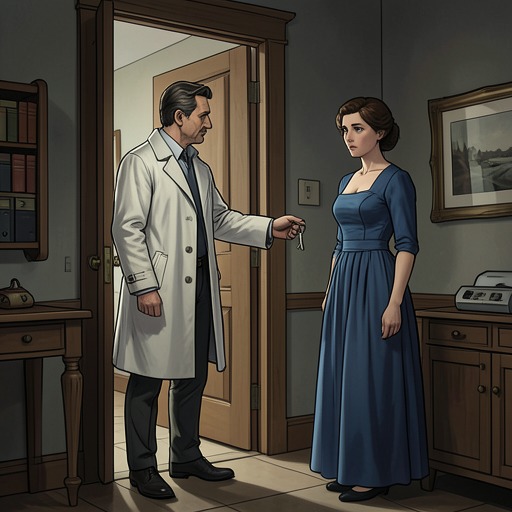
The white capsules prescribed by Dr. Sapirstein
Rosemary's BabyThe white capsules prescribed by Dr. Sapirstein shift from a proposed substitute in Rosemary Woodhouse’s pregnancy care into objects around which suspicion, concealment, and escape gather. Their changing use traces Rosemary’s narrowing trust in the people directing her care: she first considers taking them instead of Minnie Castevet’s drink and cake, later intends to have them examined, and finally hides and repurposes them against the women watching her.
Prescription and Competing Care
Abraham Sapirstein presents the capsules as an alternative to Minnie Castevet’s daily offerings. He offers to have pills sent to Rosemary the next morning, suggesting that Minnie could leave the drink and cake for Rosemary to throw away while she took a pill instead. Rosemary welcomes the arrangement, saying she would feel happier; Sapirstein treats that reassurance as important to her care. Yet she agrees only to continue as before until Sunday. The prescription therefore enters a routine that she has accepted provisionally, not one in which she has fully chosen whom to trust.
The pills are set against a food-and-drink regimen administered by Minnie, making the capsule a seemingly simple way to reclaim control over what Rosemary consumes. But that apparent choice remains framed by other people: Sapirstein proposes the substitution, while Minnie is still expected to bring the items. The capsules’ later significance grows from this uneasy arrangement. Their function cannot be separated from Rosemary’s changing belief that the people around her may be using her care to control her.
Flight and the Uncertain Bottle
When Rosemary leaves the apartment, she takes emergency money Guy Woodhouse has hidden under his underwear, her address book, and a bottle of vitamin capsules. The scene establishes that she carries capsules with her, but does not make their contents or identity certain. Soon afterward, while resting on a day bed and considering a possible stay at Mount Sinai Hospital, she removes capsules from her handbag and decides that Dr. Hill can analyze them. She wants him to make sure they contain nothing harmful, even as she reasons that her enemies would want the baby healthy for their rituals.
That reasoning holds fear and practical caution together. Rosemary does not simply assume that the capsules are dangerous: she imagines an independent medical test, and her thought that they could not be harmful sits uneasily beside her suspicion of the people controlling her. The bottle is thus both a possible source of reassurance and an unresolved threat. Her plan to give it to Dr. Hill makes the object part of her effort to find help beyond the Bramford, while her need to verify it shows how far her confidence in ordinary medical authority has fractured.
Tablets Hidden in the Bed
Later, Rosemary stops taking the pills given to her. She hides each one in the fold between thumb and palm, fakes swallowing, then pushes the tablets between mattress and box spring. The concealed stash gives her a small, repeated act of refusal inside a routine she cannot openly challenge. As she stops taking the pills, she feels stronger and more awake, a change that confirms the bodily consequence of the regimen as she experiences it.
When she retrieves the tablets, she counts eight: small white pills, alike in appearance, scored across the middle so they can be broken in half. Rosemary recalls that three a day had kept her limp and docile. She brushes them clean, wraps them in a piece of magazine cover, and hides them at the bottom of her tissue box. The precise count, the scored surfaces, and the improvised hiding place make the capsules tangible elements of her confinement—and of the plan she is assembling within it.
A Reversal of Their Use
While pretending to remain limp and docile, Rosemary eats, reads magazines, and pumps her milk. During a movie with Leah Fountain, she asks Leah to make her a cheese sandwich. Once Leah leaves the room, Rosemary takes the concealed pills. There are now eleven. She slips them into Leah’s coffee, stirs it with her own spoon, and wipes the spoon with a tissue. Her own coffee shakes in her hand, but when Leah returns, Rosemary sits and sips calmly, attributing the drink’s bitterness to its having stood too long.
Leah drinks from the cup while they watch the film. After a couple more breaks, her head droops and jerks back up; she sets down the cup when it is two-thirds empty, then falls asleep during the next section. The passage does not establish a medical explanation for the effect, but it shows Rosemary deliberately using the pills to make her watcher sleep. She quietly chains and bolts the apartment door, takes the longest, sharpest carving knife from the kitchen rack, and goes down the hall. The tablets that had been associated with her passivity have become instruments in a carefully concealed attempt to act.
Object and Narrative Function
Across these episodes, the capsules’ meaning changes with Rosemary’s access to choice. First they are offered as an alternative within a care plan controlled by others; then they are evidence to be tested; later they are a regimen she secretly refuses; finally, she turns the stored pills against the person guarding her. Their whiteness and uniform size offer no visible clue to their effects, while their scored lines, hidden locations, and exact counts become crucial as Rosemary handles them.
The capsules do not resolve whether Rosemary can trust the institutions or people around her. Instead, the shifting uses of the same small objects make that uncertainty concrete. A prescription meant to fit into ordinary pregnancy care becomes part of a system she experiences as enforced passivity, and the pills she has concealed become a means of interrupting that system. Their narrative importance lies in this reversal: the object’s power comes not only from what Rosemary believes it does to her, but also from what she decides to do with it.