Captivity
SCOTTISH ROMANCE: My Sinful Surrender to a Highlander Werewolf (Scottish Werewolf Pregnancy Romance) (Historical Medieval Shape Shifter Paranormal Science Fiction Short Stories)Captivity is a recurring state of forced dependence that drives several of the book’s most consequential reversals. It begins with physical seizure and disorientation, but it rarely ends there: captives are transported, threatened, confined, traded, or absorbed into conflicts between families, kingdoms, and clans. The state therefore functions both as immediate bodily danger and as a mechanism through which existing power relations are made visible.
Seizure and Removal
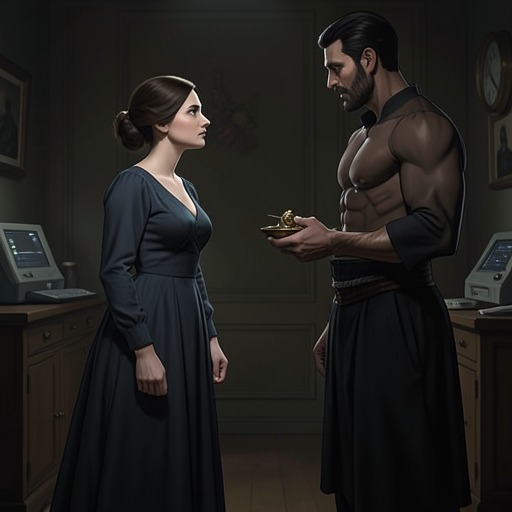
Captivity commonly begins when a character is taken before any meaningful consent is possible. Carden waits beyond the forest for Zuzulla, renders her helpless, and carries her toward a horse while knowing that Sven will soon discover that his daughter is missing. He throws her over his shoulder and runs, then tears away the obstructive material of her dress so that he can move faster, deliberately leaving the ruined clothing behind to intensify her father’s alarm. The abduction is organized as a race against discovery: Carden reaches the horse in roughly thirty minutes and intends to spend the night with Zuzulla in caves before continuing farther the next morning.
Zuzulla’s awakening turns that rapid escape into conscious captivity. She pounds on Carden’s back, realizes that there are no guards, understands that she has been taken beyond her father’s kingdom, and has no knowledge of how to return. When Carden puts her down, the contrast between his physical strength and her vulnerability becomes explicit. He ties a rope around his waist and forces her to follow him, treating her resistance as an inconvenience and even considering knocking her unconscious again because he is too exhausted to carry her. Her insistence that she is a princess cannot alter the immediate fact that the rope, the unfamiliar wilderness, and Carden’s bodily power determine where she goes.
The same pattern appears in the raid that carries Freya away. A highlander refuses to accept her claim that she possesses nothing of value, orders her to come with him, and throws her over his shoulder when she refuses. She faints almost immediately and regains consciousness only through the repeated motion of being carried across the grass. Her uncertainty is total: she does not know where she is going, what will happen to her, or whether she is the only person captured in the raid. The highlander offers water, but even that apparent care remains coercive, since he orders her to drink and warns that thirst will kill her.
Enclosure, Threat, and Exchange
Captivity does not require bars. Mary is taken because a dispute between Robert and George concerns a pond and a parcel of land. The man who removes her tells her that the dispute is not hers to settle and that she must remain with him until the men resolve it. The journey ends at a small, carefully maintained stone house containing only a main room, a stove, a table, chairs, a fireplace, and a single closed bedroom. Its ordinary domestic arrangement becomes oppressive because Mary understands that she may be confined there alone with the man, far from George and subject to whatever judgment the men make.
The terms of her confinement are openly practical rather than judicial. She is told to become comfortable because Robert will not surrender the pond and George will not surrender the land, so she may remain there for some time. She is also expected to cook and keep house. Mary’s quiet decision to wait for instructions marks the way captivity can turn a person into labor before it turns into an explicit bargain: the captive is not merely held but assigned a domestic function within the captor’s space.
Freya’s confinement is more openly commercial. After carrying her to a thatched house, the highlander tells her that she will be sold to the highest bidder in the morning. Freya responds that she is married and refuses the idea that a recognized marriage can be ignored for a few coins. Her protest identifies the central violence of the state: her personhood, marital status, and own account of her life are all being subordinated to a market in which another party may claim ownership or control. The highlander’s reply that this is simply “the way of it” reduces the transaction to custom, while Freya’s refusal exposes that custom as an imposed system rather than an inevitable law.
Military Captivity and Clan Power
The capture narrated by the unnamed prisoner places captivity inside collective warfare. The prisoner watches Highlanders destroy everything in their path, stand over the bodies of those who resisted, and celebrate their victory. Conner Patrick then identifies himself as belonging to Clan Patrick and declares that the survivor is his prisoner before lifting the captive onto his shoulders. The act is both practical and demonstrative: Conner carries the prisoner away with the rest of his clansmen while laughing at the struggle, making individual resistance appear powerless against the clan’s organized force.
Transport continues across water. The prisoner is taken to a clearing where a previously unseen vessel waits, apparently the raiders’ means of arrival and return, and is made to swim in a dress. The danger is not symbolic; survival depends on being a strong swimmer. Once aboard, Conner warns that escape will bring injury and that any signal for help will make others pay for disobedience. Captivity thus extends beyond the initial raid into surveillance and collective punishment, with the prisoner’s behavior controlled not only by direct threats but also by the risk that resistance will harm other people.
Conner’s conduct also reveals the unstable moral language surrounding captivity. He can treat the prisoner as a trophy, threaten violence, and enforce obedience, yet he can also kneel, offer his sword, and present his life as penance after admitting that he has treated the captive badly. The possibility of killing him is placed before the prisoner, who refuses to kill in cold blood. That refusal does not erase the captivity; instead, it creates a brief reversal in which the captive possesses moral and physical power over the captor without being restored to freedom.
Resistance, Survival, and Ambiguous Protection
Resistance within captivity takes several forms. Zuzulla screams, pulls against the rope, and invokes her rank, but her title has no practical force in the forest. Freya uses speech more forcefully, rejecting the claim that sale is merely customary and insisting that marriage gives her a status the highlander cannot casually erase. The unnamed prisoner chooses not to kill Conner when given the opportunity, preserving a moral boundary even while remaining under his control. These responses show that captivity suppresses agency without entirely eliminating it; speech, refusal, endurance, and ethical choice become the remaining means of self-definition.
The captors’ occasional gestures of care do not cancel the coercive structure. Carden briefly feels almost guilty while holding Zuzulla against him on the horse, yet he continues the abduction and plans her confinement. The highlander offers Freya a flask and lowers her carefully to the grass, but he still intends to sell her. Conner later asks for a form of kindness after his remorse, yet his earlier threats and continuing supervision remain decisive. In each case, tenderness appears inside domination, making protection difficult to separate from possession.
Captivity consequently operates as a transitional state between displacement and a possible new social arrangement. Zuzulla is removed from Sven’s kingdom and placed in Carden’s escape route; Mary becomes leverage in a land dispute and a worker in Robert’s household; Freya is transformed from a married woman into a commodity for prospective bidders; and Conner’s prisoner becomes a clan-held captive carried from a ruined settlement toward a trading market. The state’s narrative significance lies in this forced reclassification. A person who was previously daughter, wife, or survivor is made into property, bargaining power, labor, or clan spoils, and the surrounding characters must decide whether that imposed identity will endure.