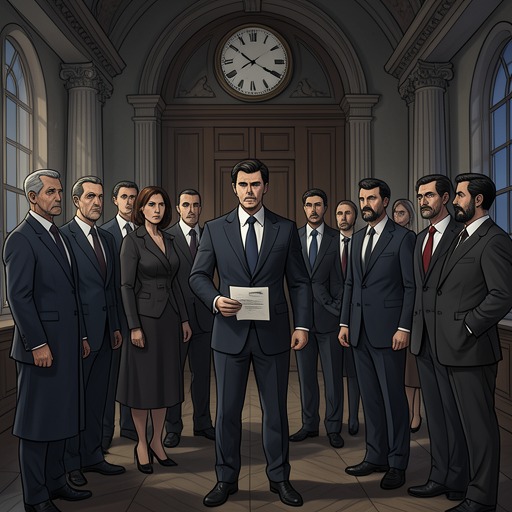
Darren Crowley
SCOTTISH ROMANCE: My Sinful Surrender to a Highlander Werewolf (Scottish Werewolf Pregnancy Romance) (Historical Medieval Shape Shifter Paranormal Science Fiction Short Stories)Darren Crowley is introduced as a wealthy man whose public identity has hardened into a scandalous caricature. The media portrays him as racist, sexist, homophobic, pompous, and generally evil, while the narrative insists that much of this reputation rests on lies that cannot easily be removed once they enter public circulation. His own habit of saying the wrong thing during interviews makes the situation worse, allowing public opinion to reduce him to a rich, self-important playboy. In his late thirties but described as immature in responsibility, he possesses the outward appeal associated with a rugged billionaire bachelor, yet his social power does not protect him from the consequences of his conduct.
Identity and Public Reputation
Darren’s defining conflict is the distance between the man described by the media and the man the narrative gradually places inside the scandal. He is not cleared of arrogance or irresponsibility: the characterization openly calls him a billionaire playboy and emphasizes that his interviews repeatedly damage his own position. However, the account also stresses that the public has little interest in whether the reports about him and his family are true. Wealth becomes sufficient evidence of guilt in the public imagination, turning his family’s money into a reason for hatred and making reputation almost impossible to repair.
That public image shapes Darren’s private expectations. When he believes his mail-order bride is about to arrive, he assumes she will be a barely legal foreign woman who speaks little English and is terrified of her prospective husband. He recognizes that his own actions during a period of drinking and casual pleasure have affected an innocent woman’s life, and he considers paying her off as a possible solution. His concern is mixed with self-preservation, since he is also afraid of scandal and of violating immigration laws. The moment exposes both his guilt and the limits of his moral imagination: he understands that the arrangement is damaging, but initially thinks in terms of compensation, concealment, and legal risk rather than an equal relationship.
Family Pressure and the Mail-Order Arrangement
Darren’s story belongs to a wider world in which marriage and reproduction are frequently treated as contracts, inheritance conditions, or negotiated exchanges. Other family and social arrangements impose marriage and childbearing requirements, while Kember’s discussion of surrogacy makes clear that carrying a child can create an attachment that money cannot simply erase. Against that background, Darren’s own mail-order-bride situation places intimacy inside a system of paperwork, expectation, and unequal power, even before he meets Kacie.
The encounter overturns his assumptions. When Darren opens the door, he expects the frightened, inexperienced woman he has imagined; instead, he meets Kacie, a confident, adult woman with cocoa-colored skin, dark silky hair, a broad smile, a blue sweater, and a large designer bag. His surprise is immediate because her appearance contradicts the stereotype he had constructed. The arrival therefore turns his private anxiety into a concrete relationship: the supposed victim is not the figure he pictured, and Darren must respond to a real person rather than to the convenient fantasy that would have allowed him to dismiss, pay off, or hide the arrangement.
Sexuality, Impulsiveness, and Pregnancy
Darren’s most consequential action is an unprotected sexual encounter with Kacie. The scene treats the event as both physical attraction and reckless behavior, and its consequence is not delayed or abstract: Kacie becomes pregnant. Their anticipation of the child is tied to the possibility of an astonishing public headline, linking reproduction to the same publicity machine that has already distorted Darren’s identity. The pregnancy thus threatens to amplify the scandal even as it creates the possibility of a more serious bond between them.
The next morning, Kacie wakes Darren with kisses and tells him that she is pregnant. Her expression carries the confidence of someone who already expects the relationship to continue in a particular direction, while Darren responds with a smile and a joking remark about the force of their sexual encounter and the fertility he believed he had left. His humor does not erase the gravity of the revelation. Instead, it shows how quickly he uses sexual banter to manage a life-changing fact, while Kacie’s pregnancy makes the consequences of his earlier irresponsibility impossible to evade.
Dreams, Father, and the Crowley Name
Darren’s inner life is marked by bizarre dreams involving Fred Sanford, television reporters, Donald Trump, and the Kool-Aid Man, whose repeated cry of “Oh Yeah!” gives the dream imagery a deliberately chaotic, media-saturated quality. When he wakes, that absurdity is replaced by the imposing face of Doc Crowley, the family patriarch. The contrast places Darren between two forms of spectacle: the ridiculous imagery of popular entertainment and the intimidating authority of his father.
Doc Crowley is an oil baron turned computer-technology investor who appears to command immense power, and he confronts Darren over making the family name a national joke. Darren’s scandal is therefore not merely personal. It becomes a threat to dynastic reputation, with the family patriarch treating public embarrassment as another failure Darren has imposed on the Crowley name. This pressure helps explain why Darren’s choices repeatedly involve appearances, headlines, and the management of what other people think of him.
Change and Narrative Significance
The available episodes do not establish a final resolution for Darren, but they do mark a decisive movement from careless bachelorhood toward unavoidable responsibility. He begins as a man who treats interviews, sexual encounters, and marriage prospects with the impulsiveness of an irresponsible playboy. He then confronts the arrival of Kacie, discovers that she is not the submissive foreign bride he expected, and learns that their unprotected encounter has produced a child.
Darren’s significance lies in the collision between privilege and consequence. His wealth gives him possible ways to manage scandal, but it cannot make Kacie’s pregnancy disappear, and his family’s influence cannot fully control public interpretation. The story also complicates his initial public label without removing the behavior that made the label plausible. Darren remains vain, sexually reckless, and shaped by the demands of a powerful family, yet the pregnancy forces him into a reality where another person’s body, future, and expectations are inseparable from his own. His arc is consequently less a completed redemption than the opening of a test: whether a man accustomed to managing appearances can accept responsibility for the human relationship created behind them.