Dave Locktine
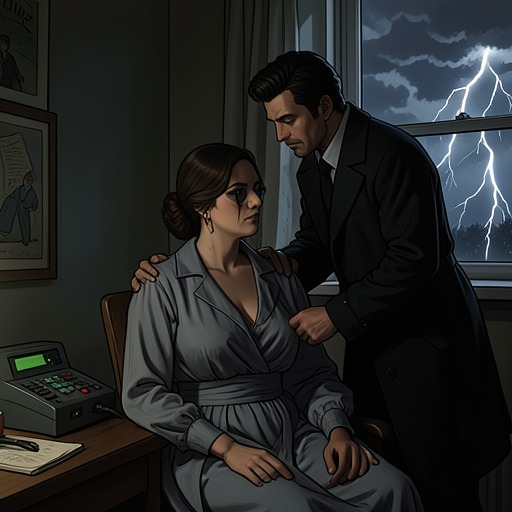
SCOTTISH ROMANCE: My Sinful Surrender to a Highlander Werewolf (Scottish Werewolf Pregnancy Romance) (Historical Medieval Shape Shifter Paranormal Science Fiction Short Stories)Dave Locktine enters Penelope’s story at the moment when practical danger and social danger have become inseparable. She is pregnant, expelled from the household where she worked, threatened with shunning, and struggling through freezing weather with luggage trapped in mud. As the local sheriff, Dave possesses both the authority and the physical means to intervene; as a landowner with a spare bedroom, he can offer something more consequential than temporary assistance. His decisive significance lies in the way he turns rescue into protection and protection into a marriage proposal designed to give Penelope and her unborn child security in a society prepared to punish them.
Identity and First Appearance
Dave is presented as a striking, physically capable country sheriff: a blond, muscular “golden boy” who lives on a small plot of land at the edge of town. He works with several other men, taking turns on the night shift, and his appearance on the road at dusk establishes him as someone whose public role involves watching over the community. That authority is initially softened by his courtesy. When he finds Penelope struggling with her bags, he stops his horse and tips his hat rather than treating her as a nuisance or an object of suspicion.
His first response is practical. He asks whether Penelope has money for an inn, then notices the possibility that she has been harmed. Before she can provide a full answer, he dismounts, lifts her luggage, secures it to his horse, and recognizes that she needs more help than her appearance initially suggests. His offer that she stay in his spare bedroom instead of going to the inn gives the encounter its first major reversal: the road, cold, mud, and uncertainty are replaced by a temporary domestic refuge. After helping her onto the horse in front of him, he takes her to his house, starts a fire, and prepares a place where she can recover.
Protection of Penelope
Dave’s care is expressed through concrete acts rather than abstract sympathy. He brings Penelope inside, lights a fire, and shares fresh food and coffee with her. For Penelope, who is accustomed to stale bread and to serving others in order to keep her position, being cared for feels unfamiliar as well as comforting. Dave’s household therefore becomes more than shelter: it is the first setting in which her immediate needs are treated as legitimate rather than as obligations owed to someone else.
When Penelope explains that the master of her former household impregnated her in an attempt to force her to surrender the child to his wife, Dave reacts with outrage. He condemns the man’s exploitation of her vulnerable position and recognizes that her expulsion into the snow was not merely an unfortunate dismissal but an act of abandonment. Penelope also explains the broader threat: the master intends to have her shunned, prevent her from finding work, and possibly take her baby or leave her to starve. Dave answers this danger with a direct promise that she is not going anywhere and that the baby is welcome in his home.
Penelope worries that remaining with Dave will cause the town to assume that the child is his and that both of them will be condemned as living in sin. Dave refuses to let communal opinion govern his decisions. His indifference to rumors is important because Penelope’s danger is partly institutional and social: the man who expelled her can use reputation, employment, and local prejudice as weapons. Dave’s protection therefore challenges the system that makes an unwed pregnant woman dependent on the goodwill of others.
Marriage Proposal and Family Vision
Penelope considers leaving after the birth or finding a husband elsewhere, but she also fears returning to her mother because trains near her mother’s home are repeatedly raided. She contemplates the dangerous logic of mail-order marriage: disappearing somewhere unknown, claiming to be a widow, or binding herself to a stranger in order to obtain respectability. Dave rejects that solution with unusual force. He warns that the unknown man could murder or abuse her or be a child abuser, and he refuses to help her exchange one form of vulnerability for another.
His alternative is blunt and practical: Dave proposes that Penelope marry him. He argues that they already get along, that he can afford to support a wife and child, and that he is willing to claim her baby as his own. The proposal offers several forms of security at once. Penelope would gain protection, the child would receive a name, and Dave would gain a wife whom he already knows and respects. The arrangement is economically and socially pragmatic, but it is not presented as a purely cold bargain; Dave’s insistence that he can handle living with her gives the proposal an intimate, personal basis.
Dave also addresses Penelope’s concern that their mixed-race relationship could provoke prejudice. He maintains that people in the area care less about skin color than about work, money, and outward respectability, and he promises that no one will dare cause trouble for her or their children. The confidence of that promise reveals both his faith in his local standing and his willingness to place his authority behind her. He further imagines a large family, explaining that his mother died giving birth to his younger brother, that his father never remarried, and that he was raised alone. His desire for more children is consequently tied to a personal memory of loneliness: he does not want his own child to grow up without the family he lacked.
Conflict at the Estate
Dave’s promise is tested when Penelope’s former household confronts her. Lucille approaches with a stick and prepares to strike while staring at Penelope’s pregnant belly. Penelope struggles in Marvin’s arms, unable to escape, until gunfire interrupts the attack. Travis and Dave arrive with weapons, and Dave’s authority shifts from protective hospitality to immediate armed enforcement.
Dave orders Marvin to release Penelope, identifying her publicly as his wife and threatening to shoot both attackers. When Lucille lunges again, Dave fires and wounds her in the shoulder, forcing her to drop the stick. He then repeats the threat to Marvin. The scene gives physical proof to the protection he had previously promised in conversation: he does not merely offer Penelope a room or insist that rumors should not matter; he places himself between her and violence, uses his sheriff’s authority, and acts decisively when her pregnancy makes the assault especially dangerous.
Character Function and Significance
Dave combines several narrative roles without being reduced to only one of them. He is a threshold guardian who meets Penelope on the road between expulsion and an uncertain future, an ally who provides immediate material help, and a romantic counterpart whose proposal offers a socially recognized escape from her precarious position. The movement from the muddy roadside to the warm house, and from the house to the armed confrontation, traces a widening circle of protection: first comfort, then shelter, then legal and social defense.
His relationship with Penelope is shaped by the tension between genuine care and the pressures of the world around them. Marriage is proposed because love alone cannot protect an unwed mother from shunning, unemployment, or the possible seizure of her child. Yet Dave’s actions repeatedly exceed bare expediency. He feeds her, listens to the circumstances of her pregnancy, defends her dignity, imagines children with her, and risks violence to keep her safe. In that combination, Dave represents a form of redemption through love grounded in labor, household responsibility, public courage, and the refusal to let abusive men define Penelope’s future.