Highlander mercenary code
SCOTTISH ROMANCE: My Sinful Surrender to a Highlander Werewolf (Scottish Werewolf Pregnancy Romance) (Historical Medieval Shape Shifter Paranormal Science Fiction Short Stories)The Highlander mercenary code is the governing ethical distinction of Carden’s clan. It does not make the Highlanders peaceful; they accept dangerous military contracts and are prepared to confront kings and armies. Its decisive limit is narrower and more demanding: violence must not become indiscriminate slaughter, and survival must not be confused with permission to abuse the powerless.
Definition and Origins
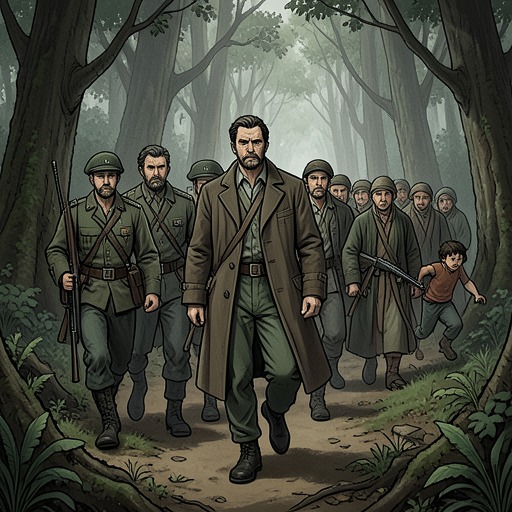
The code emerges while the Kingdom of Kigom employs Carden’s werewolf clan against Sven the Conqueror. Kigom cannot defeat Sven’s army and therefore relies on mercenaries willing to undertake the mission of seizing Sven’s daughter, Zuzulla, in order to divert him from his expansion. Carden’s clan accepts because it wants no part of Sven’s kingdom and knows that Sven regards the Highlanders as filthy animals, seeks to eradicate them, and does not want them breeding with his people or entering his cities.
This background gives the code a political as well as ethical force. The Highlanders are themselves threatened by a ruler who treats extermination as a legitimate instrument of state-building, yet they do not answer his doctrine by adopting it wholesale. The clan’s mercenary identity permits armed resistance and strategic intervention, but it does not erase an internal boundary concerning whom violence may legitimately reach.
Limits on Violence
Sven’s campaign against the Highlanders is presented as a deliberate terror strategy. He sends his army into a village frequented by the clan not only to conquer territory but also to demonstrate that he knows where the Highlanders are and intends to kill them all. His soldiers burn cottages, kill men or force strong survivors into the army, kill the old, and permit women and children to live only under conditions of submission; women who resist the soldiers may be killed. The campaign therefore defines conquest through the destruction of community, allegiance, and bodily autonomy.
Carden’s clan follows a sharply different feeding and killing practice. The Highlanders sometimes need human hearts to survive, but they do not take pleasure in killing and restrict their victims to the worst criminals. Carden may wish he were dead rather than kill another human, yet he takes comfort in knowing that he does not kill the innocent. The code thus recognizes necessity without allowing necessity to become an excuse for predation.
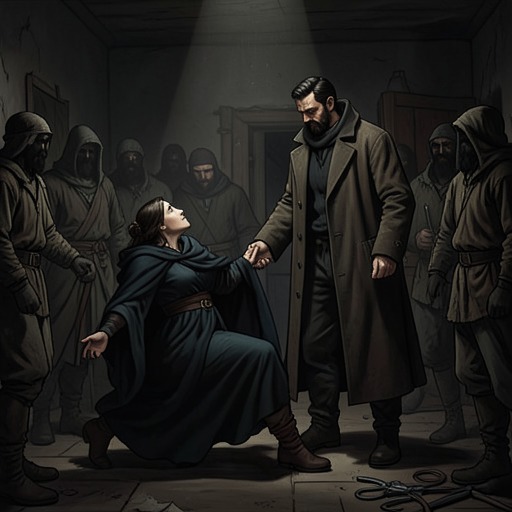
Carden’s response to the burned village makes the principle concrete. He searches the ruined settlement for survivors and safety before bringing anyone out. In a cottage that has not completely burned, he finds a dead woman exposed on a bed; he covers her with a blanket, attempting to restore a measure of dignity after the violence inflicted by Sven’s men. The gesture is not a battlefield tactic, but it shows what the code protects: the humanity of people whom the conquering army has reduced to disposable casualties.
Enforcement and Contrast
The code is defined most forcefully through contrast with Sven’s army. Carden sees the soldiers’ apparent pleasure in killing those who refuse allegiance and regards their smirks as evidence of a cruelty fundamentally different from the Highlanders’ grim necessity. Sven’s men kill to impose power, while Carden’s clan fights because it is threatened, hired, or compelled to survive within a hostile political order. The distinction does not remove the clan from violence; it gives violence a moral grammar.
That grammar also explains why the Highlanders are dangerous opponents of Sven. Sven understands that the people could revolt with their help and that a combined Highlander and popular army could defeat his own forces. His fear is therefore not only military. The clan represents an alternative organization of loyalty, one in which allegiance cannot be secured simply by burning villages and demanding submission. The mercenary code preserves a potential bond between the Highlanders and ordinary communities whom imperial violence attempts to isolate.
The code remains compatible with forceful self-defense. Carden knows that Sven has come close to discovering the Highlanders’ secrets and that, if Sven learned the one reliable method of killing them—decapitation—he would try to destroy every last member of the clan. The Highlanders’ refusal to kill innocents is consequently not naïveté. It is a chosen restraint maintained while they face an enemy who would exploit any vulnerability without reciprocal restraint.
Narrative Significance
The Highlander mercenary code complicates the book’s recurring opposition between power and vulnerability. Kings, soldiers, employers, and supernatural communities repeatedly attempt to define other people as resources: Sven treats villages as instruments of conquest, while other storylines frame pregnancy, marriage, inheritance, or mating as obligations imposed by law or custom. Against that broader pattern, the Highlander rule insists that a person cannot be made morally disposable merely because a stronger authority has declared the person useful or expendable.
Its most important function is to prevent the Highlanders from becoming a simple mirror of the society that persecutes them. Sven’s rhetoric reduces them to animals and makes extermination appear necessary for political order. Carden’s conduct answers by preserving a distinction between a dangerous enemy and an innocent victim, between feeding and enjoyment, and between military necessity and cruelty. The code therefore serves as both a survival discipline and a claim to moral personhood: the Highlanders fight as a feared nonhuman people, but they refuse the conqueror’s belief that strength grants unlimited permission to harm.