Radiant’s Rejection of Forced Breeding
SCOTTISH ROMANCE: My Sinful Surrender to a Highlander Werewolf (Scottish Werewolf Pregnancy Romance) (Historical Medieval Shape Shifter Paranormal Science Fiction Short Stories)Radiant’s Rejection of Forced Breeding marks the moment when Prince Radiant’s assigned duty collides with Amy’s insistence on bodily autonomy. Sent to impregnate a human for the Chubalahans’ breeding and experimentation program, Radiant initially treats the task as a protocol that must be completed. Amy’s refusal, however, forces him to confront the violence hidden inside that supposedly rational system. His response does not immediately become open rebellion, but his decision to delay, consult Admiral Hutt, and reconsider the use of force establishes the first meaningful break between his personal ethics and the authority he serves.
Causes and Background
Radiant’s mission belongs to a larger Chubalahan program that selects humans for experimentation and reproduction. The species considers humans comparatively primitive and views them as a population from which useful genetic material may be taken. Its officials do not regard human subjects as equals, and Admiral Hutt openly classifies them as slaves. The program therefore converts reproduction into an administrative quota: the human body is a resource to be evaluated, impregnated, and returned to the system’s schedule.
Amy enters this system already carrying a complicated desire for motherhood. In another context, she has discussed marriage and pregnancy as practical requirements, including a family inheritance stipulation that demands marriage and pregnancy within six months. Yet her willingness to contemplate having children does not mean that she consents to an imposed procedure. When Radiant explains that the Chubalahans prefer automatic impregnation because it is considered safer and less prone to infection or birth defects, Amy rejects the medical logic as an answer to her human need for intimacy. She says that she will consider children with them only if they romance her and physically connect with her, making clear that reproductive desire and reproductive consent cannot be separated.
The Confrontation with Amy
Radiant’s rejection begins as a refusal to accept the terms of the experiment. Amy tells him that she will not submit to medical evaluation and will not allow herself to be impregnated mechanically. When he approaches with a stunning device after deciding that enough time has been wasted, her protest changes the encounter from a procedural disagreement into an explicit plea for freedom. She says that she does not want the process carried out that way and asks him to respect her wishes.
Amy then explains why the demand matters to her. She has always wanted a baby, but she does not want motherhood to become another lonely experience. Men who might have fathered a child with her had seemed cold and heartless, and she had rejected relationships that offered biological possibility without affection. Her appeal therefore does more than oppose a single alien technology; it defines the conditions under which she considers reproduction meaningful. She wants a child connected to mutual care, desire, and emotional responsibility rather than to an impersonal breeding schedule.
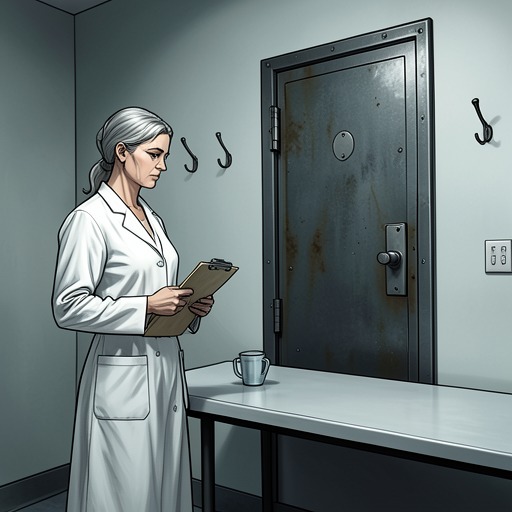
Radiant is unsettled by the directness of her fear and loneliness. Although he tries to remain mission-focused, he begins to feel pity and a desire to comfort her. He allows Amy to remain in her prison quarters while he consults Admiral Hutt instead of immediately stunning her and carrying out the procedure. The choice is limited and precarious, but it is the first action in the episode that places Amy’s expressed wishes above operational efficiency.
The System’s Answer
Radiant’s appeal to authority produces no ethical exception. Admiral Hutt orders him to impregnate Amy and stay ahead of schedule. When Radiant asks whether the scientists understand that forcing a human to become pregnant is an offense against her species, Hutt confirms that they do understand. The answer exposes the central fact of the Chubalahan regime: the problem is not ignorance but the deliberate refusal to recognize human consent as binding.
Hutt explains that humans are slaves and therefore not equals. Radiant understands that the Chubalahan system has no meaningful category for the rights Amy is invoking. Its superior technology, its claims of practicality, and its provision of comfort to prisoners do not make the captivity humane. The episode places comfort beside coercion to show how domination can operate through advanced care while preserving the captive’s lack of choice.
Radiant returns to the duty imposed on him. He considers using gas to put Amy to sleep before impregnating her, recognizing that unconsciousness would spare him the difficulty of dealing with her resistance. Yet her honesty prevents the decision from becoming routine. She has asked him not to proceed and has said that she would rather die than be forced, because forced reproduction would hurt too much. Radiant does not simply dismiss those words as irrational human behavior; he remains with the moral discomfort they create, and that discomfort is the event’s essential reversal.
Consent, Love, and Cross-Species Ethics
The dispute expands when Amy calls the Chubalahan practice cruel and identifies it as the creation of sex slaves from innocent people. Radiant admits that his race may not understand consent, treating it as a specifically human characteristic. Amy challenges him to consider whether he can understand it now that he has read her thoughts and feelings. The question shifts responsibility from an abstract species to an individual who has witnessed a particular person’s fear.
Amy describes love as irrational, difficult, and unpredictable, but also as a practice of kindness: resisting selfish actions and giving pleasure to someone else. Radiant initially struggles to understand how pleasure could avoid being selfish. Amy answers that pleasure shared by people who care about each other’s safety is an expression of love. Her explanation gives the scene its ethical vocabulary. Reproduction is not reduced to genetic compatibility or successful conception; it becomes inseparable from safety, mutuality, and the recognition of another person’s will.
Radiant’s position remains constrained by his rank and his society’s rules. He tells Amy that he cannot simply send her home because exceptions are forbidden, and the protocol still demands that he impregnate her with alien DNA. Nevertheless, his resistance has altered the meaning of obedience. He now knows that compliance will not be a neutral scientific act but a violation that Amy has clearly identified and rejected.
Consequences and Significance
The event crystallizes the book’s recurring conflict between institutions that assign reproductive roles and individuals who try to reclaim authority over their bodies. Marriage requirements can make pregnancy a condition of inheritance; surrogate arrangements can turn gestation into an obligation followed by the loss of the child; and alien breeding programs can treat human subjects as genetic material. Across these situations, the crucial distinction is between wanting a child and being compelled to produce one. Radiant’s hesitation makes that distinction visible from the perspective of an enforcer who begins to recognize the person inside the assigned specimen.
The episode also connects Amy’s crisis to other systems of unequal power. The Watchers select one human from each community and use some of those chosen people for breeding in an effort to create a superior hybrid. Slaves are excluded from the political protections of the societies that control them while remaining fully exposed to those societies’ demands. Even a condition such as pregnancy can become a contested form of custody and ownership when a powerful species claims authority over the mother and child.
Radiant’s rejection is therefore neither a completed liberation nor a simple heroic victory. He does not yet free Amy, openly defy the Chubalahan command, or abolish the breeding protocol. Its importance lies in the interruption: a prince trained to regard coercive reproduction as normal is made to pause by Amy’s refusal, loneliness, and insistence that safety must precede intimacy. The system continues to demand obedience, but Radiant can no longer encounter that demand as if it were morally empty. In the wider narrative, his hesitation opens the possibility that empathy, consent, and chosen connection may cross the boundary that the Chubalahans have built between superior rulers and disposable humans.