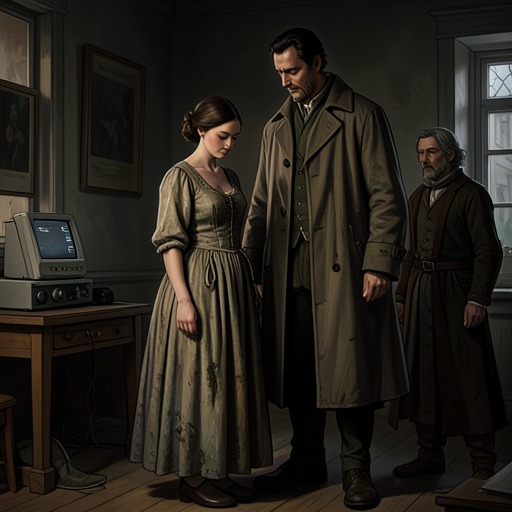
Robert's Pond
SCOTTISH ROMANCE: My Sinful Surrender to a Highlander Werewolf (Scottish Werewolf Pregnancy Romance) (Historical Medieval Shape Shifter Paranormal Science Fiction Short Stories)Robert's Pond is more than a disputed piece of property: it is the material center of the conflict between Robert and George, the reason Mary is sent into danger, and the boundary across which her life changes. George owns the surrounding land but not the water, while Robert controls the pond itself. That divided ownership turns a practical resource into a test of masculine authority, and the resulting quarrel eventually places Mary in Robert's power and helps separate her from George.
Ownership and the Initial Dispute
George returns home from a meeting with Robert in a fury, declaring that Robert's refusal to sell him the pond will be “the death of me!” His grievance is practical on its surface: he needs the water for his trees and horses and considers it absurd that he should own the land while Robert owns the water on it. Yet the dispute is also bound to pride. George cannot accept that possession of the surrounding estate does not give him control over everything within it, and Robert's refusal becomes a continuing affront that dominates George's conversation and temper.
The pond therefore functions as a contested border between two men whose claims cannot easily coexist. George believes the land entitles him to the water; Robert insists that ownership of the pond remains separate. Neither man yields, and the disagreement is sustained through repeated arguments rather than resolved through compromise. In this arrangement, the pond has a concrete economic value, but it also carries symbolic weight: it is the one resource George cannot command, making its continued independence a daily reminder of the limits of his authority.
The Apple Grove and Mary’s Trespass
The conflict intensifies when one of the trees on Robert's parcel beside the pond begins producing fresh, ripe apples. George treats the fruit as a personal insult, as though the tree's abundance magnifies Robert's power and his own inability to possess the entire property. He orders Mary and the cook to gather as many apples as they can carry. The task takes them down the hillside and around the pond, physically drawing George's household across the contested boundary in an act that George presents as ordinary harvesting.
Mary does not understand why the apples matter so much, but she follows the order. The pond's landscape thus becomes the setting where George's abstract grievance is converted into an action involving another person's property. While Mary and the cook collect the fruit, Thomas arrives on a giant black horse. He identifies himself as working for Robert and tells Mary that she is trespassing. When she argues that the trees belong to her and George, Thomas makes the ownership dispute precise: the apple in her hand belongs to Robert, not to either of them.
The immediate consequence is Mary’s detention over an apple. Thomas allows the cook to leave but orders Mary to accompany him, while instructing the cook to return home and tell George to expect a notice from Robert. The scene gives the pond an active narrative role. It is not merely the object of an argument heard at the dinner table; it is the place where George's assumption of entitlement is challenged, where Mary is removed from his household, and where Robert's claim is enforced through Thomas.
A Boundary Between Two Lives
Mary's encounter at Robert's Pond begins as an accusation of trespassing, but its deeper effect is a reversal of her domestic position. At George's home, the pond dispute feeds his anger, his drinking, and his contempt for Mary. He repeatedly tells her that she is useful only for keeping house and producing children, while his drunken sexual advances and dissatisfaction with her infertility make the household a place of humiliation. The pond is the external object around which that cruelty circulates, but it is also the point from which Mary is taken out of the pattern.
Thomas's role is initially coercive: he detains Mary because Robert's property has been entered and its apples taken. Nevertheless, his intervention changes the direction of her life. The same boundary that George tries to erase is one Thomas enforces, and that enforcement removes Mary from the husband who has treated her as an instrument of household labor and reproduction. The pond consequently marks a passage from one form of possession to another, although Mary's later experience with Thomas is presented as protective and restorative rather than as a continuation of George's degradation.
Return, Recognition, and Lasting Consequence
Months later, Robert's Pond remains part of the dispute even after Mary has established a new life with Thomas. Mary and Thomas encounter George in town as he staggers out of a pub. George tells Thomas to give Robert his regards and to keep his “blasted pond,” linking the water source once again to the bitterness of the old quarrel. His attention then shifts from the property to Mary, whose rounded, expectant belly reveals that she is pregnant by her new lover.
Thomas responds by wrapping an arm around Mary's shoulders and stating that she is taken care of. Mary leans against him and gently touches her swollen belly, a gesture that contrasts sharply with the fear, exhaustion, and diminished self-image associated with George's home. Robert's Pond has not changed hands in the evidence presented, and the property dispute is not formally settled. Its decisive consequence lies elsewhere: the quarrel over the pond has helped expose George's possessiveness, brought Mary into contact with Thomas, and become part of the chain leading to her pregnancy and new domestic security.
Narrative Significance
Robert's Pond concentrates the story's conflict between legal ownership and lived authority. George sees the pond as an extension of the land he controls and interprets Robert's separate title as an insult; Robert treats the water as property with its own boundaries; Mary experiences those boundaries first as a source of danger and then as the threshold of escape. The pond's water is needed to sustain trees and horses, while its apples become the immediate cause of confrontation, so the landscape has both practical and dramatic force.
Its recurring presence also gives the plot a clear structural arc. The pond begins as the subject of George's angry complaint, becomes the site of Mary's alleged theft and detention, and remains the object George renounces when he sees that Mary has found protection and is carrying Thomas's child. In that final contrast, George is left with the property he once treated as the measure of his manhood, while Mary has moved toward the care and family life he failed to provide. The disputed pond thus becomes an emblem of limits: George cannot own everything he can see, and his attempt to overcome that limit costs him control over Mary herself.