Supernatural mate bond
SCOTTISH ROMANCE: My Sinful Surrender to a Highlander Werewolf (Scottish Werewolf Pregnancy Romance) (Historical Medieval Shape Shifter Paranormal Science Fiction Short Stories)Supernatural mate bond is a recurring institution and bodily experience linking partners across human, werewolf, dragon, demon, vampire, and other nonhuman worlds. It is not merely romantic attraction. In different relationships it appears as an instinctive recognition, a claim with lifelong consequences, a basis for marriage or succession, or a justification for controlling reproduction. The contrast between voluntary attachment and forced breeding makes the bond one of the book’s clearest ways of testing whether desire, law, and consent can coexist.
Recognition and Instinct
The bond is often registered through the nonhuman partner’s body before the human or social mind has accepted it. Borg’s demon recognizes Dawn as his mate even while Borg consciously avoids her. Her presence brings his demon side forward, and he fears that losing control could lead him to kill both Dawn and his brother. The bond therefore arrives not as a gentle metaphor but as a dangerous physical claim: his fangs emerge, his body shifts into a gigantic horned monster, and he must force the demon back because Dawn is human and cannot heal or fight as members of his species can.
Borg later explains that his demon has already claimed Dawn and that this is why he has kept away from her. Dawn, however, does not experience the relationship as a one-sided supernatural destiny. She tells him that she wants him, that she lies awake wishing he were beside her, and that she would rather be pregnant with his child than with Uth’s. Her declaration transforms the bond from an instinct imposed on her into a relationship she actively chooses to pursue, although that choice remains constrained by her status as a human slave.
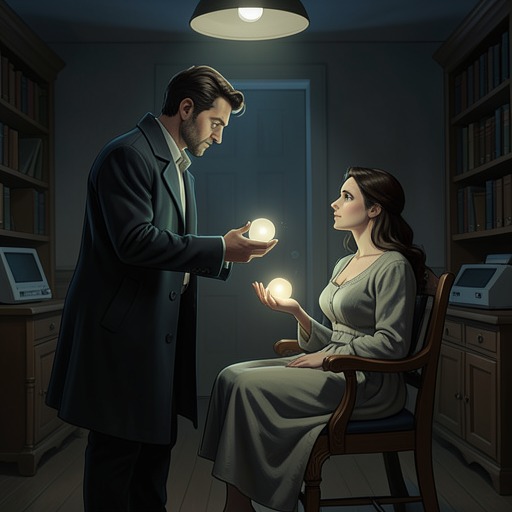
A different version appears in Lydia’s relationship with a werewolf partner. He says that his wolf knows she is his mate and that they are compatible in all the areas that matter. His recognition is joined to admiration for her intelligence, beauty, work, and independence, not reduced to physical chemistry alone. He imagines children who can shift and run freely without worrying about having a human parent. Lydia nevertheless insists that attraction cannot substitute for communication: she dislikes being ordered around and requires compromise and explanations. The scene makes the bond compatible with negotiation, but only when instinct is tempered by mutual respect.
Law, Claim, and Reproductive Power
The bond repeatedly intersects with rules that determine who may marry, who may claim a partner, and who controls a child. John challenges Kale’s attempt to retrieve a woman selected as his son’s mate by reminding him that their laws do not permit marriage to an unwilling mate. Kale treats selection as creating an obligation, while John argues that the woman must have the opportunity to live her own life. The disagreement establishes a central distinction between being identified as a mate and consenting to become one.
Borg’s relationship with Dawn exposes the harsher side of supernatural law. He tells her that if he claims her, the claim will last for life, and that he would kill Uth if Uth touched her again. He also warns that he might kill Dawn if she permitted Uth to continue. The bond therefore creates exclusivity through threat as well as devotion. When Dawn asks what would happen if she were already pregnant, Borg explains that tests would identify the father; if the child were Uth’s, Uth would receive custody on their planet because fathers normally raise the offspring. Dawn, as a slave and member of another species, would have no rights.
Borg finally proposes a test based on Dawn’s menstrual cycle. He says he will claim her, wait for her cycle, and then use the timing of a later pregnancy to establish whether the child is his. This turns the bond into a reproductive jurisdiction: sexual access, biological evidence, paternal custody, and species law all converge upon Dawn’s body. Her emotional choice is real, but it takes place inside a system that can classify her as property and assign her child to a father she did not choose.
The same reproductive pressure appears in human institutions that imitate the logic of mating law. Sloan and Amy discuss a will requiring them to marry and become pregnant within six months. William learns that he must marry and produce an heir before he can fully control his family’s estate, including its home, property, and business. In these cases there is no supernatural wolf or demon claiming a mate, yet inheritance converts marriage and pregnancy into conditions of legitimacy. The book thus places instinctive bonds beside economic contracts to show how different societies can make reproduction compulsory.
Consent, Surrogacy, and the Body as Property
Penelope’s pregnancy reveals the most explicit conflict between a reproductive arrangement and the mother’s right to keep her child. The man who arranged sex with her explains that his wife wants a baby and that Penelope is expected to remain until the birth, surrender the child, and accept payment while keeping the arrangement secret. Penelope refuses, saying that she has already decided to keep her baby. Her outrage comes from the assumption that money and household authority can purchase not only her pregnancy but also the child she will carry.
His response strips the relationship of its previous familiarity. He threatens to throw her into the streets and withhold her final wages, insisting that she cannot afford to raise a baby and that his wife can provide a better life. To him, Penelope has become an incubator rather than a person. The scene clarifies what is at stake whenever a mate bond or reproductive agreement is treated as ownership: the language of family can conceal the removal of the pregnant person’s agency.
Kember articulates the same fear from the perspective of a proposed surrogate. She distinguishes donating eggs from carrying a baby and then handing it over after birth. Pregnancy would involve physical change, attachment, holding the child, and surrendering it immediately afterward. Dennis responds by proposing a two-parent arrangement in which Kember would remain the child’s mother and share the child as it grew older. His proposal recognizes that genetic contribution, gestation, and parenthood are not interchangeable, even though his appeal still frames Kember through the scarcity of Black surrogates and donor eggs.
The Watchers extend this reproductive logic to an entire society. Each community must provide one adult every year, and those chosen may become servants or be used for breeding while the Watchers attempt to combine their genes with humanity to create a superior being. The annual Choosing is administered through numbered stones, with each adult required to participate until age forty-five unless permitted to withdraw. Maggie’s stone makes the system tangible: a personal identity is reduced to a number carried from year to year, while the public ceremony names the chosen person as a servant to the Watchers.
Transformation, Survival, and Mutuality
The bond can also be connected to bodily transformation as a form of rescue rather than domination. Valerie reveals that she had a cancerous brain tumor, was suffering, and had only weeks to live when her partner turned her into a vampire. He did so while she was still lucid enough to make a coherent decision, because he wanted certainty that the transformation was truly hers. Valerie does not claim to love him, but she acknowledges that he saved her life and accepts becoming his mate as a possible return for a lifetime free from a painful death.
Her account complicates the usual opposition between consent and supernatural intervention. The transformation changes Valerie’s body and future, but the timing is presented as an effort to preserve her capacity to choose. Her gratitude and indebtedness also show how consent can become morally unstable when survival depends upon accepting a relationship. The mate bond may be freely entered, yet the circumstances surrounding it can make refusal difficult.
Lydia’s relationship offers the most balanced model in the supplied material. The werewolf values her independence, notes that she does not care about his money, and respects that she works and manages her own life. Lydia does not surrender her personality to the bond; she says she is a cat who does things her own way and requires him to compromise. His response is to appreciate her resistance rather than treat it as disobedience. Here, supernatural compatibility becomes a foundation for partnership only because both parties retain recognizable selves.
Narrative Significance
Across the book, supernatural mate bond links intimacy to institutions that regulate bodies: clan law, species hierarchy, inheritance, slavery, marriage, pregnancy, and custody. Its most romantic formulation is the promise of lifelong recognition, but its most unsettling form is the claim that recognition itself creates entitlement. Dawn’s bond with Borg contains both possibilities at once: she wants him, while he warns that his claim could permanently exclude Uth and deprive her of rights. Lydia’s negotiation shows that instinct need not erase agency, whereas Penelope, Kember, Maggie, and the chosen breeding victims show the cost when reproductive roles are assigned from above.
The recurring pattern suggests that a bond becomes ethically meaningful only when the person designated as a mate can answer it freely. A wolf’s recognition, a demon’s desire, a vampire’s rescue, or a family’s inheritance rule may explain why a relationship begins, but none by itself settles who controls the body, the pregnancy, or the future child. The narrative therefore treats supernatural partnership as both a promise of belonging and a site of legal struggle, where love must continually distinguish itself from possession.