Thomas
SCOTTISH ROMANCE: My Sinful Surrender to a Highlander Werewolf (Scottish Werewolf Pregnancy Romance) (Historical Medieval Shape Shifter Paranormal Science Fiction Short Stories)Thomas is defined by a tension between command and care. He first appears as a formidable rider working for Robert, using the authority of a landowner’s dispute to seize control of Mary’s immediate circumstances. Later, as an employee caught inside Colin August’s corrupt dealings, he becomes Merriam August’s uneasy protector, supplying transport, a concealed shotgun, and evidence that may free her from her husband’s reach. Across both episodes, Thomas is neither simply rescuer nor villain: his protection is entangled with power, attraction, and the danger of deciding another person’s fate for her.
Identity and Introduction
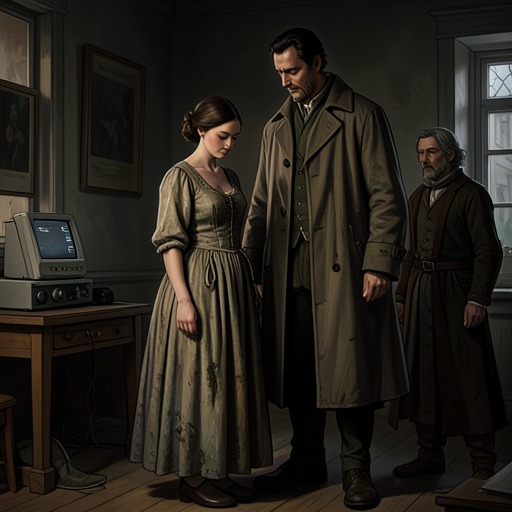
Thomas introduces himself to Mary as someone who works for Robert and treats her presence in the apple orchard as trespassing. His entrance is deliberately intimidating: he arrives on a giant black beast, and neither Mary nor the cook can initially identify the rider. Mary is certain that none of George’s soldiers would approach her with such confidence, which immediately places Thomas outside her husband’s ordinary sphere of control.
His voice is described as rumbling like a summer thunderstorm, and his physical appearance reinforces the impression of strength. Mary sees a very broad chest, dark eyes, sun-browned hair combed straight back, and several days of beard growth that gives him a dashing rather than neglected appearance. The presentation combines threat and romantic spectacle: Thomas is frightening because he has the power to take Mary, yet visually compelling enough to attract her attention even while she is afraid.
Authority, Detention, and Mary
Thomas separates Mary from the cook and orders Mary to accompany him while the dispute between Robert and George is resolved. He refuses to accept Mary’s explanation that George sent her to collect the apples, insisting that the disagreement between the two men determines her fate. His reasoning reduces her freedom to the settlement of a property quarrel: she must remain with him because Robert will not surrender a pond and George will not surrender a parcel of land.
The confinement places Mary in a small, unfamiliar room with Thomas and only one bedroom. She worries about gossip, George’s anger, and the prospect of being punished for allowing the situation to occur. Thomas, however, treats the arrangement as practical and potentially lengthy, telling her to make herself comfortable and asking whether she is a good cook and housekeeper. He then directs her to draw him a bath, sending her to the well for water and placing domestic labor inside the same structure as detention.
This mixture of legalistic language and personal command defines Thomas’s early conduct. He claims to be enforcing a trespassing rule, but the result is that Mary becomes an object exchanged within a dispute between men. The language of property and punishment gives his coercion an institutional appearance, while the isolated room makes its intimate consequences unmistakable.
Desire and the Relationship with Mary
The relationship changes from captivity to sexual intimacy without the power imbalance disappearing. Thomas’s physical initiative leads directly into their encounter, and Mary responds bodily even though the circumstances began with fear and confinement. He moves beneath her as she reaches a climax, and she calls his name while embracing him; she does not try to withdraw, instead wrapping her legs around him and pulling herself against him.
The aftermath gives the relationship its decisive emotional turn. George has declared that he does not want Mary returned and has called her useless and barren, effectively abandoning her rather than surrendering his land. Thomas then asks Mary whether he can keep her. Her answer is not a declaration of romantic freedom but an admission that she has nowhere else to go. They fall asleep with their naked limbs still entwined, making the scene both a consummation and a transfer into a new dependency.
Thomas therefore occupies an ambiguous position in Mary’s arc. He offers shelter after George rejects her, but he frames that shelter through possession. The question of whether he may keep her converts emotional attachment into ownership language, while Mary’s lack of alternatives prevents the relationship from becoming an uncomplicated rescue. The romance plot follows a movement from fear and resistance toward physical closeness, yet the book leaves the coercive conditions of that movement visible.
Protection of Merriam August
In the later account, Thomas’s role is more openly protective. He prepares a stagecoach for Merriam August and tells her that the horses have been fed and recently shod. He warns her to remain on the main road rather than taking smaller paths, which he considers dangerous because of wildlife and hostile attackers. He also hides a shotgun beneath the front seat and advises her to fire over the heads of anyone who approaches too closely, limiting the weapon’s intended use to self-defense and deterrence.
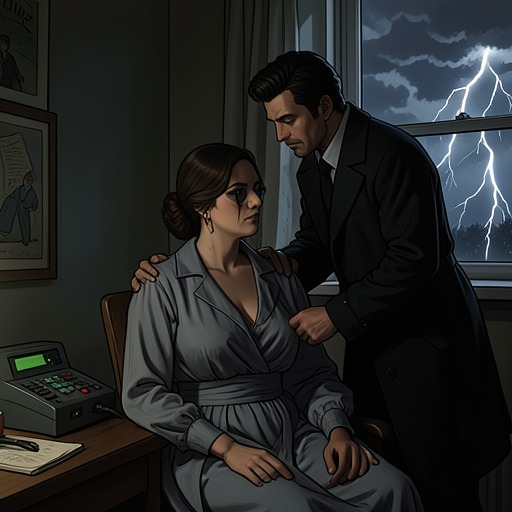
Thomas’s assistance is personal as well as practical. Merriam recognizes that he has a crush on her and believes he would do almost anything she asked within reason. He compliments her and tells her that Colin is not a good man, criticizing Colin’s habit of stepping over people to obtain land and using his influence over the Mayor. Thomas suspects that the papers Merriam carries will force the sheriff to act for Colin and warns her not to read them, directing her instead to deliver them to the Sheriff.
Merriam asks Thomas to keep watch over Colin because she fears that her husband is hiding something and may be trying to remove her in order to replace her. Thomas agrees to do so, promising to look after Colin and insisting that Colin could not find someone better than Merriam. Merriam regards his warmth as brotherly rather than romantic, and she admits that she may be using his feelings to gain leverage against her husband. The contrast with Mary is sharp: Thomas still has feelings and still acts through a male-coded protective role, but Merriam retains a clearer awareness of how his attachment can be mobilized.
Betrayal, Evidence, and Consequences
Thomas’s most consequential action in Merriam’s story is connected to a leather package. Merriam discovers that the documents reveal Colin’s attempts to obtain gold-mining rights through blackmail and coercion, along with other evidence of his criminal dealings. The papers give her leverage and suggest that Colin may have intended to eliminate her after using her to deliver them.
Thomas had given Merriam the package while telling her not to open it. Once the evidence is exposed, Merriam suspects that his decision to defy Colin was deliberate: Thomas may have believed that he was doing the right thing and was giving her the freedom she had been seeking. She also worries that Colin may discover the betrayal and punish Thomas, because Colin is vindictive and the men pursuing her may have been sent to silence her.
Vance questions whether Colin was directly responsible, noting that the stagecoach and horses may have been sabotaged before the package reached Merriam. Merriam remains uncertain about the full chain of events, but the uncertainty does not erase Thomas’s moral risk. By passing along the documents and assisting her departure, he places himself between an employer’s interests and a woman’s survival. His action transforms him from a subordinate carrying out orders into a potential whistleblower whose loyalty has shifted toward Merriam.
Narrative Role and Significance
Thomas functions as a recurring figure of redirected male power. In Mary’s story, he uses authority to detain a woman and then offers possession in the place of the freedom her husband has denied her. In Merriam’s story, he uses his access to horses, weapons, transport, and incriminating papers to help a woman resist a husband whose land ambitions depend on coercion. The same qualities—physical confidence, decisiveness, and proximity to male power—can therefore produce captivity in one context and protection in another.
His character is more rounded than a single description of either lover or rescuer would allow. He is capable of issuing commands, exploiting or being caught within unequal desire, warning a woman about danger, and betraying an employer when conscience or affection demands it. Yet the narrative does not present his protective behavior as wholly selfless: Merriam knows he is attracted to her, and Thomas’s earlier relationship with Mary shows how readily care can overlap with possession.
Thomas’s significance lies in this unresolved contradiction. He helps expose the vulnerability created when men treat women as collateral in disputes over land, marriage, and authority, but he also participates in that same structure by deciding where Mary must go and whether she may be kept. His later assistance to Merriam suggests a moral movement toward protection, though the evidence stops short of offering a final redemption. Thomas remains a figure whose loyalty is valuable precisely because it is costly, and whose intimacy is never separable from the power he carries into it.