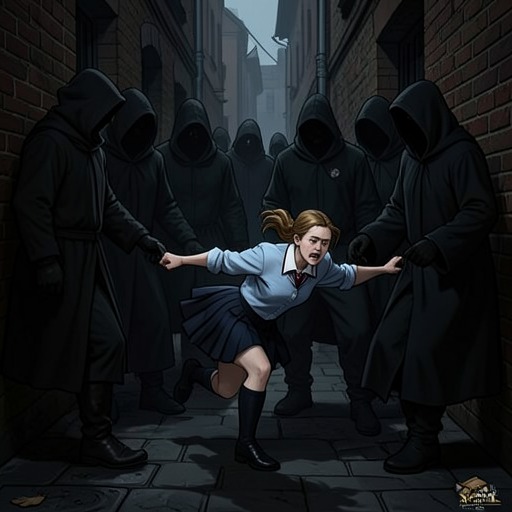
Valerie’s Kidnapping
SCOTTISH ROMANCE: My Sinful Surrender to a Highlander Werewolf (Scottish Werewolf Pregnancy Romance) (Historical Medieval Shape Shifter Paranormal Science Fiction Short Stories)Valerie’s Kidnapping is a strategic abduction in which Melonius, acting for his vampire father, removes Valerie from college before the werewolves can turn her into a wolf or formalize her position as the pack leader’s bride. The event matters because it converts Valerie’s supposed marriage into a battlefield objective: the vampire King wants to injure werewolf leadership by stealing the woman they carefully selected, while Valerie herself had imagined the arrangement as a limited, paper-based agreement that would allow her to finish college and retain her own life.
Causes and Political Background
The kidnapping begins with the continuing war between Vampires and Werewolves. The vampire King orders his son, Melonius, to find Valerie because he wants her taken before the werewolves can change her into a wolf. He describes the capture as a benefit to his side: taking a human mate would allow the vampires to get under the werewolves’ skin and damage their authority. His motive is therefore not Valerie’s safety or consent, but the symbolic and political value of depriving the opposing faction of its chosen bride.
The King makes the immediate reason explicit when he explains that the werewolves have selected a human as the princess bride of their pack leader. In his view, the selection is a carefully constructed act of leadership, and stealing Valerie from beneath the werewolves’ noses would create a visible wound in that leadership. The abduction consequently operates as both a rescue-prevention mission and an act of rivalry: Valerie’s body and future become instruments in a contest over prestige, succession, and supernatural power.
Melonius questions the policy before carrying it out. He argues that a human would offer little practical benefit beyond provoking the werewolves and suggests that his father should consider ending the war rather than escalating it by stealing mates. The King rejects that appeal, invoking the death of his own mate as the emotional source of his rage toward the wolves. His grief is not resolved; instead, it is converted into a justification for another coercive act, making the kidnapping part of a cycle in which earlier losses perpetuate new violence.
Planning and Execution
The vampire side first searches for a point of vulnerability in Valerie’s routine. Jesse discovers that she attends a college class every Tuesday at 8:30 a.m. Two guards escort her as far as the parking lot but do not follow her into the school, apparently believing that an attack in a classroom would be unlikely. This information gives Melonius a predictable schedule, a partially protected route, and a precise place where Valerie can be separated from her werewolf security.
Jesse proposes that Melonius create a distraction and remove Valerie away from public view. He recommends drugging her rather than attempting to drag her away while she struggles, reasoning that witnesses might recognize an abduction. The plan includes a getaway vehicle positioned at the back of the college, with Jesse ready to drive once Melonius has acquired the target. The language of the preparation is deliberately operational: Valerie is treated as a target to be acquired rather than as a person whose decision could determine whether the plan is legitimate.
Melonius watches Valerie enter the college from the parking lot and communicates with Jesse through an earpiece and a small microphone pinned to his shirt pocket. Although he initially intends to coax her out of the building, he decides that she is unlikely to cooperate willingly. He therefore uses chloroform. When Valerie stops alone in an empty hallway to tie her shoes, Melonius approaches from behind, apologizes as he places the cloth over her face, waits for her to lose consciousness, and carries her out through the back of the hall.
He puts Valerie into the van Jesse has waiting. Jesse is surprised by how quickly the abduction has occurred, but the danger has not ended: he fears the werewolves’ response and recognizes that being a human participant in the war places him at risk. Jesse drives away and checks that they are not being followed. When Valerie begins to wake during the journey, Melonius sedates her again and keeps her unconscious until they reach their destination, preferring continued incapacitation to the possibility of a struggle inside the van.
Valerie’s Position and the Conflict Over Consent
The abduction exposes a sharp contrast between the political story told about Valerie and the life she says she intended to lead. Valerie explains that the werewolf leader first noticed her beauty and then learned her personal history, after which he wanted to give her a chance at a real life. His father was pressuring him to select a mate, but neither Valerie nor the leader initially intended to treat the union as a conventional marriage. She wanted to complete college; he wanted to pursue his own activities. In her understanding, the arrangement could have remained largely symbolic and workable for both of them.
That account complicates the vampire King’s claim that taking Valerie is simply an attack on the werewolves. Valerie is not presented as an eager participant in a supernatural breeding project, nor as someone who has freely surrendered her future to the pack. She understands that the werewolves may eventually expect her to produce pups, but she believes there is no immediate need to consummate the relationship. Her expectations are limited, conditional, and centered on preserving time for her education and personal plans.
The later confrontation turns the issue from military possession into a question of legal and personal agency. Kale insists that Valerie was chosen as his son’s mate and therefore has an obligation to the werewolves. John answers that, under the werewolves’ own laws, an unwilling mate cannot be married. He further argues that the werewolves cannot claim a woman who needs an opportunity to live her own life, warning that marriage to them could take away the freedom Valerie has not agreed to surrender.
John’s argument does not make the kidnapping harmless. Valerie has been removed from her college and from the choice she might have made for herself; she has merely been transferred between competing powers. Yet the exchange identifies the decisive value shift in the event. Valerie begins as a woman with a constrained but negotiable future, while the competing factions treat her as a strategic possession. The kidnapping turns freedom into captivity, and the subsequent debate restores the language of consent as a direct challenge to the werewolves’ customary claims.
Consequences and Narrative Significance
The immediate consequence is that the werewolves lose physical control of the woman they intended to use as their leader’s mate, while the vampires gain a hostage whose significance extends beyond her individual identity. Jesse expects the wolves to be furious when they discover Valerie is gone, and Melonius leaves the political consequences to his father. The operation therefore threatens to intensify the war rather than resolve the grievance that produced it.
The event also reveals the instability of supernatural systems that connect bloodline, mating, and political authority. Elsewhere in the story, Tate recognizes the pressure to preserve pure werewolf royal blood while rejecting the contempt directed at humans and mixed-blood werewolves. Valerie’s kidnapping gives that broader conflict a physical form: both factions speak of mates, transformation, and leadership as if those institutions authorize possession, while Valerie’s own account insists that a political arrangement cannot erase her independent intentions.
As a plot structure, the event combines pursuit, abduction, rivalry, and rescue. Its suspense comes from the gap between the werewolves’ guarded expectation and the vampires’ successful exploitation of a routine weakness at college. Its deeper reversal is that the vampires’ attempt to undermine werewolf control does not establish Valerie’s freedom; it demonstrates how easily one coercive order can replace another. The kidnapping is therefore not a completed return to safety or integration. It is a forced crossing into a new sphere of danger, leaving Valerie’s autonomy as the unresolved stake around which the larger vampire–werewolf conflict continues.