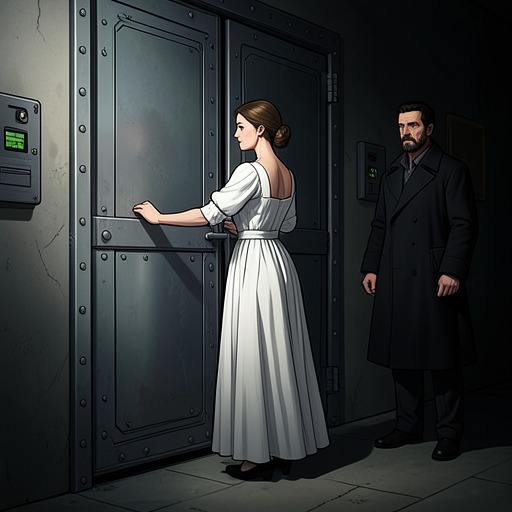
Watchers
SCOTTISH ROMANCE: My Sinful Surrender to a Highlander Werewolf (Scottish Werewolf Pregnancy Romance) (Historical Medieval Shape Shifter Paranormal Science Fiction Short Stories)The Watchers are the dominant extraterrestrial power in the Watchers storyline and one of the book’s clearest embodiments of benevolent rule turning into colonial control. They present themselves as the civilization that saved Earth and supplied humanity with technology and healing, yet they demand an annual human tribute, remove chosen people from their communities, and pursue a hybrid offspring that will combine Watcher intelligence and strength with a human body. Their authority therefore rests on both dependence and force: humans are taught to regard the Watchers as indispensable even while being compelled to serve them.
Origin and Dominion
The Watchers arrived on Earth years before Maggie was born and replaced human self-government with their own administration. Communities were required to provide one person each year, while the Watchers controlled essential conditions of life and could even stop the rain when humans behaved improperly. To Maggie, the idea that people had once ruled themselves seemed almost unbelievable, because the Watchers had become the source of everything her society received. Their intervention was remembered not as a temporary alliance but as the foundation of political order.
Their claim to have saved humanity is supported by their technical achievements. They taught humans about medicine, construction, science, and astronomy, and they possessed sufficiently advanced technology to govern an entire planet. Urieal later explained that the Watchers had returned because they believed the human race could not survive without them. This history complicates their role without absolving them: the same knowledge that makes them appear protective also gives them the power to define human weakness, set the terms of obedience, and justify continued domination.
Human Tribute and Social Control
The annual selection system turns every community into a source of bodies for the Watchers. Those chosen are taken away, and no one on Earth truly knows what awaits them. Some become slaves; others are used for breeding. The possibility of being declared unwanted is itself terrifying, because an unwanted selection may be disposed of and replaced by another human. The system thus makes survival conditional on extraterrestrial approval and teaches people to approach the lottery as both civic obligation and potential death sentence.
The workers are transported to the Watchers’ planet, which resembles Earth, where they labor in fields, work as carpenters, and attend to the Watchers’ needs. Their lives are short, since the Watchers are quick to eliminate slaves who disappoint them and assume that another human will arrive the following year. The Watchers’ alleged rescue of Earth therefore produces a sharply unequal exchange: technological instruction and planetary stability are purchased with labor, submission, and the loss of human choice.
Breeding Program and Physical Encounter
The Watchers separate breeders from ordinary workers and keep them in sterile containment. The purpose is to prevent human impregnation and to record the progress of every fetus. The program has not yet produced a successful birth. Previous pregnancies have involved babies growing at twice the normal rate, embryos consuming the host’s nutrients, and mothers dying within months of conception. A healthy woman selected for her capacity to bear a child is consequently not being honored but placed in a process that may amount to a death sentence.
Maggie’s selection exposes the system at its most intimate and violent. After her number is announced, she is moved from the stage to a metallic room and then to the Watchers’ planet. A Watcher with completely white eyes orders her to stand and later to remove her clothes. In a cold, dim room that resembles a cage, a Watcher enters in its natural form: a huge, six-legged body with a broad tail, scorpion-like in appearance, and liquid seeping from its tip. The creature’s legs carry spikes that pierce Maggie’s skin as it pins her around the hips. The scene converts the abstract language of hybridization into an immediate struggle over a human body.
The Watchers usually adopt a human appearance, but the natural form remains a reminder that their civilization is not simply a more advanced version of humanity. Another extraterrestrial man encountered by Dawn looks nearly human except for his height, slightly pointed ears, and purple eyes. The contrast between human disguise and alien anatomy allows the Watchers to move among humans while preserving a hierarchy between the species. Their technology can conceal difference, but it does not remove the power imbalance created by that difference.
History of Hybridization and Urieal’s Exception
Urieal offers Maggie a different account of the Watchers’ past. He says that, during their first presence on Earth, Watcher men fell in love with human women and fathered children. These children appeared human but possessed Watcher intelligence, greater strength, and larger bodies; Urieal identifies them with the giants remembered in human history. None lived for more than a few months, making the earlier contact a failed form of hybridization rather than a stable shared society.
According to Urieal, human men eventually became angry as more women formed relationships with Watchers, and war followed. The Watchers departed, then returned when they decided humanity again required their intervention. They now forbid Watchers from going to Earth to mate with women, although attraction remains. Urieal also says that many Watchers still want to cross their genes with humanity, create bodies that can take human form, and produce beings with Watcher intelligence and strength but without what they regard as human weaknesses.
Urieal’s conduct toward Maggie sharply contrasts with the institutional behavior of the other Watchers. He washes her gently, explains the hidden history, and acknowledges that some older Watchers remember love for humans while younger ones understand only the system. His apparent compassion does not erase the breeding program, but it reveals an internal division within Watcher society between care and possession, memory and doctrine, and personal feeling and reproductive policy. Maggie’s response is not simple reassurance: his account gives her more questions because the history has been excluded from human books, suggesting that Watcher rule depends as much on controlling knowledge as on controlling bodies.
The Watchers Across the Supernatural World
The Watchers belong to a wider pattern of species-based hierarchy in the novel. Werewolves distinguish ancient pure bloodlines from human-born and changed members, while Dragons have adapted from earlier human predation to conceal themselves and avoid being hunted. Like those groups, the Watchers organize survival around inherited difference, but their planetary dominion makes their hierarchy unusually comprehensive. They classify humans as intellectually limited and physically weak, then use that classification to rationalize experimentation, labor, and forced reproduction.
Their power also resembles the coercive arrangements surrounding human marriage, inheritance, and servitude elsewhere in the book. Human characters may be treated as dependents, breeding partners, or property by wealthy households, families, and supernatural communities; the Watchers enlarge that logic to an entire species. The result is a society in which rescue, education, romance, and scientific progress can all be made to serve possession. The Watchers are significant not merely because they are alien, but because they make familiar systems of paternalism and reproductive control appear on an interplanetary scale.