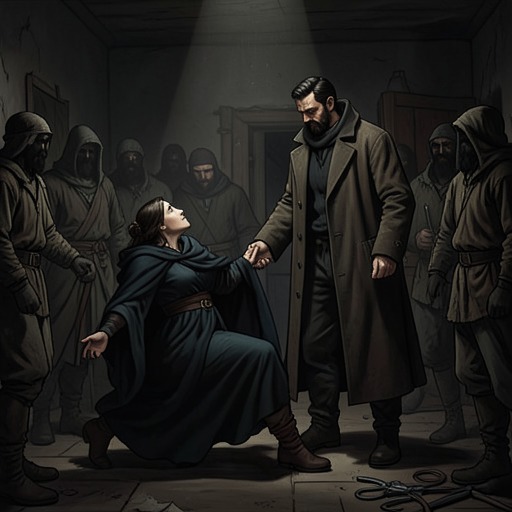
Werewolf lifelong mating rule
SCOTTISH ROMANCE: My Sinful Surrender to a Highlander Werewolf (Scottish Werewolf Pregnancy Romance) (Historical Medieval Shape Shifter Paranormal Science Fiction Short Stories)The Werewolf lifelong mating rule is the principle that a werewolf’s mating bond lasts for life, transforming a proposed union into an irreversible commitment with consequences for personal freedom, family authority, bloodline politics, and pack membership. Its decisive force appears when Tate realizes that accepting Accalia as his mate would bind him to her permanently, even though he rejects both her character and the hierarchy she represents.
Definition and Social Force
The rule distinguishes werewolf mating from ordinary human sexual relations. Tate does not object simply to the prospect of being intimate with Accalia; he objects to spending the rest of his life bound to a woman he despises. A physical or reproductive arrangement that might be temporary among humans therefore becomes, within werewolf society, a permanent relational status. The rule gives mating an institutional weight that exceeds personal desire and makes the question of consent central to the story’s conflicts.
The permanence of the bond also links private partnership to pack structure. Tate is the prince of the pack, and his family expects him to preserve the royal bloodline. Accalia is likewise pure-blooded, with ancestry extending thousands of years, so her selection as Tate’s mate is presented as part of a succession-minded system rather than merely an emotional preference. Because mating is lifelong, the choice of partner is simultaneously a choice about dynasty, status, and the future composition of the pack.
Tate and the Rejected Match
Tate is ordered by his father to mate with Accalia, but he openly resists the arrangement and describes her as revolting. He can imagine overpowering her in a human sense and then avoiding her, yet the lifelong rule makes that imagined escape impossible. The binding quality of werewolf mating is precisely what turns his anger into refusal: he does not want a momentary encounter that he could leave behind, but an enduring union with someone he considers cruel and unworthy.
His objections are ethical as well as personal. Accalia has never participated in a hunt, may have been responsible for the disappearance of a previous assistant, and treats her current assistant Sheldandra with contempt. She also looks down on werewolves who are not pure-blooded and treats humans even worse. Tate accepts that his own family wants to keep the royal lineage pure, but he rejects the belief that blood determines human or werewolf worth. In his view, a werewolf remains a werewolf and a human remains a human, regardless of pedigree; the rule becomes troubling when it is used to force a lifelong bond with someone who embodies bloodline discrimination.
Bloodline, Reproduction, and Competing Rules
The mating rule operates inside a wider hierarchy of werewolf identities. The narrative distinguishes werewolves born from long lines of werewolf parents, werewolves born of a werewolf and a human, and those changed by another werewolf. Accalia’s lineage has never included a human or a half-blood werewolf, while Tate can also trace his ancestry back thousands of years. Their shared purity makes the proposed match politically attractive to the ruling family, but it does not make Tate willing to accept it.
The same pressure appears in other forms of marriage and reproduction across the book. A family inheritance may require an heir, as in William’s estate stipulation, and Sloan Tiller’s will requires marriage followed by pregnancy within six months. A wealthy husband proposes that Penelope carry a child for his wife and then surrender the baby, treating her as an incubator rather than a person. These arrangements are not identical to werewolf mating, but they illuminate the same conflict: institutions attempt to convert intimacy, pregnancy, and parenthood into enforceable obligations, while the individuals involved insist that desire and consent cannot be reduced to lineage or inheritance.
The rule also helps explain why the claim that Valerie “belonged” to a werewolf family is so forceful. Valerie had been selected as a mate for a werewolf heir, but she and the man initially intended the arrangement to exist only on paper while she completed college and he pursued his own plans. Kale nevertheless insists that selection created an obligation. John counters that, under the werewolves’ own laws, an unwilling mate cannot be married. This dispute exposes a contradiction at the heart of the system: the bond is treated as lifelong and socially binding, yet the law also recognizes that marriage cannot legitimately proceed without willingness.
Consent and Resistance
John’s challenge to Kale reframes the rule from a justification for possession into a reason for caution. If marriage to wolves would permanently limit Valerie’s freedom, then her choice must precede the bond rather than follow it. John argues that she deserves an opportunity to live her own life, refusing the idea that a selected mate can be claimed like property. The conflict therefore separates two interpretations of the rule: one treats permanence as proof of obligation, while the other treats permanence as proof that consent must be especially meaningful.
Valerie’s account further complicates the apparent coercion. She says that the werewolf heir chose her because he found her attractive and wanted to give her a chance at a real life after hearing her story. Neither expected to carry out the relationship immediately, and both imagined preserving their separate plans. Yet the surrounding culture assumes that a mating arrangement cannot remain indefinitely symbolic. Once bloodline, marriage, and reproduction enter the picture, the promise of a paper union threatens to become an unavoidable bodily and domestic commitment.
The contrast is sharpened by Dennis’s conversation with Kember. Dennis admits that he initially wanted a baby, but explains that he wants more than the child: he wants Kember herself and asks for a genuine relationship. His distinction between desiring a baby and desiring the woman who would bear it presents an alternative to the systems that treat reproduction as the primary objective. Although Dennis is not governed by the werewolf rule, his confession clarifies the narrative’s recurring standard for a defensible union: the person must not disappear behind the reproductive function.
Narrative Significance
As a recurring rule, lifelong mating turns romance into a contest between inherited structures and chosen attachment. It supports the book’s interest in arranged marriages, heir requirements, surrogate pregnancies, alien breeding programs, and claims that a woman or mate has an obligation to reproduce. Across these situations, permanence can promise security and belonging, but it can also magnify the violence of an unwanted decision. The more irreversible the bond, the less acceptable it becomes to impose it through rank, family pressure, or biological expectation.
The rule also gives Tate’s refusal a broader significance than dislike of Accalia. He recognizes the legitimacy of preserving ancestry as a historical concern, yet refuses to let purity excuse cruelty or determine every relationship. His conflict is therefore with both a particular woman and the ideology that makes her an acceptable permanent partner solely because her lineage is uncontaminated. The werewolf lifelong mating rule remains powerful because it binds bodies to institutions, but the surrounding stories repeatedly ask whether a bond can be worthy of permanence unless it is freely chosen.