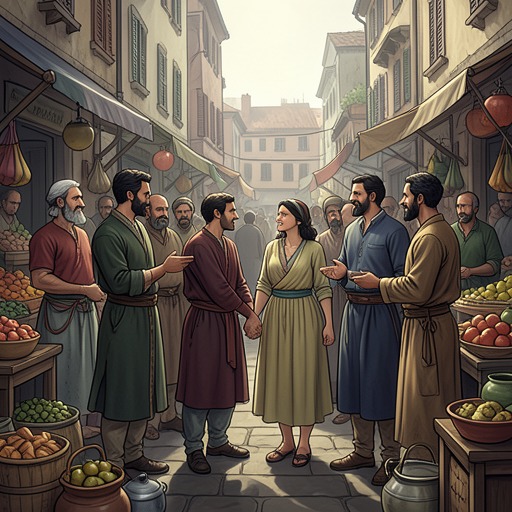
Arranged Marriage as a Political or Economic Bargain
SCOTTISH ROMANCE: My Sinful Surrender to a Highlander Werewolf (Scottish Werewolf Pregnancy Romance) (Historical Medieval Shape Shifter Paranormal Science Fiction Short Stories)Arranged Marriage as a Political or Economic Bargain is one of the book’s most persistent social mechanisms: marriage becomes a contract through which wealth is preserved, businesses are joined, borders are crossed, heirs are produced, and violence is temporarily restrained. Its apparent language of choice—deal, benefit, arrangement, solution, or opportunity—often conceals unequal bargaining power, because one party controls money, land, citizenship, employment, inheritance, or military force. The resulting marriages may begin as transactions, but the stories repeatedly test whether intimacy can survive, resist, or transform the bargain that created it.
Definition and Operating Logic
The clearest modern version appears when William learns that he cannot control his family estate unless he marries and produces an heir. The stipulation applies to the estate, the home property, and the family business; it is presented as an inherited safeguard intended to keep the family’s assets within the family. William has built his life around his career rather than relationships, so the condition abruptly turns marriage and parenthood into requirements imposed on him by property law and family succession. His private future is treated as an instrument of institutional continuity.
William and Mr. Jenkins then translate the requirement into an explicitly commercial plan. William proposes finding a spouse who will gain something from the marriage while protecting the family name and estate from claims by the bride. The lawyer concludes that a mail-order bride could serve the purpose through a contract promising transportation, citizenship, and material care in exchange for a minimum ten-year marriage and a child, with the bride barred from claiming part of the estate. The arrangement makes the underlying logic unmistakable: affection is optional, while access to property, legal status, and reproduction is itemized as reciprocal consideration.
This logic also governs relationships that are not formally described as conventional arranged marriages. Abigail summarizes her own proposed escape from London as selling herself to a rich American: she would marry him so that he could inherit his family fortune, later divorce him, and use the money he gave her to begin a business. Her plan follows the same structure as William’s, although the bargaining position is reversed. For Abigail, marriage is an exit strategy shaped by grief, financial ambition, and the need for a clean break after the death of her family in a yacht storm. The fact that she was the only survivor makes the proposed transaction less like romantic adventure than an attempt to purchase a future after catastrophic loss.
Property, Employment, and Reproduction
The book repeatedly links marital bargains to labor and bodily service. Avril, a successful chef in London, discovers that her work visa has expired and that she will be sent back to Nigeria. She finds a proposed solution online by becoming an e-mail order bride, and the man she contacts turns out to be a regular at her restaurant. Her professional achievement does not protect her from immigration precarity; instead, marriage becomes the legal route through which she might remain in the country and continue the life she has built through work. The arrangement therefore converts citizenship and intimate access into substitutes for secure employment rights.
Penelope’s situation exposes the coercive edge of the same system. After becoming pregnant, she is told by the man who employs her that his wife wants a baby and that Penelope can remain in the household until the birth, then surrender the child in exchange for payment and discretion. Penelope refuses, saying that she has decided to keep her baby, but he answers that she cannot afford to raise a child and threatens to throw her into the streets without her final paycheck. His language strips away the fiction of mutual agreement: the servant’s wages, housing, and food are placed against her child, while pregnancy is treated as a service that her employers may purchase. He no longer sees her as a person but as an incubator, and the absence of any meaningful consultation reveals that the proposed reproductive bargain is enforced through economic dependence.
Sloan and Amy’s arrangement is more openly legalistic but still binds marriage to reproduction. Amy asks about the requirements of Sloan’s inheritance and learns that they must be married and pregnant within six months. Sloan presents medical intervention as an acceptable contingency so long as they are actively trying to satisfy the condition. Amy considers the demand in relation to her age, regular cycles, work as a teacher, and long-standing love of children; she must decide whether motherhood is a personal desire or merely the performance required by a will. The bargain thus places a biological deadline inside a marital contract and makes fertility part of an inheritance timetable.
Dennis offers Kember a different reproductive contract: one hundred thousand dollars for surrogacy, payment of all medical expenses, and continued consideration for a personal-assistant job paying fifty thousand dollars a year with medical benefits. He also offers an open-adoption arrangement under which she could receive pictures or visit the child. Kember’s objection is not simply financial. She asks what would happen if the child needed a mother in a two-parent family, forcing Dennis to answer not as a purchaser of reproductive labor but as a prospective parent. His willingness to let her remain involved softens the transaction, yet the proposal still demonstrates how money, employment, medical care, parenthood, and emotional access can be assembled into negotiated terms.
Marriage as Trade and Political Security
In the historical storyline involving Dylan, Andrew, and Victoria, marriage is directly tied to commerce. Dylan travels to town with clansmen to arrange a wife, while concealing the purpose because he expects the marriage to become an excellent business pairing for trade with the English. Andrew independently travels to the same meeting because the deal promises profitable exchanges: Scottish wool can command a good market price, while Dylan’s grain is heartier than what Andrew’s side can grow. The daughter is not merely the object of a family alliance; she is the condition that makes the economic partnership possible.
The negotiation is conducted in stages that emphasize its commercial character. Andrew and Dylan first settle the business portion over soup and ale, calculating the likely gains and worrying about what will happen if the grain turns sour. Only after the bowls and mugs are empty do they turn to the marriage portion. Andrew recognizes that the trade depends on the promised wife, and he also treats Victoria’s age and difficult temperament as reasons she has limited value in the local marriage market. Once the men shake on the deal, Victoria is informed only after the agreement is complete. Her anger, confusion, and disgust show the human cost of a bargain finalized between men who control the economic and familial structures around her.
The later Highland arrangement makes the political function even more severe. A magistrate orders a woman to meet Patrick McDowell because Highland warriors may attack and desecrate the land if negotiations fail. She is escorted by her brother and one guard to a secluded clearing, where Patrick arrives carrying a Scottish flag, wearing green-and-white tartan, and carrying a sword. The agreement requires her to remain his for two full years in exchange for the Highlanders leaving the town alone for ten years. The marriage is therefore a hostage-like peace settlement: a woman’s body and future are exchanged for the temporary safety of an entire community.
The secrecy of the meeting reinforces the arrangement’s coercive nature. The public is not told about it, and the woman understands that refusal would not restore her freedom; guards could take her by force. Her brother acknowledges that he is handing her over like cattle, even while claiming that both of them must obey those who hold legal authority. The scene’s bitter historical conclusion—that people in expensive clothing remain barbarians beneath the surface—turns the political bargain into an indictment of civilization’s external forms. Law, diplomacy, family duty, and military threat operate together, but none gives the woman genuine consent.
Agency, Resistance, and the Possibility of Choice
Although these bargains are often imposed, the book distinguishes between arrangements that exploit vulnerability and those that allow negotiation. Emma leaves England after a house fire destroys her home and family life, carrying painful reminders of what she has lost and facing accumulating bills. She is uncertain about becoming a mail-order bride, but decides that Lucas is a good man who needs help with his niece. The decision remains a departure shaped by grief and economic necessity, yet Emma presents it as a possible new home in Texas rather than merely a sale of herself. Her movement toward the American West shows how a transactional beginning can also function as an attempt to reclaim direction after disaster.
Greyson’s circumstances reverse the usual economic imbalance without eliminating the problem. At forty, he is unmarried, wealthy, and lonely, with two failed near-marriages behind him and a life centered on his ranch, his favorite horse, his housekeeper’s cooking, and his fawn-colored pit bull, Daisy. He dislikes the city’s boardroom costume and prefers denim and open land, but his wealth makes it difficult to know whether a prospective wife wants him or his money. He therefore asks Lydia to find a woman who will want children, friendship, companionship, and life on the ranch rather than his fortune. His desire is emotionally recognizable, but his method still treats a spouse as a selection problem to be solved through screening and controlled access.
Tomas makes that method more troubling. He asks Lydia, a paralegal rather than a dating service, to find him a wife because he fears women may be interested in his money. He wants someone who will welcome him home, have children, grow old with him, work hard, play in the mud, and ride a horse. Yet he threatens to send Lydia to assignments that will place her at his mercy, grips her arm, and kisses her while asking her to perform this search. His stated wish for an unmercenary marriage is undermined by his own coercive conduct: even the man trying to escape transactional intimacy reproduces a hierarchy in which he controls another person’s employment and bodily space.
Jenna’s open-marriage arrangement reveals a different model of negotiated intimacy. Her husband has given her permission to have a boyfriend because his work keeps him away, and he considers opening the marriage preferable to divorce. Jenna comes to a bar to discover whether she can flirt with a stranger, openly acknowledging that she is unsure she can live within the arrangement. Unlike the older bargains in which fathers, lawyers, employers, or warriors decide for women, this agreement at least begins with discussion between spouses. Nevertheless, Jenna’s uncertainty shows that formal permission does not erase emotional risk; a contract can authorize conduct without making the feelings it produces predictable.
Narrative Significance
Across these episodes, arranged marriage functions as a pressure test for the meaning of consent. A marriage can be called a solution while one party faces deportation, homelessness, starvation, loss of inheritance, military violence, or exclusion from a child’s life. It can also be presented as an opportunity—citizenship for Avril, a new home for Emma, security for Abigail, an heir for William, trade for Andrew, or peace for the threatened town—without distributing benefits equally. The central question is not whether an arrangement contains an exchange, since every marriage in these stories involves obligations, but whether the vulnerable party can refuse without losing the essentials of survival.
The concept also gives the book a recurring contrast between institutional permanence and personal change. Wills, estates, businesses, immigration systems, family names, trading agreements, and magistrates’ commands seek to make intimate life predictable by attaching marriage to enforceable outcomes. People resist that predictability through refusal, bargaining, emotional reinterpretation, or departure. Penelope rejects the purchase of her baby; Amy interrogates the inheritance condition before accepting it; Kember asks whether the proposed child will have a stable family; Victoria protests the trade arranged around her; and the unnamed woman in the Highland settlement recognizes that a ten-year peace has been bought with two years of her life.
The recurring pattern is therefore neither a simple condemnation of marriage nor a celebration of romantic escape. The book shows how economic and political systems enter the most intimate decisions, then asks whether affection can emerge after the contract has already assigned the parties their roles. Some arrangements promise protection but conceal ownership; others begin as practical bargains and leave room for mutual regard. In every case, the transaction supplies the plot’s pressure, while the struggle to recover personhood from the terms of the deal supplies its moral and emotional force.