Chris
SCOTTISH ROMANCE: My Sinful Surrender to a Highlander Werewolf (Scottish Werewolf Pregnancy Romance) (Historical Medieval Shape Shifter Paranormal Science Fiction Short Stories)Chris is the central antagonist of Marie’s domestic life in Rescued by the Bad Boy. An unemployed mechanic who drinks heavily, gambles, and treats his wife as an object responsible for his comfort, he converts an ordinary home into a place of surveillance, punishment, and forced service. His importance lies less in any independent ambition than in the destructive pressure he exerts on Marie: his violence confines her, while the prospect of losing him becomes the condition through which she can imagine freedom.
Identity and Domestic Power
Chris is Marie’s husband, but the marriage is presented as a profoundly unequal arrangement. Marie works long days at a law firm, while Chris is out of work and appoints himself the keeper of her evenings. His authority rests not on care or shared responsibility but on intoxication, anger, and the expectation that she will anticipate and satisfy every demand. He drinks the money she earns, watches sports from his easy chair, and leaves her to manage the household around him.
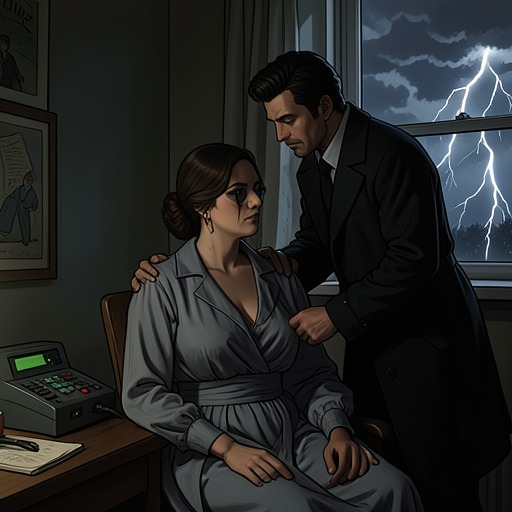
The physical evidence of his rule is written across Marie’s body. A black eye follows a dinner he considers badly prepared; a split lip becomes punishment for serving it incorrectly; tender ribs mark her failure to clean quickly enough after he throws spaghetti across the kitchen wall. Even while injured, Marie scrubs the mess and fetches him another beer when he shouts from the living room. Chris therefore makes domestic labor both a duty and a trap: Marie’s work is necessary to preserve the household, yet any imperfection in it can be used to justify further abuse.
Abuse, Alcohol, and Control
Chris’s drinking structures the rhythm of the household. On one comparatively quiet night, he consumes twelve beers and passes out in the easy chair before demanding sex, which Marie experiences as relief rather than intimacy. The grim measure of a good evening is not affection or safety but the moment at which Chris becomes unconscious and can no longer reach her. His alcoholism also intersects with gambling and debt. Marie imagines loan sharks or bookies coming to punish him, but even that fantasy is contaminated by fear: she worries that they might break his knees rather than his neck and leave her with an incapacitated, still-dangerous man.
His control extends beyond physical assault. Chris insults Marie, questions her movements, and treats her employment as a source of money for his habits. When she returns home early after a dentist appointment and he sees her, he calls her lazy and accuses her of skipping work. At another moment, he confronts her with the demand, “What are you looking at, bitch?” Marie immediately retreats into stammered reassurance that she is only bringing him a beer. The exchange shows how thoroughly his violence has trained her responses: danger is anticipated before it is fully expressed, and appeasement becomes a survival technique.
Marie’s Concealed Resistance
Marie is not unaware of her situation, but shame and fear prevent her from openly naming it. At work, she evades questions about her injuries and repeated doctor visits, while recognizing that her colleagues probably do not believe her claims of being accident-prone. Her silence is not consent; it is the guarded behavior of someone calculating the risks of disclosure and departure. The narrative places her private wishes beside the tasks Chris imposes on her, creating a sharp contrast between the woman who keeps cleaning and the woman who imagines a meteor crushing him in his La-Z-Boy chair.
Her employment provides a narrow but important margin of independence. Because Chris never checks her paychecks, Marie secretly saves money twice a month in an account at another bank. She pays the bills, conceals books under her car seat, and occasionally stops at a bookstore, using the small freedoms produced by his laziness against the household he controls. She even buys a twelve-pack on the way home so that he will not run out of beer, not because she accepts his rule but because preventing an immediate escalation is safer than provoking one. Her resistance is therefore practical and concealed: financial preparation, private reading, and the preservation of an imagined future beneath the routines of submission.
Confrontation and Consequence
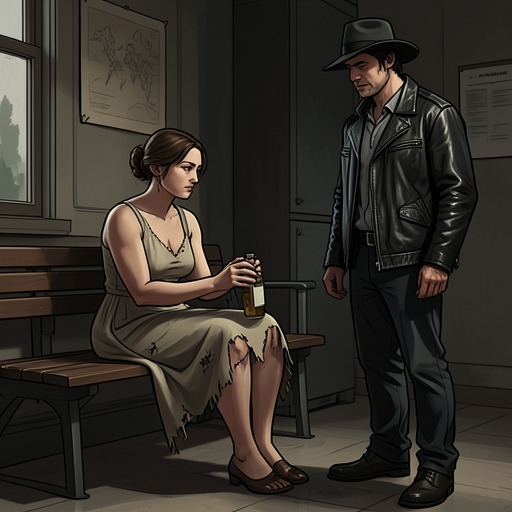
Chris’s position changes when Marie comes home early and finds an enormous, leather-clad man looming over him in the easy chair. The stranger is demanding payment for an unspecified debt, and his fist strikes Chris’s jaw, leaving him slumped and moaning in his own lap. Marie nearly smiles at the sight, though the expression reopens the cut on her lip and brings a stab of pain. The scene reverses the household’s familiar arrangement: Chris, normally the source of bodily fear, is suddenly the one receiving violence, while Marie watches from the edge of a possible escape.
The intervention does not erase the damage Chris has caused, and Marie’s own pain remains present as she faces the unfamiliar man. Yet the assault breaks the sense that Chris is untouchable. Months later, Chris is described as a distant nightmare, and Slate’s friends have ensured that he understands the marriage is over. His hospital stay is long enough to communicate the finality of the separation, but not so long that the narrative turns him into a continuing presence in Marie’s new life. His defeat is consequently both physical and social: he loses the power to command her home, her labor, and her future.
Narrative Function and Significance
Chris embodies the coercive domestic order from which Marie must be rescued, but the story also shows that rescue depends on capacities Marie has cultivated herself. She works, saves money, pays the bills, hides the books, and continues to imagine a life beyond the easy chair. Slate’s arrival changes the balance of force, yet Marie’s preparation makes change materially possible. Chris’s role is thus not merely to personify cruelty; he establishes the value shift at the center of Marie’s plot, from a home organized around fear to a future in which safety, desire, and self-determination can coexist.
The contrast between Chris and Slate also drives the story’s reversal of appearances. Chris occupies the familiar domestic role of husband while behaving as a predator within the home; Slate initially looks threatening through his leather clothing, shaved scalp, and tattoos, yet Marie later recognizes him as the same sweet soul she had known as Howard. Against Chris’s demand that Marie clean, serve, submit, and conceal, Slate becomes associated with the possibility of protection without the same domestic captivity. Chris therefore functions as the negative measure of the relationship Marie eventually builds: his violence teaches her what survival has cost, while his removal allows her to recognize that intimacy need not reproduce his power.