Irrevocable Highlander Werewolf Joining Rule
SCOTTISH ROMANCE: My Sinful Surrender to a Highlander Werewolf (Scottish Werewolf Pregnancy Romance) (Historical Medieval Shape Shifter Paranormal Science Fiction Short Stories)The Irrevocable Highlander Werewolf Joining Rule defines membership among the Highlander werewolves as permanent. Its decisive significance is that refuge and captivity become difficult to separate: Zuzulla can choose Carden over return to the Highlanders’ enemies, but the choice binds her irrevocably to his people and requires her to accept a new communal identity.
Definition and Operation
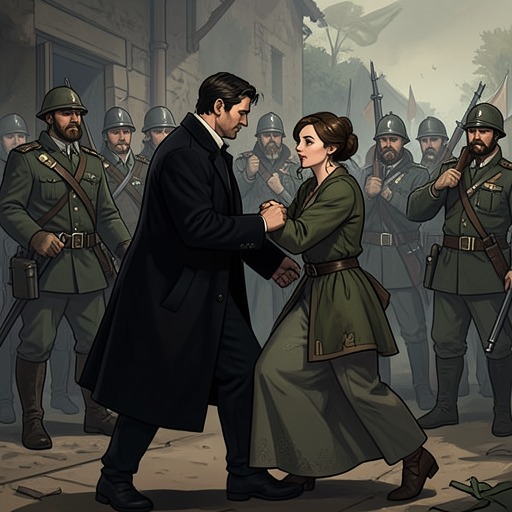
The rule is presented as an absolute condition of joining. Carden explains that Zuzulla has two immediate options: he can take her to the King of Kigom, whose treatment of her is uncertain, or he can report that he captured her while secretly keeping her for himself. Under the second arrangement, her father will remain distracted while she escapes with Carden. The proposed escape is therefore not an unqualified rescue; it is an exchange of one danger for permanent incorporation into another community.
Carden makes the condition explicit before Zuzulla commits herself. He tells her that they must first go to his people and then hide until the search for her ends, adding that once she joins them, she can never leave. The rule has no stated time limit, trial period, or route of withdrawal. It is not a temporary pact made for the duration of the pursuit, but a lifelong boundary between outsiders and Highlander members.
Zuzulla’s Choice and Carden’s Motive
The rule emerges at a moment when Carden’s personal desire and Highlander social policy converge. While hunting, he has reconsidered Zuzulla’s earlier words and wants to take her back to the Highlanders so that the Alpha can change her and make her like him. He recognizes that the two of them must remain apart from the group temporarily while the search continues, yet his intention is still to bring her into the community rather than release her to an independent life.
Zuzulla accepts the arrangement after hearing its consequences. She chooses to go with Carden and assures him that she will never leave him. Her consent is emotionally direct, but it occurs under sharply unequal conditions: the alternative is delivery to the King of Kigom, while her father’s search continues around her. The scene thus gives her a voice in the decision without making the surrounding power structure equal. Her choice is real within the available options, but the rule ensures that it cannot later be revised without violating the fundamental terms of Highlander membership.
Conflict with Other Marriage and Mate Rules
The joining rule belongs to a larger supernatural legal order in which relationships are treated as matters of communal authority, inheritance, and bodily status. Elsewhere, Kale argues that a woman selected as his son’s mate has an obligation to fulfill that role. John counters that, under the relevant laws, an unwilling mate cannot be married. This opposition establishes a conflict between customary claims of ownership and a consent-based limit on marriage.
The Highlander rule complicates that distinction. It does not necessarily describe marriage itself, but it makes communal affiliation irreversible, so that entering the group can carry consequences comparable to a binding mate relationship. John argues that a woman must have the chance to live her own life rather than be claimed by wolves, and he warns that marriage could take that freedom away. The joining rule raises the same question at an earlier stage: whether a person’s apparent agreement to enter a supernatural society remains meaningful when departure has been removed as a future possibility.
Institutional Parallels in the Wider Story
Other parts of the narrative repeatedly depict marriage, reproduction, inheritance, and service as systems governed by nonnegotiable conditions. Penelope is told that she may remain in a household until giving birth, after which the child must be handed to the man’s wife; refusal would lead to expulsion and the loss of her final wages. The demand reduces her from a worker and person to an instrument of reproduction, and she resists the assumption that money can purchase her child.
Sloan explains that his inheritance requires marriage and pregnancy within six months. William learns that he cannot fully control his family estate, home property, and business unless he marries and produces an heir apparent. In both cases, private relationships are subordinated to economic succession. The Highlander rule operates differently because it governs entry into a supernatural community rather than an estate, but it produces the same structural pressure: an intimate or personal decision is transformed into an institutional commitment whose consequences extend beyond the people making it.
The Watchers’ Choosing offers another contrast. Adults must participate in an annual lottery until age forty-five unless they withdraw or are selected. Each person receives a numbered stone, must preserve it, and brings it to the yearly drawing. The chosen person becomes a servant to the Watchers. Unlike the Highlander rule, which is attached to a person’s decision to join, the Choosing is imposed through a collective mechanism and can remove meaningful consent altogether. Both systems show communities converting human lives into durable statuses, but they differ in how permanence is assigned: one follows entry, while the other follows selection.
Consequences and Narrative Significance
For Zuzulla, the rule transforms escape into permanent exile from her former life. Carden’s plan can shield her from the King of Kigom and keep her father searching elsewhere, but it also requires her to abandon the possibility of returning to her old community. The rule therefore functions as both protection and confinement, preserving the Highlanders’ ability to absorb new members while denying those members a recognized path back out.
Its narrative force lies in that double meaning. Carden frames the condition as necessary knowledge that Zuzulla must receive before joining, which gives the rule the appearance of transparency. Yet disclosure does not erase coercion; it merely places the coercive consequence inside a stated bargain. Zuzulla’s declaration that she will never leave Carden supplies the emotional answer to the rule, while the rule itself supplies the political and social answer: once she becomes part of the Highlanders, her identity is no longer treated as hers alone to revise.
The rule also reveals the Highlander community as more than a refuge or collection of individual werewolves. Membership is a total affiliation, enforced through permanence and sustained by the assumption that joining changes what a person is allowed to do afterward. In this world, love, safety, mating, reproduction, inheritance, and communal belonging repeatedly overlap. The Irrevocable Highlander Werewolf Joining Rule is one of the clearest expressions of that overlap, because it makes belonging itself a binding transformation rather than a reversible choice.