Opal
SCOTTISH ROMANCE: My Sinful Surrender to a Highlander Werewolf (Scottish Werewolf Pregnancy Romance) (Historical Medieval Shape Shifter Paranormal Science Fiction Short Stories)Opal’s decisive significance lies in the contrast between the freedom she wins and the freedom she can initially inhabit. A woman of mixed Haitian and Native American parentage, she escapes a plantation system that has treated her labor and body as property, then crosses the countryside hungry, cold, and constantly threatened by recapture. Her meeting with William does not erase that history, but it gives her the first credible route from survival to belonging; when she accepts his proposal, marriage becomes not another imposed household but the home she actively chooses.
Identity and Background
Opal’s appearance is inseparable from the social hierarchy that shaped her life. Her mother was Haitian by birth, her father a Native American who disappeared into the forest, and her mother was sold away from the plantation while Opal was still very young. Although she was technically without family, she formed a substitute family among the other workers, making her later departure emotionally costly even as escape became necessary.
Her lighter skin altered the work assigned to her. Opal understood that she had been moved from the fields into domestic labor partly because she looked different from the workers with dark ebony skin who were expected to remain outside on the plantations. The arrangement did not protect her. Inside the house, she watched workers being bought, sold, and removed from one another, while some men treated access to female workers as their right. Domestic service therefore appears not as safety but as another form of confinement, organized through racialized appearance, ownership, and vulnerability.
Opal also loves cooking and once imagined that skill as part of an ordinary life. Her childhood began with farm work, but increasing domestic assignments took her away from that possibility. The small future she later dreams of—a piece of land, a tiny house, a vegetable garden, and a few chickens—draws its emotional force from everything the plantation denied her: control over place, work, food, and the meaning of home.
Flight and Precarious Freedom
Opal’s escape begins as a movement through danger rather than a triumphant arrival at liberty. She spends her first night hidden in a tree in rural Arkansas while men search nearby and dogs bay after her. Once the pursuit falls silent, the quiet of the forest frightens her almost as much as the chase, because she is unused to a world in which no one is immediately demanding her labor or trying to reclaim her.
For months she travels north only at night, moving between small towns whose general stores, saloons, dining halls, and occasional inns offer both supplies and the possibility of capture. Her reading ability is limited, but an older field worker had taught her enough to practice signs and basic navigation. That modest education becomes a practical instrument of escape: Opal cannot rely on official protection, money, or family, so every readable sign helps her remain in motion.
The journey subjects her to extremes of deprivation. She borrows horse blankets, wears discarded clothing, gathers scraps, and occasionally takes an apple or carrot from the edge of a farm. Towns provide more resources but expose her to people who might return her to bondage; open country gives her room to breathe but leaves her with little food. She experiences heat so severe that breathing becomes difficult and cold so intense that sleep threatens to become permanent. Wrapped in a stolen horse blanket and sleeping in the woods, she recognizes the contradiction at the heart of her escape: she has gained freedom, but that freedom currently means dirt, hunger, invisibility, and the continual fear that someone else may claim her.
Encounter with William
William discovers Opal near the wooded perimeter of his property while checking whether calves have become trapped in the brush. Their first meeting is marked by mutual caution. She emerges from the greenery with dark, fearful eyes, long black hair, a threadbare dress, and a horse blanket wrapped around her shoulders. William tries to offer his coat, but Opal refuses, already conscious that she has taken enough and carrying a can of tomatoes in a canvas bag.
The encounter places her between two possible readings: to William she is a vulnerable stranger in need of shelter, while to herself she is a fugitive whose every act of taking food or clothing could be used against her. His initial response is practical rather than theatrical. He later offers her work around the house and farm, food, a place to sleep, winter clothing from the general store, and a small wage of a couple of dollars a month. The offer is still structured as labor, and Opal immediately fears that she may have traveled all this way only to enter another household resembling the one she escaped.
That hesitation is central to the relationship. William’s home can become refuge only if it differs from the plantation, and Opal must judge that difference for herself. The narrative does not make her freedom meaningless merely because she accepts domestic work; instead, it dramatizes the difficult negotiation by which a person with almost no material resources tests whether an apparent offer of protection conceals renewed ownership.
Relationship and Chosen Home
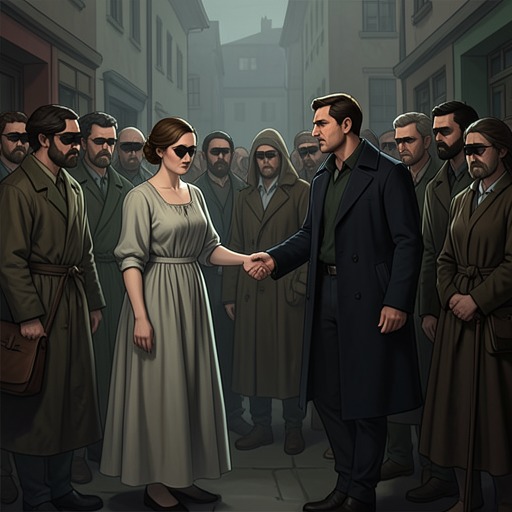
William eventually tells Opal that he wants her to be his family and asks her to marry him. Her answer is immediate and joyful: “William! To marry you? I never… Of course!” The proposal reverses the logic of her earlier life. She is not seized, purchased, or threatened into a union; she is asked, considers the emotional meaning of the request, and accepts because the relationship has come to represent safety and affection rather than coercion.
Their intimacy is presented through ordinary domestic details rather than social display. Opal has no lace dress, so she marries in a button-down shirt, trousers, and work boots. A traveling chaplain comes to the homestead within a few days, and the couple marry in the cool stillness of a spring evening. In the kitchen, William embraces her so warmly that she feels at home for the first time in her life; later, sharing a bed for the first time, he shows her the love that makes the household emotionally distinct from the places where she had been compelled to serve.
The contrast with other relationships in the wider narrative sharpens Opal’s arc. Mail-order and contractual unions elsewhere are repeatedly shaped by money, citizenship, inheritance, visas, or reproductive obligations: Abigail describes a plan to marry a rich American, divorce him, and use the money to start a business; Avril turns to an email-order marriage because her work visa has expired; William himself considers a mail-order bride as a business arrangement designed to protect an estate; Dennis offers Kember one hundred thousand dollars for surrogacy while negotiating continued access to the child. Against these transactions, Opal’s marriage begins in economic vulnerability but reaches emotional reciprocity. Her story does not deny material dependence; it asks whether care can become genuine when the person who needs shelter retains the power to say yes or no.
Change and Narrative Role
Opal’s transformation is not a change from weakness to strength, because the evidence shows strength from the beginning. She survives pursuit, hunger, racialized exploitation, weather, and months of concealment. What changes is the form that strength can take. At first, survival requires silence, night travel, stolen food, and constant movement. With William, endurance can be redirected into work, trust, family, and a stable future without surrendering the freedom that motivated her escape.
Her story also gives the novel a perspective from the social margins. Opal sees domestic respectability from underneath it: she knows that a house can hide sexual exploitation, that a worker can be treated as an object, and that the word home may describe a place that legally belongs to someone else. This position makes her an especially forceful counterpoint to the wealthy and aristocratic figures elsewhere in the book, whose marriages are planned around inheritance, reputation, citizenship, or social rank. William’s own world is modest despite his resources, and his proposal succeeds because it meets Opal not as an acquisition but as a person whose history has made consent and belonging inseparable.
By the end of her arc, Opal has moved from a fugitive sleeping in the woods to a bride who feels at home in a kitchen she has entered by choice. The wedding does not cancel the violence of enslavement or guarantee that every structural danger has disappeared. Its importance is more precise: it marks the first time Opal’s domestic life is grounded in mutual affection rather than ownership, and it turns the small future she once imagined—land, food, work, and family—into a plausible shared life with William.