Open Marriage
SCOTTISH ROMANCE: My Sinful Surrender to a Highlander Werewolf (Scottish Werewolf Pregnancy Romance) (Historical Medieval Shape Shifter Paranormal Science Fiction Short Stories)Open Marriage is the central relationship arrangement between Jenna and Kyle, created when Kyle’s long absences make Jenna’s desire for companionship and sex feel incompatible with continued monogamy. Rather than accept divorce, Kyle agrees to a deliberately limited form of non-monogamy, and the arrangement later expands when Jenna becomes pregnant by Rack. Its decisive significance lies in the way a marital crisis is converted into negotiation: the couple attempts to preserve their emotional bond by separating marriage from sexual exclusivity, only to discover that the consequences include jealousy, parenthood, and the difficult redistribution of domestic responsibility.
Origins and Terms
Kyle and Jenna have been married for three years when Jenna admits that the urge to cheat has become overwhelming. Kyle’s work keeps him away for long periods, while Jenna is left alone and increasingly preoccupied with other men and sex. Her stated alternative is divorce, not because she has stopped loving Kyle, but because the existing structure of their marriage no longer accommodates her needs. Kyle answers with a compromise that surprises her. He says that he loves her and wants her to be happy, and therefore is willing to let the marriage become open rather than end it. The arrangement is not presented as unrestricted freedom. Kyle establishes one explicit boundary: Jenna may see other men, but they must not enter the bedroom that he and Jenna share. Her outside relationships may take place elsewhere, while the marital bed remains symbolically reserved for the original couple. Kyle initially leaves open the question of whether the permission should operate in both directions. He acknowledges that he has sometimes been tempted by other women, although he has not acted on those impulses, and reasons that if Jenna receives permission, the principle may need to apply to him as well. The possibility of reciprocity makes the arrangement a shared agreement rather than a unilateral license, even though the narrative gives much more attention to Jenna’s outside relationship.
From Marital Alternative to Experiment
Jenna accepts because the proposal removes the immediate choice between suppressing her desires and packing her belongings. She had expected to tell Kyle that she wanted a divorce, but his willingness to compromise gives her an alternative she had not believed possible. The arrangement therefore begins as an attempt to preserve the first relationship by allowing another kind of intimacy to exist beside it. Jenna’s uncertainty remains visible when she meets Rack at a bar. She explains that Kyle has given her permission to have a boyfriend because he is frequently away, and that the choice had seemed to be opening the marriage or getting divorced. She has come partly to discover whether she can actually flirt with a stranger, not because she already possesses confidence about the new arrangement. Her wedding ring, and the visible ring tan on her fingers, become evidence of the contradiction she is trying to inhabit: she is still married, yet has entered a public space to consider another man. Rack understands that he is approaching an existing marriage rather than replacing a failed one. His later position is that he loves Jenna, does not intend to interfere with her marriage, and is willing to share her with Kyle. That response changes the arrangement from a private permission between spouses into a possible three-person structure with its own emotional and practical demands.
Pregnancy and the Crisis of Inclusion
The arrangement becomes substantially more serious when Jenna becomes pregnant by Rack. She tells Kyle that the pregnancy was not planned and insists that she loves both men, does not want a divorce, and cannot accept being forced to choose between them. The pregnancy exposes the limits of the original agreement: sexual openness had been discussed as a way to manage loneliness, but parenthood requires decisions about recognition, presence, authority, and long-term belonging. Rack does not treat the pregnancy as a reason to remove Kyle. He says that Jenna is important to both of them, that he has no desire to take her away, and that he wants to be part of the child’s life because the child is his. His proposed role is therefore both romantic and paternal. Kyle, however, must decide whether the open marriage can include not only another lover but also another man’s child. Kyle’s first response is confusion and the need for time to process what has happened. He nevertheless reaffirms that he loves Jenna and is willing to do what is necessary to preserve the relationship, even if that means sharing her. He also recognizes that Jenna wanted children and apologizes for not having been the husband or father she needed him to be. His acceptance is not effortless; it is presented as an extension of the compromise he offered without fully understanding its possible repercussions. Jenna makes the condition explicit: if she and Kyle remain married, Kyle must accept the baby and take an active role in its life. The requirement turns emotional tolerance into a concrete obligation. Kyle cannot simply permit Rack’s sexual presence while keeping the consequences outside the household; he must decide whether the child can belong within the family he and Jenna are attempting to preserve.
The Three-Person Arrangement
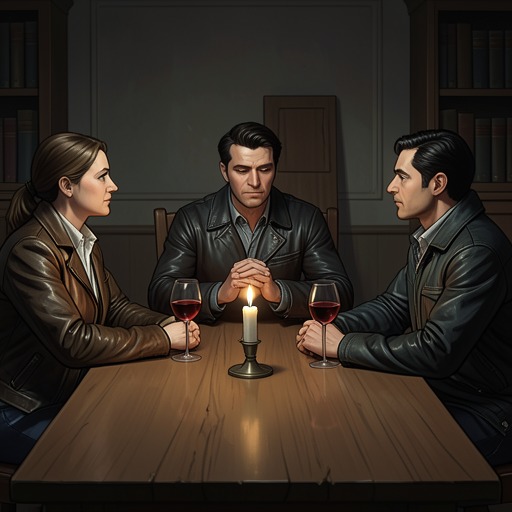
Kyle and Rack eventually agree to test whether the relationship can function with all three adults involved. Rack promises to respect the bond between Jenna and Kyle and to keep his own relationship with Jenna from becoming an attempt to displace her husband. Kyle retains the history and priority of the marriage, while Rack claims a separate and undeniable connection through love for Jenna and biological fatherhood. The physical staging of their reconciliation emphasizes both cooperation and possessiveness. Rack embraces Jenna, Kyle also holds her, and neither man immediately withdraws; Kyle tightens his grip as if asserting his place, while Rack repeats that he does not need to take Jenna away. The scene does not erase rivalry, but it converts rivalry into a negotiated household arrangement. Jenna remains the person around whom the agreement is organized, yet she is also the one who must manage the emotional pressure of both men. Jenna’s insistence that Kyle must be comfortable with Rack’s presence establishes the practical test of the open marriage. Permission to seek companionship elsewhere is no longer sufficient. Rack must be allowed into the shared life, and Kyle must tolerate a continuing presence rather than a temporary affair conducted at a safe distance. Kyle later leaves for work for about a month and entrusts Jenna’s immediate care to Rack. He tells Rack to take care of her, assures Jenna that he loves her, and admits that he has not been with anyone else and cannot bring himself to be with another woman. His departure reveals the unequal conditions that helped create the arrangement in the first place: Kyle’s work continues to remove him from the home, while Rack can provide the presence Kyle cannot. Kyle accepts that Rack may be part of their life as long as he respects the marriage and keeps Jenna safe and healthy, and he promises to explore ways of reducing his absences by delegating work or taking projects closer to home.
Meaning and Consequences
The Crowley arrangement treats marriage as more than sexual exclusivity. Kyle and Jenna attempt to preserve love, domestic priority, and a shared future while permitting outside sexual and romantic attachment. The rule concerning the bedroom gives the agreement a spatial boundary, but the pregnancy demonstrates that no boundary can keep consequences entirely outside the marriage. A partner may enter through sex, then through emotional attachment, and finally through parental responsibility. The arrangement also redistributes care. Kyle’s response is framed through love and willingness to compromise, but his absences leave Jenna needing companionship and Rack positioned to provide daily support. Rack’s promise to protect Jenna and remain involved with the child offers a practical answer to Kyle’s absence, while Kyle’s promise to reconsider his work commitments suggests that the marriage cannot survive on permission alone. Emotional care, physical presence, sexual freedom, and parental responsibility must all be renegotiated together. Open Marriage therefore remains an ongoing experiment rather than a neatly settled formula. Jenna receives the possibility of keeping the husband she loves without suppressing her need for intimacy; Rack receives recognition as both lover and father; and Kyle is asked to transform a private marital compromise into a durable three-person family arrangement. The narrative leaves the success of that arrangement dependent on continued consent, respect, safety, and the ability of all three adults to accept that preserving the original marriage may require changing what marriage means within their household.