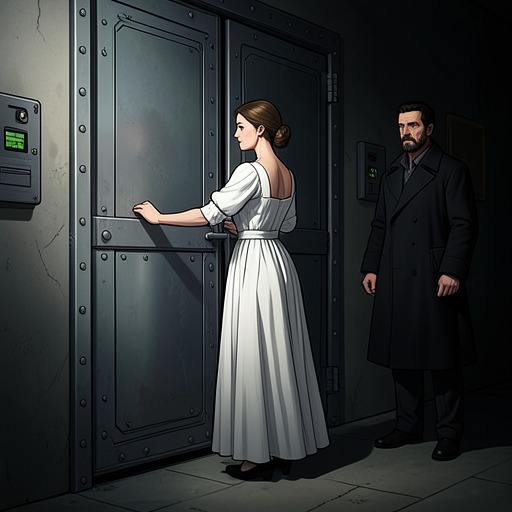
Kyle
SCOTTISH ROMANCE: My Sinful Surrender to a Highlander Werewolf (Scottish Werewolf Pregnancy Romance) (Historical Medieval Shape Shifter Paranormal Science Fiction Short Stories)Kyle’s decisive role in the narrative is that of an absent but emotionally committed husband who converts a threatened divorce into an open-marriage arrangement. His work keeps him away for long periods, yet his response to Jenna’s unhappiness is not abandonment: he tries to preserve their marriage, even when preserving it requires him to surrender the exclusivity he once assumed it possessed.
Identity and Marital Background
Kyle has been married to Jenna for three years when their relationship reaches a crisis. Jenna tells him that the urge to cheat has become overwhelming because he is so often away, and she is already contemplating divorce. The conflict is therefore not presented as a simple collapse of affection. Jenna still loves him, but the marriage no longer supplies the companionship and sexual presence she wants, while Kyle’s work continues to determine the practical rhythm of their lives.
Kyle’s position is defined by absence coupled with attachment. He recognizes that he cannot offer Jenna the daily presence she needs, and he does not pretend that affection alone erases that limitation. His willingness to discuss the problem directly distinguishes him from a husband who would simply demand obedience or treat Jenna’s desire as betrayal without context.
The Open-Marriage Agreement
Kyle’s solution is an explicit open-marriage agreement. He tells Jenna that he is willing to let her have human companionship and see how the arrangement works, since he is gone for extended periods and understands that she needs more than he can provide while away. The central condition is that other men may not enter the bedroom Kyle and Jenna share; Jenna may visit them elsewhere, but their marital bed remains reserved for the marriage.
The proposal is reciprocal in principle. Kyle acknowledges that he has sometimes been tempted as well and reasons that permission should work both ways. He frames the arrangement as a means of protecting the marriage rather than dissolving it, insisting that their relationship must remain primary even if other partners are involved. Jenna accepts, realizing that she no longer has to pack her belongings and leave as she had planned.
Kyle’s agreement is also a negotiation over boundaries and control. He does not abandon every claim to exclusivity: the bedroom rule preserves a symbolic and physical center for the marriage. At the same time, he accepts that intimacy can no longer be governed by a conventional one-partner structure. The arrangement is therefore both permissive and restrictive, replacing an absolute prohibition with rules intended to keep the original bond intact.
Rack, Pregnancy, and the Crisis of Consequences
Jenna later meets Rack because Kyle has given her permission to have a boyfriend. She admits that opening the marriage was the alternative to divorce and that she is uncertain whether she can even flirt with a stranger. Her uncertainty emphasizes that Kyle’s proposal has not made the emotional consequences simple; it has created a new set of choices Jenna must learn to inhabit.
When Jenna becomes pregnant by Rack, the theoretical arrangement becomes an irreversible family crisis. Kyle struggles with the shock and tells Jenna that she cannot impose such a situation on him without giving him time to process it. His reaction is not immediate approval, but neither is it an automatic demand for separation. He recognizes that he agreed to the open marriage without fully understanding its possible consequences, including the possibility that Jenna would conceive a child with another man.
Kyle then accepts a difficult responsibility. He tells Jenna that he loves her and is willing to make the relationship work even if it means sharing her with Rack. He also acknowledges that Jenna wanted children and apologizes for not being the husband or father she needed him to be. His words reveal that he interprets the pregnancy not only as a violation of expectation but as evidence of a need he had been unable to meet.
Kyle does not immediately claim Rack as a partner, but he is willing to get to know him and accept him for the sake of Jenna and the child. This is a significant shift from the bedroom boundary that originally organized the open marriage: the consequences of the arrangement force Kyle to consider not merely an outside sexual relationship, but a continuing domestic and emotional connection among three people.
Conduct as a Partner
Kyle’s care is most visible in the practical form it takes. In the established routine of another relationship in the book, Tate comes to his partner’s home after work, cooks dinner, shares the day with her, and continues his counselling training; that pattern provides a useful contrast to Kyle’s situation, because Kyle’s absence makes precisely this kind of ordinary companionship difficult for him to provide. Kyle’s problem is not indifference but the structural pressure of work and distance.
When he leaves again for approximately a month, Kyle tells Rack to take care of Jenna. He embraces Jenna, tells her that he loves her, and assures her that they will make the arrangement work. He also says that he has not been with anyone but Jenna and cannot bring himself to be with another woman. The open marriage thus does not reflect equal emotional behavior from both spouses: Kyle grants permission for Jenna’s outside relationship while remaining personally exclusive.
Kyle tries to reduce Jenna’s guilt by reminding her that he gave permission and that the arrangement was preferable to divorce. His condition is that Rack respect the existing relationship and keep Jenna safe and healthy. He treats care, fidelity to the agreed structure, and physical safety as the minimum obligations required of the new partner.
His departure is accompanied by a tentative plan for change. Kyle promises to begin figuring out how to make the arrangement sustainable and considers delegating work or taking on projects closer to home. The promise matters because it identifies the underlying problem as his unavailability rather than Jenna’s desire alone. He does not merely ask her to endure the same conditions; he considers altering the life that produced the crisis.
Relational and Thematic Significance
Kyle embodies the book’s recurring transformation of intimate life into negotiated contracts. Elsewhere, marriages are proposed as business deals, mail-order arrangements, inheritance strategies, or paid surrogacy agreements. Kyle’s marriage begins as a conventional bond but becomes an explicit contract of permission, reciprocity, and spatial boundaries when its old form no longer seems workable. Unlike arrangements centered primarily on money, citizenship, inheritance, or payment, his proposal is motivated by the preservation of an emotional relationship, although it still depends on clearly stated rules.
His conduct also complicates the distinction between protection and control. The bedroom prohibition limits Jenna’s conduct, but Kyle presents it as a shared boundary rather than an attempt to eliminate her outside relationship. After the pregnancy, he moves further toward an ethic of accommodation: he accepts that Rack may become part of their life, provided Jenna’s safety and the primacy of the marriage are respected.
Kyle’s attachment to Jenna is therefore expressed through flexibility rather than possession. He is hurt, confused, and aware that the arrangement may have consequences he failed to anticipate, but he does not reduce Jenna to either a wholly faithful wife or a wholly disloyal one. He holds together contradictory responses—love, fear, regret, jealousy, and willingness to adapt—and makes the marriage’s future depend on acknowledging all of them.
The available narrative leaves Kyle at the threshold of that new domestic structure rather than presenting a fully completed resolution. He departs for work while promising to return, reconsider his schedule, and learn how Rack might fit into their lives. His ending is consequently an open commitment: Kyle remains Jenna’s husband, accepts the pregnancy and the possibility of a three-person family, and begins the difficult work of turning an emergency compromise into a sustainable relationship.