Melonius
SCOTTISH ROMANCE: My Sinful Surrender to a Highlander Werewolf (Scottish Werewolf Pregnancy Romance) (Historical Medieval Shape Shifter Paranormal Science Fiction Short Stories)Melonius is the son of the vampire King John and a conflicted subordinate within the vampire-werewolf war. His importance lies less in independent power than in the friction he creates between John’s dynastic aggression and a more skeptical, unwilling conscience: he is ordered to help steal a human woman chosen as a werewolf leader’s mate, yet he openly questions both the strategy and the authority behind it.
Identity and Position
Melonius is identified as John’s son and is placed close enough to the vampire throne to receive sensitive assignments, but he does not appear to share his father’s certainty. When John orders the search for the human bride, Melonius asks why a human would benefit their side beyond provoking the werewolves. His objection recognizes that the proposed kidnapping is primarily an act of psychological and political warfare rather than a practical necessity.
His position is therefore divided. As the King’s son, he is expected to carry out royal decisions; as an individual, he sees the cost and absurdity of escalating a conflict over a mate. He also challenges the continuation of the war itself, telling John that the casualties on both sides are not worth the struggle and questioning the morality of stealing mates. This makes him a rare internal critic of the vampire leadership, even though his resistance remains verbal rather than openly rebellious.
The Search for the Werewolf Bride
John’s objective is to seize the human woman before the werewolves can transform her into a wolf. The King regards her selection as the princess bride of the werewolf pack leader and believes that taking her would damage werewolf leadership while allowing the vampires to penetrate their enemies’ political and emotional defenses. Melonius receives this explanation, but it does not resolve his doubts; instead, it confirms that the operation is designed to injure the opposing side by taking away a chosen mate.
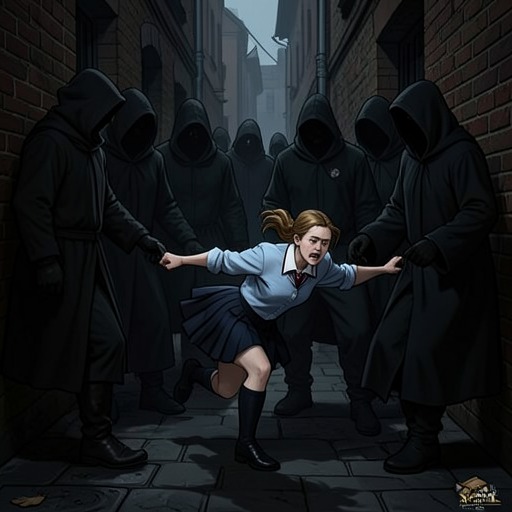
John places Melonius in charge of finding and bringing the woman back. Melonius then turns to Jesse with her picture and file, describing her as a werewolf princess or something similar and admitting that his father is having another of his royal tantrums. The assignment gives him operational responsibility without genuine authority: he must execute a plan he considers irrational while absorbing the consequences of his father’s decisions.
The planning becomes disturbingly concrete. Jesse proposes creating a distraction at the woman’s school, drugging her if necessary, moving her away from her guards and the school building, and preparing a vehicle for escape. Melonius accepts Jesse’s practical intelligence, calling him the brains, but the compliment also exposes his frustration. He says that he had wanted only to study music and has instead become his father’s errand boy. His assigned role thus conflicts sharply with his personal aspiration, and the abduction plan turns that conflict into a forced test of obedience.
Relationships and Conflict
Melonius’s central relationship is with John, whose authority he both depends on and resents. He addresses John as his father and challenges him as a son might challenge an unreasonable parent, but he does not yet possess the freedom to refuse. The language of filial obligation and royal command remains stronger than his protest. His complaint that everyone has a role until he learns to stand up to his father captures the limit of his agency: he understands the problem but has not broken the structure that produces it.
His relationship with Jesse is more collaborative and informal. Melonius brings Jesse the file and picture, while Jesse supplies the tactical planning that Melonius lacks or does not want to perform. Their exchange presents Melonius as self-aware and sarcastic rather than bloodthirsty. He can recognize Jesse’s usefulness, joke about his own predicament, and still walk away to consider how to proceed. The partnership helps him function inside the operation, but it does not erase his reluctance.
The broader conflict places Melonius between two incompatible accounts of the woman’s status. John treats her as a strategic prize whose abduction would injure werewolf leadership. Kale insists that she was selected as his son’s mate and therefore has an obligation, while John counters that she cannot be married to an unwilling mate and deserves the chance to live her own life. Melonius’s earlier question about why a human should be kidnapped aligns him more closely with the recognition that the woman is a person than with either faction’s claim that she is property or a political instrument.
Change and Narrative Role
The available evidence does not establish whether Melonius ultimately completes the kidnapping, rejects the assignment, or breaks with John. What it does establish is a character suspended at the threshold of resistance. He sees the war’s casualties, understands that the planned abduction is meant to provoke and weaken the werewolves, and identifies a personal life centered on music that royal service has displaced. Yet he still leaves to plan the next step after Jesse advises him on how to drug and extract the target.
That unresolved movement gives Melonius a distinctive narrative role. He is not presented simply as an antagonist carrying out vampire policy, nor as a fully liberated dissenter. He is the reluctant agent through whom the machinery of coercion becomes visible from within. His father’s command converts a son’s proximity to power into servitude, while the proposed abduction converts a human woman into a contested object. Melonius’s discomfort does not stop the machinery, but it makes its violence legible and preserves the possibility that obedience may eventually give way to judgment.
Thematic Significance
Melonius embodies the conflict between inherited authority and personal choice. John assumes that dynastic position authorizes him to direct his son and to treat another person’s mate-selection as a weapon. Melonius’s objections expose the weakness of that logic: the operation risks lives, intensifies an already destructive war, and depends on removing the woman’s ability to choose her own future.
His story also parallels the book’s recurring struggles over marriage, reproduction, inheritance, and bodily autonomy. Elsewhere, people are pressured to produce heirs, surrender children, accept arranged mates, or submit to breeding systems. Melonius occupies the opposite side of that coercive structure: he is not the immediate victim of the abduction, but he is recruited to enforce it. His reluctance shows that oppressive systems rely not only on rulers and formal rules but also on compromised intermediaries who recognize the humanity of those being controlled while continuing to serve the command.
The contrast between Melonius’s desire to study music and his forced role in planning a kidnapping gives the character a final note of unrealized possibility. He is capable of reflection, humor, and moral questioning, but the evidence leaves him before the decisive choice. His significance therefore rests in the tension he carries: a royal son who does not fully believe in the King’s war, an operative who dislikes the operation, and a potential dissenter who has not yet learned how to stand against his father.