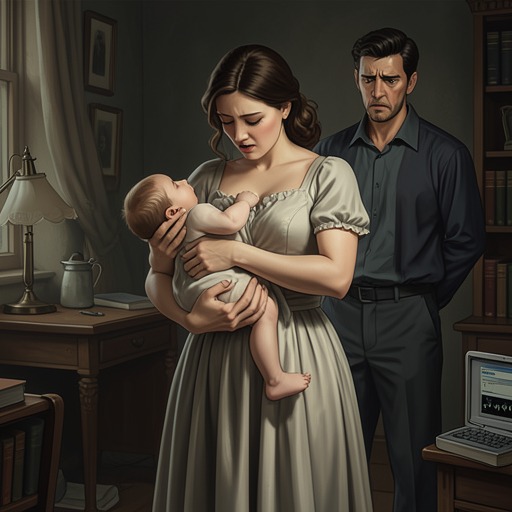
Polyamorous Family Arrangement
SCOTTISH ROMANCE: My Sinful Surrender to a Highlander Werewolf (Scottish Werewolf Pregnancy Romance) (Historical Medieval Shape Shifter Paranormal Science Fiction Short Stories)Polyamorous Family Arrangement is the three-person relationship established by Jenna, her husband Kyle, and Rack after Jenna becomes pregnant by Rack. It begins as an emotionally dangerous consequence of an open-marriage agreement but develops, through direct negotiation, into a tentative domestic arrangement founded on shared love, acknowledged parenthood, and the promise of continued honesty. The arrangement is significant because nobody is allowed to treat the pregnancy as an isolated sexual mistake: it forces all three adults to decide what marriage, partnership, and family will mean when affection does not remain exclusive.
Origins in an Open Marriage
Jenna’s relationship with Rack emerges from an existing agreement between Jenna and Kyle rather than from a secret plan to replace Kyle. When Jenna discovers that she is pregnant, Rack immediately tells her that she should keep the baby, that the two of them should raise it, and that she must tell her husband. His response gives the pregnancy a practical consequence: the child is not treated as a private burden belonging only to Jenna, but as a responsibility that requires disclosure and shared decision-making.
Jenna’s first reaction is confusion about what the pregnancy means for her marriage. She intends to tell Kyle in person when he returns, because the couple had never discussed how their arrangement would respond to a pregnancy. Rack offers to be present for that conversation and reassures her that he will not abandon her. He tells her that he loves her despite having known her for only a short time and that he is prepared to fight for a place in her life whether or not there is a baby. Jenna answers that she loves him too, while still loving Kyle, making simultaneous attachment rather than replacement the central emotional problem.
Rack does not demand that Jenna leave her husband. Instead, he acknowledges that she still loves Kyle and says he is willing to find a way forward if Kyle can remain open to it. That position establishes the arrangement’s basic principle: Rack seeks recognition within Jenna’s existing marriage, not the destruction of that marriage. His desired role is simultaneously romantic partner, biological father, and participant in the household’s future.
Negotiating Love, Marriage, and Parenthood
The decisive confrontation occurs when Kyle learns the situation. Rack states plainly that he loves Jenna and is willing to share her with Kyle. He promises not to interfere with their marriage unless Kyle no longer wants her, while also insisting that the child is his and that he wants to be part of its life. His proposal places emotional equality and parental responsibility alongside one another: he is not asking merely for sexual access, but for an enduring family role.
Jenna tells Kyle that she does not want a divorce and does not want to choose between the two men. She admits that the pregnancy was unplanned and accepts that Kyle may need time to decide whether he can remain in a relationship of this kind. At the same time, she sets a firm condition: if Kyle stays married to her, he must accept the child and become an active part of its life. The arrangement therefore depends not only on permission for Jenna’s relationship with Rack, but on Kyle’s willingness to recognize a child conceived outside the marital pair as part of his own family.
Kyle initially reacts with confusion and anger, but his response gradually shifts toward acceptance. He says he loves Jenna and would do anything to make the relationship work, including sharing her with another man. He acknowledges that he had agreed to the open arrangement without understanding its possible consequences and recognizes that Jenna wanted companionship and children. He also apologizes for not having been the husband or father she needed while his work kept him away. His acceptance is thus presented as both an expression of love and an admission that his earlier arrangement had carried responsibilities he had not fully imagined.
Kyle tells Rack that he is willing to get to know him and accept him for the sake of Jenna and the child, provided Jenna truly can handle loving them both. The language of family is made explicit when Jenna says that Kyle must also be the baby’s father in practice if their marriage is to continue. Rack, in turn, emphasizes that he has no desire to take Jenna away from Kyle. He respects the importance of their bond while asserting his own love and his right, as the child’s biological father, to remain involved.
From Conflict to Household
The arrangement becomes concrete through small acts of provisional cooperation rather than through a single declaration of certainty. Kyle and Rack initially face one another as rivals, and Kyle’s physical closeness to Jenna carries a possessive edge when he reminds Rack that she was his wife first. Yet Rack does not answer by challenging Kyle’s status. He repeats that he does not want to threaten the marriage, while Jenna insists that Rack must be permitted to remain present if the relationship is to work.
Kyle finally agrees to test the arrangement. He kisses Jenna and then invites Rack to join them, signaling that Rack’s presence is no longer being treated as an intrusion that must be hidden or expelled. The moment does not erase the awkwardness between the men; while sharing a shower with Jenna, they make a point of avoiding one another’s gaze. The scene therefore presents acceptance as a practice still under construction, marked by discomfort as well as willingness.
Kyle’s work soon requires him to leave again for approximately a month. Before departing, he tells Rack to take care of Jenna and assures her that he loves her, that he has never been with anyone but her, and that he is glad she found someone who could be present when he could not. He says that they will make the arrangement work and that he will try to reduce his absences by delegating or taking projects closer to home. His departure reveals one of the arrangement’s practical pressures: emotional consent must be matched by time, care, and daily availability.
Rack’s role is consequently defined through care as much as desire. He remains with Jenna when Kyle is away, accepts that she loves her husband, and promises to help make the new structure work. Jenna’s need is not framed solely as a wish for multiple romantic partners; it also involves companionship, support during pregnancy, and the creation of a household in which the child will have two committed male figures.
Emotional and Ethical Stakes
The arrangement tests several competing ideas of responsibility. Jenna’s pregnancy makes reproductive choice inseparable from relational consent: she did not intend to become pregnant, but she refuses to treat the child as disposable or to conceal the circumstances from Kyle. Rack supports her decision to keep the baby and accepts the consequences of fatherhood. Kyle must decide whether marital fidelity is defined by sexual exclusivity or by continued honesty, commitment, and participation in family life.
The emotional labor of stabilizing the arrangement falls heavily on the three participants. Jenna must disclose the pregnancy, withstand the possibility of divorce, and articulate conditions that protect both her marriage and her child. Rack comforts her when she cries, tells her that she will not face the situation alone, and offers to participate in difficult conversations. Kyle must process jealousy, revise his understanding of the open-marriage agreement, and confront his own absences. The arrangement can survive only if these forms of care are recognized as shared obligations rather than left to Jenna alone.
Jenna ultimately believes that she can love both men without treating that love as a contradiction that must be resolved by choosing one. She hopes Kyle will learn to accept and love Rack and that Rack will be able to get along with Kyle. The story does not portray the household as automatically secure; Jenna specifically worries about keeping the relationship healthy and strong once a baby is involved. Its ethical foundation is therefore conditional, resting on honesty, mutual effort, respect for existing bonds, and active care for the child.
Ending and Narrative Significance
By the ending, Kyle has accepted that Rack will remain part of their lives, while Rack has reaffirmed that he understood the risk of loving a married woman who still loved her husband. Jenna falls asleep content after both men have agreed, in different ways, to attempt the relationship. The conclusion offers a hopeful but qualified future rather than a claim that jealousy or logistical difficulties have disappeared.
Polyamorous Family Arrangement transforms what could have been a conventional romantic triangle into a negotiated family model. Its structure depends on preserving rather than erasing pre-existing love: Kyle remains Jenna’s husband, Rack remains her lover and the child’s biological father, and Jenna refuses to reduce either relationship to a temporary mistake. The final promise is not that the arrangement will be easy, but that it may endure if all three remain honest and continue trying to stay aligned.