Racial and social discrimination
SCOTTISH ROMANCE: My Sinful Surrender to a Highlander Werewolf (Scottish Werewolf Pregnancy Romance) (Historical Medieval Shape Shifter Paranormal Science Fiction Short Stories)Racial and social discrimination functions throughout the novel as a system that turns visible difference and social position into unequal treatment. It appears in direct racial hostility, assumptions about who belongs in particular occupations or relationships, color-based assignment of labor, and institutions that treat marginalized people as exploitable bodies. At the same time, the narrative repeatedly gives those targeted by such judgments a voice, a desire, and a capacity to resist the roles imposed on them.
Gendered and Social Boundaries
The social order frequently marks certain pursuits as belonging to men and treats female ambition as an intrusion. When Sky considers becoming an MMA promoter and gym owner after losing her car-sales job, Owen warns that the sport is predominantly male and questions whether anyone will take her seriously. Sky nevertheless intends not only to compete but also to bring women and men into the same arena to train for competition. Her determination challenges a gendered division of work and physical authority: the objection is framed as concern for her safety, but it also exposes the assumption that a woman must justify entering a dangerous public sphere in a way a man would not.
Other scenes make the same hierarchy more intimate and theatrical. Draco approaches Taylor wearing only a tightly cinched bathrobe while she tries to maintain composure, placing male sexual display and female discomfort within a socially unequal encounter. Mercy, meanwhile, refuses the reputation assigned to her by prospective husbands. Her grandfather says that people either laugh at her name or panic and run, while Mercy insists that people should be able to handle her forthright nature and proposes presenting marriage as a business arrangement to someone who has not already heard the local gossip. Her resistance does not erase the social judgment surrounding her, but it denies that a woman must soften her speech to become acceptable.
The novel also contrasts conventional masculine expectations with men who occupy gentler or more domestic positions. Sloan treats Amy with patience, serves her coffee, offers horseback riding, and appreciates her hearty appetite, while their relationship is simultaneously constrained by the will's demand that they marry and become pregnant within six months. The contrast shows how gender expectations are attached not only to bodies but also to conduct: kindness and care can unsettle the assumptions by which people are evaluated, even when legal and family structures continue to impose reproductive conditions.
Race, Color, and Social Classification
Opal's history presents racial discrimination as a material arrangement of labor, visibility, and vulnerability. Because her mother was Haitian and her father was Native American, her lighter skin distinguished her from workers with darker ebony skin and helped determine that she would be moved from plantation labor into domestic work. The apparent privilege of working inside the house does not amount to freedom. She sleeps in the sheds with the other workers, witnesses people being bought and sold, and endures men in the household treating her body as available for their use. Colorism therefore operates within an already coercive system, sorting workers into different forms of exploitation rather than granting genuine protection.
Opal's family history intensifies that dispossession. Her father disappeared into the forest, her mother was sold away when Opal was young, and the fellow workers became her only family of sorts. Her escape is consequently both a flight from enslavement and a separation from the community that sustained her. After hiding in a tree in rural Arkansas while men searched and dogs bayed below, she understands that remaining in the South could leave her vulnerable to anyone who regarded a fugitive as free for the taking. Her dream of a small home, vegetable garden, and chickens is modest, but its modesty measures the scale of what the social order has denied her: not luxury, but ownership of her own life.
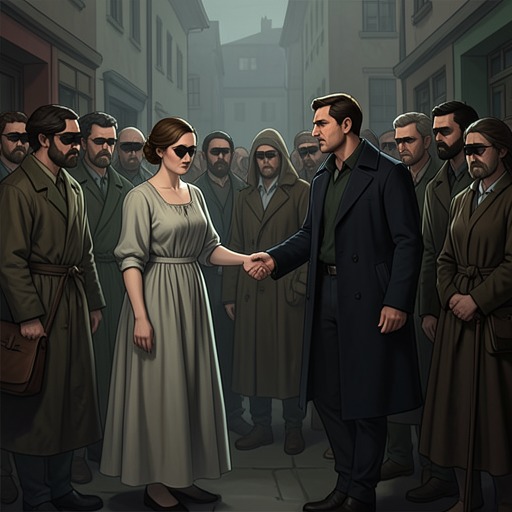
The racial hostility Opal encounters after reaching William's protection is explicit. A rough man insinuates that a white man keeping a colored woman in the house must have an improper motive and suggests that she is a runaway. William rejects the premise that Opal is something he can possess, insisting that she is his employee and must be treated with respect. His response is important because it changes the language of the encounter from ownership to employment, even though the surrounding society continues to view Opal through racial suspicion and the legacy of slavery. The confrontation makes clear that discrimination is sustained not only by individual cruelty but also by a vocabulary that reduces a person to property, sexual access, or presumed criminality.
Race also shapes the possibility of intimacy across distance and class. Lilly corresponds for months with a white man from the United States and worries about how her mother would react. She is uncertain how to discuss finances, yet recognizes that a man willing to correspond with her may be better off than she is. Her question about becoming a mail-order bride is therefore inseparable from economic inequality, cultural difference, and the risk that romance may reproduce a transaction. The narrative presents her uncertainty as more than personal shyness: she is negotiating the social meanings attached to race, nationality, poverty, and marriage.
Institutions of Marriage, Inheritance, and Reproduction
Discrimination in the novel is often embedded in rules that appear neutral because they apply to an entire family or community. William learns that he cannot fully control his family's estate, home property, and business unless he marries and produces an heir. The stipulation does not care whether the heir is male or female, but it still treats marriage and reproduction as conditions of property ownership. His career-centered life becomes legally inadequate because the inheritance system defines a complete adult future through marriage and succession. Amy faces a related arrangement when Sloan explains that the will requires pregnancy within six months of marriage. Her willingness to consider children is personal, but the timing and conditions originate in an external inheritance structure.
These requirements distribute reproductive risk unevenly. Kember understands the difference between donating eggs and carrying a child to term before surrendering it after birth. She fears the bodily changes, the attachment formed by pregnancy and holding the baby, and the possibility of being unable to keep the child. Dennis responds by asking her to become the mother of his child within a two-parent relationship, partly because it is difficult to find a Black surrogate or donor eggs. His proposal recognizes her as someone specifically desired, but it also reveals how race enters reproductive arrangements as a scarce and valued category. Kember is not merely choosing whether to help; she is deciding whether an arrangement made around her racial identity and reproductive capacity can protect her emotional and parental claims.
Other species and social systems make reproductive control even more severe. Maggie learns that the Watchers select one person from each human community every year. Those chosen may become slaves, while others are used for breeding in an attempt to integrate Watcher genes into humanity and create a super being. The Watchers provide technology, healing, and environmental control, but their benefits are tied to a compulsory human offering. On the Watchers' planet, enslaved humans work in fields, serve as carpenters, and attend to every need of their masters, with little protection from violent disposal. The arrangement is therefore both colonial and biological: humans are useful as labor and as genetic material, while Watcher superiority defines human weakness as a failure deserving punishment.
Dawn confronts a similarly coercive reproductive order when Borg demands to know whether she is pregnant. Her pregnancy could fulfill Uth's request, but Borg explains that tests would determine the father, that custody would belong to the father on their planet, and that Dawn, as a nonhuman slave, would have no rights. Her body is caught among species law, male authority, and competing claims to offspring. The question of paternity is not simply personal; it determines custody, status, and whether Dawn can be recognized as a parent at all. These episodes connect racial and social discrimination to reproductive justice by showing who is allowed to choose, who is selected, and whose relationship to a child can be legally erased.
Resistance, Recognition, and Narrative Significance
Against these structures, the novel repeatedly stages recognition as a practical act rather than a sentimental idea. Sky claims the right to enter a male-dominated profession; Mercy refuses to apologize for the voice that makes others uncomfortable; Kember questions whether compensation can justify surrendering a child; and Opal chooses flight over returning to a household where her freedom could be taken again. Their resistance differs in scale, but each challenges a social classification that presents itself as inevitable.
The narrative also exposes the instability of the categories used to rank people. William's wealth and authority can place him on the powerful side of a racial confrontation, yet his defense of Opal rejects the language of possession. Sloan's contractual marriage begins as an inheritance requirement, but his considerate conduct complicates the stereotype of the domineering patriarch. Valerie's account of being turned to cure a brain tumor reveals another form of unequal bodily dependence: she is indebted to the man who saved her life and may accept becoming his mate without loving him. Across these episodes, care, desire, law, and coercion cannot be cleanly separated, because social conditions determine which choices are available and what price accompanies them.
Racial and social discrimination is consequently not a single prejudice or isolated insult. It is a recurring structure connecting the plantation, the family estate, the dating market, the gym, the marriage contract, and the alien breeding program. The novel's most forceful reversals occur when a person treated as a category insists on being encountered as an individual: Opal as an employee rather than property, Sky as a fighter and owner rather than an intruder, Lilly as a woman making a precarious decision rather than a commodity, and Maggie or Dawn as persons whose bodies cannot be reduced to communal quotas. The persistence of these conflicts gives the state its central significance: social identity is repeatedly used to justify control, while acts of speech, escape, refusal, and recognition open limited but consequential spaces of autonomy.