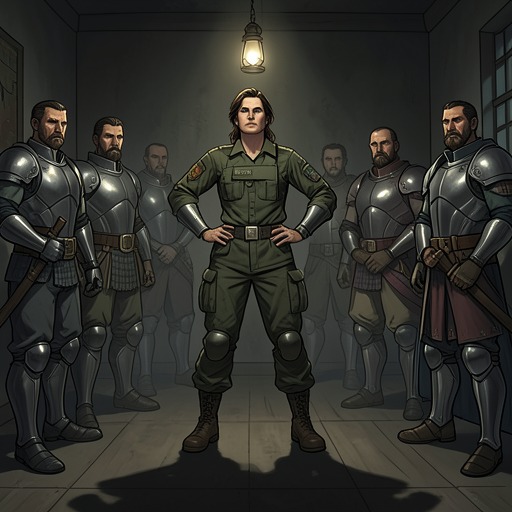
Sky Williams
SCOTTISH ROMANCE: My Sinful Surrender to a Highlander Werewolf (Scottish Werewolf Pregnancy Romance) (Historical Medieval Shape Shifter Paranormal Science Fiction Short Stories)Sky Williams’s decisive significance lies in the way she converts an uncertain life into a public challenge to the gender boundaries of mixed martial arts. After losing her job selling cars, she refuses to remain directionless: she seeks a bank loan, acquires a deteriorating gym, plans to train women and men together, and then enters competition herself. Her ambition is not merely to own a venue but to make female participation visible, credible, and commercially viable in a field that initially treats her as an intruder.
Identity and Background
Sky begins from a position of financial and professional instability. Her savings are limited, and the small loan secured from the bank is only a beginning, yet she accepts the danger of investing what she has in a gym that needs renovation. Owen warns her that the sport is predominantly male, physically dangerous, and unlikely to take a woman seriously as either promoter or owner. His concern identifies the practical stakes of her decision, while Sky’s response establishes the stubbornness that governs her character: she recognizes the risk but sees it as preferable to drifting without a purpose.
Her inspiration comes from watching Rhonda Rousey succeed in the ring. Sky does not simply want to imitate a famous fighter or participate in an exclusively female division. She imagines an arena in which women and men can train together and compete within the same broader fighting culture. That vision makes her ambition both personal and institutional. She wants to fight, but she also wants to alter who is allowed to belong in the gym and who is presumed capable of enduring its demands.
Building the Gym and Its Public Meaning
Sky completes the purchase only after inspecting the entire premises from top to bottom. The gym looks as though it is falling apart, but she determines that its deficiencies are largely cosmetic and that minor renovations can make the enterprise workable. The old owner confirms that existing members initially scoff at the idea of a woman becoming their new owner; his blessing helps persuade them to give her a chance, but the burden of proving the gym’s future remains hers.
She approaches the business with more than enthusiasm. Sky prepares a prospectus and preliminary financial projections, describes promotional resources that could make the gym appear first in Google searches, and hopes to secure opportunities connected with pay-per-view events, including the possibility of televising local semifinals. Her numbers are deliberately conservative, and she expects the operation to triple its projected performance by the end of the third year. The commercial plan therefore functions as a second form of resistance: she answers assumptions about female incompetence with preparation, market strategy, and a willingness to risk her own capital.
The newly installed octagon becomes the gym’s most visible material sign of change. It costs a substantial amount, but Sky believes it will repay the investment through future returns. When she stands at the entrance in jeans and a denim shirt tied at the waist, she is presenting herself as the person in charge of an MMA enterprise rather than asking permission to enter one. The setting’s transformation and her own public posture develop together; ownership becomes credible only when it is tested before the skeptical men gathered around the cage.
Training Under Brandon Summer
Sky’s business proposal contains a deliberate trap for Brandon Summer. Before he decides whether to invest, she asks him to train a woman of the opposite sex and push that trainee beyond her limits. She then identifies herself as the candidate. Brandon expects that he can throw her around and make her quit on the first day, while Sky turns his confidence into a wager: if he makes her quit, he will receive twenty percent of the profits instead of the proposed ten percent; if she goes the distance and reaches her first MMA fight in under two months, his share falls to five percent.
The first lesson is deliberately punishing. Brandon’s opening strike catches the side of Sky’s head and sends her against the chain-link fence, followed by a straight kick to her stomach that lifts her onto her hands and knees. His command that she get up and do something about the pain makes the training’s value unmistakable: the question is not whether she can avoid hardship, but whether hardship can force her out of the ring. Sky responds by attacking his lower body. When he drives both hands into her back, she holds on, turns slightly, and uses a move she studied on the Internet the previous night to take him off his feet.
The reversal does not make her the superior fighter, but it changes Brandon’s perception. He admits that she has found a new trick and recognizes that the novice can surprise an experienced trainer. Sky cares less about the concession than about the new image reflected in his surprised eyes: for the first time, she feels like a fighter. Her progress is thus built from endurance and observation rather than an implausible instant transformation. She absorbs punishment, studies technique, and converts a remembered movement into a practical answer under pressure.
First Fight and Personal Commitment
Sky’s first opponent is known as the Crusher, a nickname whose meaning becomes clear when the fight begins. Though Sky has no substantial record and is treated as a joke by an opponent who expects an easy victory, she enters with Brandon in her corner. He tapes her wrist and privately reveals that she is special to him and that he does not want to lose her. He presents a large diamond ring, and Sky accepts the engagement immediately, while asking him to keep the news private until the surrounding publicity settles.
The engagement complicates rather than replaces her public objective. Sky does not want the gym’s promotion to be defined by the couple’s happiness; she wants attention to come from what the venue and its fighters accomplish. The ring is therefore both a sign of Brandon’s emotional change and a secret held beneath the commercial surface of her debut. Brandon, once characterized as callous and interested in successive conquests, now demonstrates commitment through the ring, while Sky interprets that change as evidence that her influence has helped make him a better man.
Inside the octagon, the Crusher quickly puts Sky in a rear chokehold, with one hand pressing on her forehead and a forearm cutting off her oxygen. Sky escapes not by overpowering the hold directly but by using the enclosure and her body intelligently: she slams the Crusher repeatedly against the chain, bends at the waist, and flips her opponent over the top of her. Once the contact breaks, Sky moves into a triangle hold. The Crusher struggles, but increased pressure forces her to tap out, and the referee stops the contest after less than five minutes.
The result overturns the expected hierarchy. Sky’s lack of an established record suggests vulnerability, yet her rapid use of the technique Brandon demonstrated shocks both her opponent and the observers. The Crusher responds with sportsmanship, shakes Sky’s hand, and tells her that she has a future. This recognition matters because it comes from the fighter Sky has just defeated, not merely from Brandon, whose investment in her is personal as well as professional. Her victory gives the gym a credible inaugural spectacle and turns skepticism into the possibility of wider acceptance.
Change, Relationships, and Narrative Role
Sky’s trajectory is organized around a repeated refusal to surrender. Owen sees that refusal as part of her nature, even joking that she should have been born a man because she possesses the attitude, fire, and readiness to defend herself physically. Sky’s own ideal is more disciplined than simple aggression: she knows she can fight dirty, but wants to learn how to defeat opponents without hurting them unnecessarily. The distinction separates her from a caricature of toughness. She seeks mastery, control, and legitimate technique rather than violence for its own sake.
Her relationship with Brandon develops through conflict before it becomes intimate and committed. He begins as the skeptical trainer and potential investor whose authority could exclude her, but the wager forces him to treat her as a serious trainee. Their physical training becomes intertwined with a sexual relationship, and Sky expects that she will become pregnant while continuing toward the ring. Even under that new personal consequence, she refuses to abandon competition. The narrative therefore binds her reproductive future, romantic commitment, business ownership, and athletic ambition together rather than allowing any one of them to erase the others.
As a character, Sky is more rounded than a simple underdog emblem. She is financially cautious enough to inspect the gym, prepare projections, and negotiate percentages, yet audacious enough to stake her remaining resources on an unconventional enterprise. She is receptive to instruction but not submissive to the identity assigned by a male trainer or skeptical customers. Her first victory does not prove that gender barriers have disappeared; it proves that the barriers can be confronted through preparation, endurance, and a performance that opponents cannot dismiss. Sky’s story consequently joins an underdog plot with a transformation plot: the former car salesperson becomes an owner and a recognized fighter, while her success gives the newly mixed gym a future beyond the assumptions that first defined it.