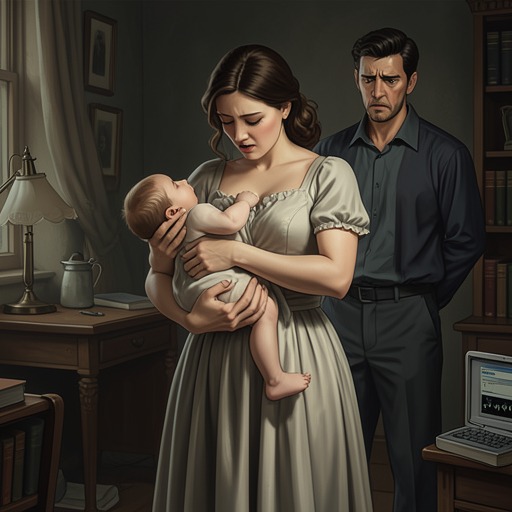
Sloan Tiller inheritance stipulation
SCOTTISH ROMANCE: My Sinful Surrender to a Highlander Werewolf (Scottish Werewolf Pregnancy Romance) (Historical Medieval Shape Shifter Paranormal Science Fiction Short Stories)The Sloan Tiller inheritance stipulation is the decisive mechanism that converts Sloan Tiller’s succession into a timed marriage-and-childbearing contract. After his parents die in a car crash, Sloan, their only heir, can preserve the family company only by marrying and becoming a father within six months. The condition forces him to leave a twenty-year military career he does not truly want to abandon and to treat romance, fertility, inheritance, and corporate continuity as parts of one urgent transaction.
Origin and Purpose
The stipulation survives because Sloan Tiller’s parents expected him to be married and to have a child before their deaths, yet never changed their will when his life took another direction. The document therefore becomes binding at precisely the moment when he is least prepared to satisfy it. The requirement is not merely that he marry; he must also produce an heir within a defined period, so the family’s property and business remain under dynastic control rather than passing into uncertainty.
The arrangement reflects a broader protective logic within the family. The will treats an heir as insurance that the estate, home property, and business will remain within the family. Sloan’s career-focused life had left little room for relationships or children, but the inheritance condition makes those previously optional parts of adulthood immediate obligations. His parents’ expectations thus continue to govern him after their death, turning grief and succession into a legal demand for reproduction.
Operation of the Requirement
The condition requires Sloan to marry and become pregnant with his spouse within six months of the marriage. When Amy asks directly whether the will requires a baby, Sloan explains that the couple is expected to be pregnant within that period. He assumes that infertility would not automatically end the arrangement if medical intervention were needed and the couple were actively trying to resolve the problem, showing that the stipulation values demonstrable reproductive effort as well as the eventual child.
The requirement places reproductive risk and decision-making at the center of the proposed relationship. Amy has regular cycles, is not using birth control, and has long liked children; as a teacher, she understands parenthood as part of the life she wants. Yet she has not previously imagined herself pregnant with a child of her own, and the six-month deadline makes that possibility suddenly concrete. Sloan, for his part, says he is open to having children but admits that the accelerated timetable exists because of the will and because he is no longer getting younger.
Contractual Marriage and Negotiation
Because the stipulation makes ordinary courtship impractical, Sloan considers finding a spouse online. His lawyer presents an online bride as a potentially workable solution, and the proposed arrangement is framed explicitly as a business deal. The spouse would receive transportation, citizenship, and material care; in exchange, she would remain married to Sloan for at least ten years and bear a child. The planned contract would also prevent her from claiming any share of the estate, preserving the family’s property while assigning her the bodily and legal obligations required by the inheritance scheme.
This logic parallels other marriage arrangements in the narrative. Abigail describes marrying a rich American so that he can inherit his family fortune, then divorcing him and using money from the arrangement to begin a business. Emma leaves England to become a mail-order bride for Lucas, hoping to escape the painful reminders and financial pressure left by a house fire and the loss of her family. Jenna’s open marriage is likewise presented as a negotiated alternative to divorce when her husband’s work keeps him away. These cases place marriage beside citizenship, money, security, escape, and inheritance, making the Sloan condition part of a recurring world in which intimacy is organized through explicit exchange.
Amy and the Human Cost of the Will
Amy does not accept the stipulation passively. She asks whether Sloan wants children independently of the inheritance, and he must distinguish personal willingness from parental compulsion. Their conversation gives the rule an intimate human dimension: Sloan reaches across the breakfast table and asks whether she can truly undertake the arrangement, while Amy answers that she likes him, his house, and his dog, wants children, and believes their chemistry might grow beyond friendship. She nevertheless insists on sleeping with him before marriage so that she can test whether the physical relationship is something she can accept before binding herself legally.
Her bluntness exposes the asymmetry beneath the apparent bargain. Sloan risks losing control of a company and estate, but Amy would bear the immediate bodily consequences of the deadline. She is asked not only to marry a stranger but also to become pregnant on a schedule designed by dead parents and enforced through inheritance law. The condition therefore makes consent more complicated than a simple yes or no: Amy has meaningful bargaining power because she can refuse, yet the arrangement is attractive precisely because the will concentrates wealth, status, and urgency on Sloan’s side.
Wider Reproductive and Legal Pattern
The stipulation belongs to a larger pattern in which reproduction is used to secure property, identity, social belonging, or species survival. Kember initially considers paid surrogacy but fears the emotional cost of carrying a child, bonding with it, and surrendering it after birth; Dennis responds by offering a two-parent relationship so she can remain the child’s mother. Valerie accepts a lifelong mate obligation after being turned into a vampire to save her from a fatal brain tumor, understanding the relationship as a debt for survival rather than as love. Dawn faces an even harsher system in which pregnancy may determine custody while her status as a human slave leaves her without rights.
The Sloan condition is less openly violent than the Watchers’ breeding program, which uses selected humans as slaves or breeding subjects in an attempt to integrate Watcher genes into humanity. Even so, both systems treat reproduction as an institutional resource and place control over a person’s body inside a larger political or economic structure. The difference is that Sloan’s prospective spouse can negotiate terms, while the Watchers’ victims are selected and compelled. Across these variations, the stipulation dramatizes the conflict between reproductive autonomy and obligations imposed by inheritance, wealth, marriage, or collective continuity.
Narrative Significance
As a plot device, the Sloan Tiller inheritance stipulation supplies a precise countdown and a built-in contradiction: Sloan needs a marriage that appears stable enough to satisfy the will, yet the very contractual logic used to arrange it threatens the emotional trust required for a lasting family. The six-month limit turns a conventional inheritance problem into a test of whether a relationship can move from transaction to attachment before legal necessity overwhelms personal choice.
Its most important effect is thematic. The will insists that family can be secured through paperwork, property protection, and a biological heir, while the surrounding relationships repeatedly show that care, parenthood, and belonging cannot be guaranteed by a clause alone. Sloan may satisfy the document through marriage and pregnancy, but the condition cannot by itself create affection, mutual desire, or a genuinely shared family life. In that gap between legal inheritance and lived intimacy, the rule becomes the central pressure that drives Sloan and Amy’s story.