
The Founder’s Hidden Parentage
SatanThis flow follows the evidence that may connect Élie D’Anjou to the Castelmont twins, from an infant’s rescue in Missouri to the unresolved modern claim.
increasing Bearing strength in each event
 decreasing
Bearing strength in each eventdecreasingA Child Rescued
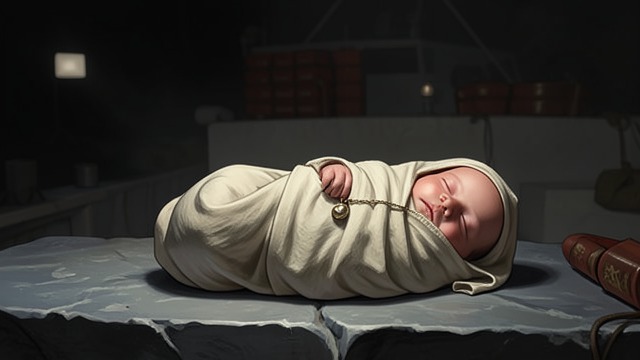
A Child Rescued
The sisters find an infant
A Jesuit account describes a baby found alive in the snow beside a dead young woman who had used her own clothing to protect him. A cameo was attached to the child’s swaddling clothes.
Adoption obscures origins
The child is baptized and adopted by a French-Canadian couple named D’Anjou. The record gives the future founder a name and family, but not the identity of his mother or the circumstances of his rescue.
A Rancher’s Identity
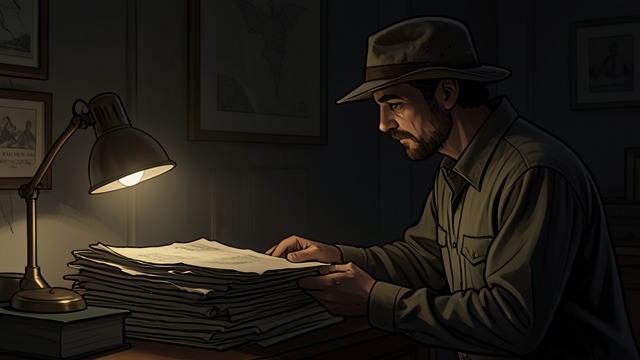
A Rancher’s Identity
Newspaper traces
Loïc finds a report of an attack on the ranch of a man named Castlemount, followed by an official denial that bodies had been found. The altered account suggests suppression or confusion, not a reliable identification.
The ancestry hypothesis
Because the name resembles the French Castelmont, Loïc considers whether the rescued infant could have been the rancher’s child. The theory explains the cameo’s presence but cannot establish the woman’s identity or the child’s parentage.
Twins Divided by Revolution

Twins Divided by Revolution
A royal gift
Delphine de Castelmont receives paired cameos associated with Louis XVI and entrusts one to each twin son before her execution. Louis and Charles escape France separately as the family is destroyed.
A lasting rivalry
Louis eventually travels to America, while Charles restores his position in France. Their struggle over inheritance supplies a possible motive for the 1842 Missouri raid, though Loïc finds no conclusive proof that Charles ordered it.
The Paris Pair

The Paris Pair
A missing twin recognized
Régis D’Anjou sees a photograph and engraving at Christie’s that resemble the family cameo and its undamaged twin. The display identifies the pair as having belonged to the collection of the Regent.
A historical lead
The exhibition gives Régis a strong European provenance for the object and suggests that the missing stone is Castor. It also attracts the attention of Victor Bourdieu, whose interest helps set later schemes in motion.
An Unsettled Claim
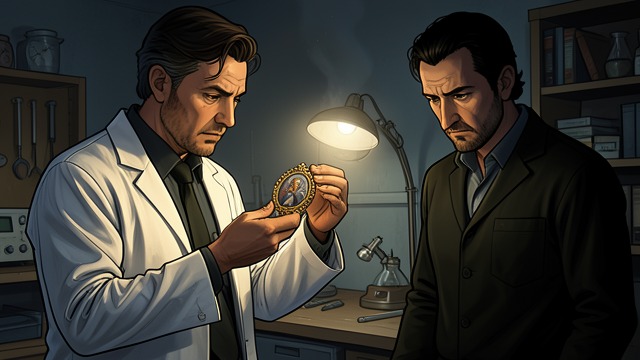
An Unsettled Claim
A genetic proposal
Mathieu D’Anjou proposes DNA testing to establish whether the Canadian family descends from the Castelmont line. Charles de Castelmont rejects the family’s evidence and treats the returned cameo as a counterfeit.
Proof remains incomplete
Later photographs show that the New York replacement is itself a copy, so neither claimant can rely on it as a definitive ancestral link. The lineage remains plausible, consequential, and unresolved.
November 1842 near Florissant
1842, reconstructed during Loïc’s research
1793 to the early nineteenth century
May 1996
2011 to 2016
