1969 Belfast riots and residents' displacement
Say NothingThe 1969 Belfast riots and residents' displacement turned a civil-rights crisis into a rupture in the city’s everyday geography. Violence spreading from Derry engulfed Catholic neighbourhoods, while residents built barricades, lost homes to fire, and fled in large numbers. The McConville family’s successive moves—from their threatened home to a relative’s house, a makeshift shelter, and finally new housing—trace the cost of that upheaval at household scale. The riots did not simply damage buildings: they made belonging, safety, and the right to remain in one’s home immediate questions, with consequences that outlasted the streets’ first fires.
Background and Escalation
On 1 January 1969, student protesters assembled at Donegall Square in Belfast to begin a march to Derry. Their protest challenged discrimination against Catholics in Northern Ireland, where Catholics were excluded from good jobs and housing and lacked access to executive power at Stormont. The marchers hoped that peaceful protest might expose injustice and change public opinion. As they crossed unionist strongholds, local men blocked their route, while police accompanying the march diverted it around villages. Some of Major Bunting’s men taunted the marchers; the presence of a Lambeg drum helped summon counterprotesters. By the march’s final day, hundreds were on the road, and the marchers openly accepted the possibility of being hurt. The hope that young people could redraw the conflict’s lines through nonviolent action stood against the mounting threat of physical attack.
Later in 1969, the Apprentice Boys’ annual march in Derry commemorated the Protestant defenders who had shut the city gates against Catholic forces in 1688. This year, the march’s traditional provocations against the Catholic Bogside were met with resistance, and the resulting Battle of the Bogside became the immediate trigger for violence spreading to Belfast. The sequence joined an existing dispute over discrimination to street confrontations in which religious and political divisions shaped who was threatened and who felt protected.
Riots and Flight from Home
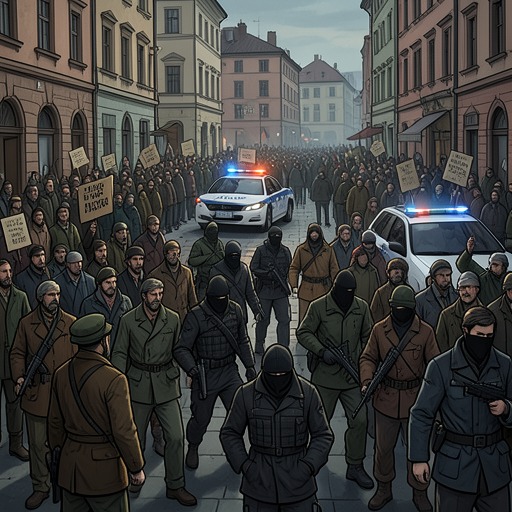
As news from Derry reached Belfast, Protestant gangs broke windows and set fire to homes in Catholic neighbourhoods; Catholics fought back with stones, bottles, and Molotov cocktails. Catholics complained that the Royal Ulster Constabulary and the B-Specials bore down on their communities while standing by as loyalists committed crimes. In response, residents turned school buses and bread vans onto their sides to block streets. They prised up paving stones for barricades or to throw at police, while the Royal Ulster Constabulary sent squat armoured vehicles known as Pigs through the narrow roads. Stones struck the vehicles; petrol bombs burst on their steel bonnets, flames spreading over the metal.
Attacks moved systematically through Bombay Street, Waterville Street, Kashmir Road, and other Catholic enclaves. Loyalist gangs smashed windows and threw petrol bombs inside, gutting hundreds of homes and forcing their occupants out. Families prepared for attack as if for a hurricane: they boarded windows, moved old furniture away from the front room, and gathered in back kitchens while grandparents held their rosaries. Nearly two thousand Belfast families fled their homes that summer, overwhelmingly Catholic. The city had about 350,000 residents, and over the following years as many as one in ten would relocate. Some families were driven out by mobs; others received a note giving them an hour to leave. They crowded into cars bound for safety, and thousands of Catholics eventually queued at the railway station for southbound trains to the Republic of Ireland.
The flight of Jean McConville, Arthur McConville, and their children gives this mass displacement a particular route and sequence. Local men told Arthur that he had to leave, and he slipped away under cover of darkness to his mother’s house. Jean and the children stayed at first, hoping tensions would ease, but eventually packed what they could into a taxi. The city they crossed was a landscape of hurried removals and damaged streets: lorries carried salvaged furniture, cars burned at intersections, firebombed schools smouldered, and broken traffic lights left young civilians directing traffic. Sixty commandeered buses formed barricades, marking new physical lines between ethnic strongholds. The rubble and glass gave the scene its later poetic shorthand, ‘Belfast confetti’.
The McConvilles’ Displacement
Fear constrained even the family’s attempt to reach safety. Their taxi driver refused to carry them beyond the Falls Road, so Jean and the children had to haul their belongings the remaining distance on foot. They reunited with Arthur at his mother’s house, but the refuge was precarious: there was only one bedroom, Jean and her mother-in-law did not get along, gun battles took place nearby, and the family feared that a timber yard behind the house might catch fire and spread the blaze. They moved again, this time into a Catholic school converted into a temporary shelter, where they slept on a classroom floor.
The housing authority was constructing temporary accommodation for the thousands newly displaced, but a promised chalet did not guarantee a home. Squatters had occupied the first chalet before the McConvilles arrived; at a second, another family was already living there and refused to leave. For the next one on Divis Street, Arthur stayed with the workmen until construction was finished so nobody else could get in first. The four-room chalet had an outside toilet, but it was the first place the family could legitimately call their own. Jean went out to buy material for curtains, a small act of settling into a home after repeated flight. The family remained there until February 1970, when it was offered permanent accommodation in Divis Flats.
That move brought refuge within a housing scheme intended to replace overcrowded nineteenth-century streets. Built as part of a slum-clearance programme, Divis Flats comprised twelve interconnected blocks and 850 units. Its modern amenities, including showers and indoor toilets, promised a striking improvement over the family’s temporary chalet. Yet the flats also altered the neighbourhood’s physical scale, looming over the surrounding area. The displacement crisis thus led the McConvilles from sudden homelessness into planned redevelopment: relief from immediate danger was real, but it came through the remaking of the city as well as the loss of their former home.
Political Afterlives and Contested Memory
The riots belong to a wider shift from protest to armed organisation, but the evidence distinguishes the decisions and pressures involved rather than making violence automatic. The Burntollet Bridge ambush changed Dolours Price’s view of peaceful resistance; in 1971, she joined the IRA and insisted on full membership rather than a women’s auxiliary role. The Provisionals’ Army Council then decided, for the first time, that women could become full members. This later development gives the earlier hope of peaceful protest a painful counterpoint: for Price, the experience of attack helped make armed struggle seem necessary, while the organisers of the march had believed nonviolent protest could redraw the political divisions.
The political repertoire changed again during the hunger strike. After Frank Maguire’s death created a by-election in Fermanagh and South Tyrone in 1981, republicans planned for Bobby Sands to stand while imprisoned. His candidacy marked a break with the movement’s longstanding suspicion of parliamentary politics. By 1983, Dolours Price canvassed for Gerry Adams in West Belfast and drove voters to polling stations; Adams won, advancing an electoral strategy alongside the armed struggle. These later turns do not undo the consequences of the 1969 flight. They show how the conflict’s response evolved, from street protest and defensive barricades toward armed organisation and electoral politics.
The displacement also endured as a problem of memory. After the Good Friday Agreement, the conflict ended without a formal process to determine how it should be commemorated or understood. Gerry Adams’s refusal to acknowledge that he had been in the IRA reinforced a culture in which participants’ accounts remained politically fraught. Sinn Féin’s leadership was described as maintaining a monopoly over the memory of republican armed struggle, while dissenting republicans were discredited as opponents of the peace process. In a later Belfast that could appear cosmopolitan to visitors, more than 90 per cent of children still attended segregated primary schools, and peace walls continued to divide neighbourhoods. The riots’ history therefore persists not only in accounts of homes burned and families displaced, but also in the contested boundaries—physical and political—through which Belfast remembers its past.