Albert Price
Say NothingAlbert Price, an upholsterer and former IRA volunteer, made Irish republicanism both a political conviction and a family inheritance. His stories of prison, armed resistance and comrades killed by the British helped shape Dolours Price’s understanding of the cause; later, as she and Marian Price faced imprisonment and hunger strikes, he publicly defended their commitment. His life and words illuminate how a household’s memories could make political violence seem not exceptional, but continuous with the duties of family and nation.
Family and Political Formation
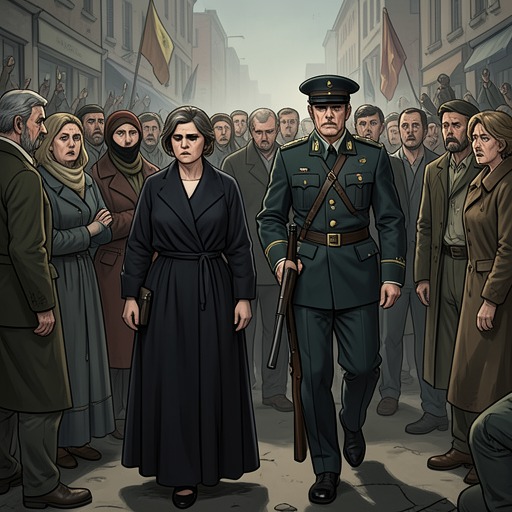
The Prices lived in a small, semi-detached council house on Slievegallion Drive in Andersonstown. Albert made the chairs that filled its cramped front room. The family’s display of prison photographs, rather than holiday pictures, gave the home a visible political history. Albert and Chrissie Price shared a fierce commitment to Irish republicanism: they regarded the British as an occupying force and believed the Irish had a duty to expel them by any means necessary.
When Dolours was little, she sat on her father’s lap as he recounted joining the Irish Republican Army in the 1930s, while still a boy, and going to England as a teenager to carry out a bombing raid. He had cardboard in his shoes because he could not afford to repair the soles, but, in the story he passed on, that hardship accompanied an audacious challenge to the British Empire. His account joined personal deprivation to political defiance, making sacrifice part of the family’s own history.
Albert also told his daughters about escaping from a jail in Derry with twenty other prisoners. They had dug a tunnel out of the facility, while one inmate played the bagpipes to cover the noise. His stories of long-dead patriots and comrades hanged by the British made imprisonment and death familiar features of the household’s political imagination. He also discussed the safest way to mix improvised explosives: a wooden bowl and wooden utensils, never metal, because a single spark could be fatal. Dolours sometimes listened with goose bumps. To her as a child, parents with friends who had been hanged could seem an ordinary fact of life.
From Family Tradition to Armed Struggle
Albert was an intermittent presence during the years when the conflict intensified, because he was involved in the new struggle. When the IRA needed guns, he went looking for them; men gathered in the Prices’ front room to confer with him in low voices. At some point he went on the run, taking refuge across the border in the Republic of Ireland. His political commitment therefore appeared not only in what he told his daughters, but in the practical work and risk that occupied his own life.
Dolours began studying at St Mary’s Teacher Training College in 1970, after failing to gain a place at art school. The experience of the Burntollet Bridge ambush had changed her and Marian, their father later said: after they returned to Belfast, they were never the same. In 1971, Dolours approached an IRA commander and asked to join. Her formal induction took place in the front room of the family home, where she raised her right hand and pledged to promote the IRA’s objectives and obey orders from a superior officer. Chrissie sat in the next room with a cup of tea, appearing unaware of the ceremony. Dolours would later regard joining as a return to the convictions on which her family’s legacy had been built.
Albert’s Defence of the Provisional IRA
Albert explained the Provisional IRA as a response to an escalation of violence and failed protection. He described its beginnings as people erecting barricades against loyalist attacks, first fighting with stones while their opponents had guns. The movement, he argued, had to obtain weapons; then British troops, whom the residents expected to protect them, raided their homes. In his account, bombing followed from that sequence: “What way could you fight? So you went down and you blew them up.” He maintained that without British intervention there might have been no Provisional IRA.
His defence did not depend on denying the humanity of individual British soldiers. Albert acknowledged that humanity, but argued that a soldier in uniform was an enemy in a war as Irish people understood it. He insisted that he was against death, while treating the means as subordinate to the intended political end. The prospect of a united socialist Ireland, he concluded, might make the struggle worthwhile. His reasoning placed the family’s armed commitment within a consequentialist argument: violence was defended as a means to national and social transformation, even as its human costs remained visible.
A Father at the Trial and During the Hunger Strike
At the London trial of Dolours, Marian and their fellow defendants, Albert and Chrissie travelled to attend. Their old friend Eamonn McCann observed the older Prices sitting ramrod straight and proud. That composure, he thought, concealed the pain of watching their daughters face the prospect of life sentences. In the dock, the sisters smiled and waved to supporters; Albert’s public bearing formed a striking contrast with the suffering McCann sensed beneath it.
When the sisters later went on hunger strike, Albert did not urge them to abandon it. He told a reporter that many people passed through life without contributing anything to the world, and that if his daughters died, at least they would have done something. Chrissie likewise said she had raised them to do their duty to their country: she was heartbroken to see their suffering and proud of them, but would not ask them to give up. Their support made the hunger strike a family ordeal as well as a political confrontation. Chrissie kept conversation light during prison visits, postponing the question of what her daughters were consuming until she was about to leave.
As the sisters’ condition deteriorated, Albert emerged from a visit to them in the terminal ward and told reporters they were ready to meet their fate: “They are happy,” he said. “Happy about dying.” The Provisional IRA warned that their deaths would bring devastating consequences for the British Government. Albert’s words thus occupied two registers at once: they presented his daughters’ readiness as a matter of resolve, while exposing the terrible consequence toward which that resolve was directed.
Return and Bereavement
The sisters were eventually allowed to return home. By then, their aunt Bridie Dolan had died, and Chrissie had died of pancreatic cancer four days after the aunt’s funeral. The Prices had petitioned for compassionate leave so the sisters could attend their mother’s funeral, but the request was denied. They sent a wreath of Easter lilies instead. Four hundred people joined the cortège from Slievegallion Drive to Milltown Cemetery; Albert walked beside his wife’s coffin with his head bowed, behind a young girl playing bagpipes in an IRA beret and dark glasses.
The funeral’s familiar republican symbols—Easter lilies, a tricolour-associated procession, and bagpipes—echoed the histories Albert had told at home, but now marked an irreversible family loss. His daughters had returned to Ireland, yet not in time to see their mother again. The arc of Albert’s story holds together the inheritance he helped transmit and its cost: political struggle gave the family a language of duty and belonging, while prison, hunger, absence and bereavement entered the same household history.