Archie McConville
Say NothingArchie McConville was sixteen when masked neighbours took his mother, Jean McConville, from their home in Divis Flats. He tried to go with her, was forced back at gunpoint, and watched her being driven away through the building’s pigeon holes. The episode made him the family’s immediate witness to an abduction that left the children waiting for a return that never came; years later, he was still trying to understand what had happened and to defend his mother’s name.
Family life in Divis Flats
Before Jean disappeared, Archie was already carrying responsibilities beyond his age. He was the oldest child at home, and after his mother was taken he was the only one with a job: an apprenticeship as a roof tiler. The children had little money and, as they struggled to remain together in the flat, began running short of food. Archie’s work did not make him a guardian in any formal sense, but it placed him among the few supports available to his younger siblings.
The family had also been made vulnerable by its position in the divided city. They had been displaced from East Belfast for being Catholic and found themselves treated as outsiders in West Belfast for being too Protestant. After Jean helped a wounded British soldier, graffiti accusing her of being a “BRIT LOVER” appeared on the family’s door. Local friends withdrew, and the children encountered hostility rather than protection. Archie himself was badly beaten by the republican movement’s youth wing and had his arm broken after refusing to join. His experience of Divis was therefore not simply that of a close-knit neighbourhood: it was also a place where belonging could be demanded and enforced.
The night Jean was taken
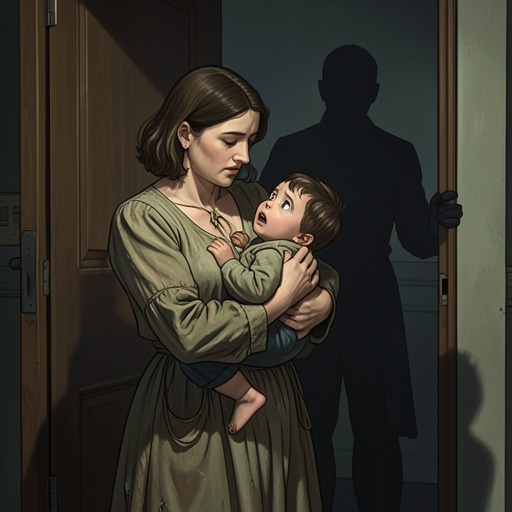
When a group of roughly eight to twelve men and women burst into the flat, some wore balaclavas and others had stockings over their faces; at least one carried a gun. Jean was pulling on her clothes while her frightened children gathered around her. The intruders told them that she would be gone only a few hours. Archie, at sixteen the eldest child present, asked to accompany his mother. The group agreed, and Jean put on a tweed overcoat and head scarf as the younger children were herded into a bedroom.
The assurances did not conceal the intruders’ identities. A couple were unmasked, and Michael recognized them as neighbours. Outside the flat, Archie stayed close to Jean as they moved through the stairwell. Divis Flats was usually occupied even at night, but on this occasion he noticed that the complex seemed emptied out: there was no bystander to call for help. At the bottom of the stairs, a larger masked group waited beside an idling blue Volkswagen van. Several had guns. One man pressed a pistol against Archie’s cheek and ordered him away. Outnumbered and unarmed, he turned back up the stairs.
From the second level, Archie watched through the vertical openings the children called pigeon holes as the group bundled Jean into the van and drove away. He understood only later that the permission to accompany her had been a means of getting her out of the flat, not a genuine promise to let him stay beside her. Jean’s last words to him were an instruction to watch the children until she came back. He returned to the flat in winter silence, with that expectation still hanging over the family.
A witness to danger and exclusion
Archie had already seen how quickly an act of compassion could be recast as disloyalty. After a gun battle outside the flat, Jean went to a wounded British soldier lying in the gallery. She brought him a pillow, cradled his head and comforted him with a prayer. Archie rebuked her for intervening because he feared it would bring trouble. Jean answered that the wounded man was somebody’s son. By the next morning, the family’s door bore the accusation “BRIT LOVER.” The episode helps explain the perilous atmosphere in which the family lived: care for an injured stranger could be turned into evidence against a neighbour.
After the abduction, rumours spread that Jean had left willingly to be with a British soldier. Archie and his siblings heard people whispering and felt the judgement of neighbours; at home, the children even wondered whether the story could be true, because they could not explain their mother’s absence. Archie later described the gossip as “an attempt to wreck our minds.” His account identifies the rumours not as harmless speculation but as another injury imposed on children already waiting for their mother.
The children tried to remain at home because they believed Jean might return. Their routine deteriorated: dishes accumulated, bedtime ceased to matter, and food ran out. Eventually social welfare authorities took several of the children into care. Helen McConville promised the younger ones they would be away only until their mother came back; Archie, old enough to work and fend for himself, was not taken with them. The separation formalized a dispersal that had begun in the flat, leaving siblings to grow up in different circumstances while their mother’s fate remained unresolved.
Adulthood, testimony and the search for truth
The family’s later efforts to understand Jean’s disappearance brought their different memories and judgements into the open. Archie wondered whether she might have been mistaken for another woman suspected of being a double agent in Divis. Michael rejected the idea that their mother had been a spy, describing her as an overworked and psychologically fragile mother of ten who spent her days in the flat, smoking, caring for the children and washing clothes by hand. The family’s insistence on clearing her name arose amid competing claims about why she had been taken; none of those claims erased the children’s knowledge of the mother they had lost.
The disappearance continued to shape the siblings’ lives and relationships. Michael, after leaving institutional care at sixteen, lived with Archie for a time before moving in with Helen. His later clashes with Helen and periods without a home were part of a wider family history in which each sibling had been left to manage alone. When the children argued about whether forgiveness was possible, Michael said he had hoped they would come together, but that the dispute was tearing them further apart. Archie’s place in that history was both personal and public: he had been the boy at the stairwell, and he remained one of the family members trying to make sense of the loss.
Thirty-one years after Jean vanished, her body was found. At the inquest, Archie called her a very good mother and said that all their lives had been hell without her. The identification of her remains gave the family a grave and a funeral, but it did not close the case. The coroner ruled that the limited amnesty for the disappeared did not apply because Jean’s body had been found by a member of the public, not through assistance from the Irish Republican Army. The criminal case therefore remained open. Archie’s testimony stands at the boundary between recovery and resolution: the family could finally bury Jean, while the circumstances of her abduction and death remained subject to investigation.
Narrative significance
Archie’s story is marked by the distance between what he was promised and what he witnessed. The intruders said Jean would return within hours; he saw neighbours take her away, was threatened into retreat, and was left with her instruction to care for the children. The memory anchors the family’s long ordeal in a specific sequence of choices and coercion, rather than in rumour alone.
His later role also shows how the consequences of disappearance extend beyond the missing person. The siblings’ hunger, separation, troubled childhoods and disagreements over forgiveness followed from Jean’s absence, while public suspicion added a further burden to their grief. Archie’s account does not supply a final explanation for why Jean was taken. Instead, his testimony preserves the family’s claim to know who she was: not the figure of the rumours, but their mother, whose disappearance altered the course of their lives.