Belfast–Derry civil-rights march (January 1969)
Say NothingThe Belfast–Derry civil-rights march (January 1969) was a student-led protest against systemic discrimination in Northern Ireland, but it also became a defining break in the political outlook of Dolours Price and Marian Price. The march set out to demonstrate that peaceful action could challenge injustice; the violence it encountered helped convince the sisters that protest alone would not bring the change they sought.
Background and Purpose
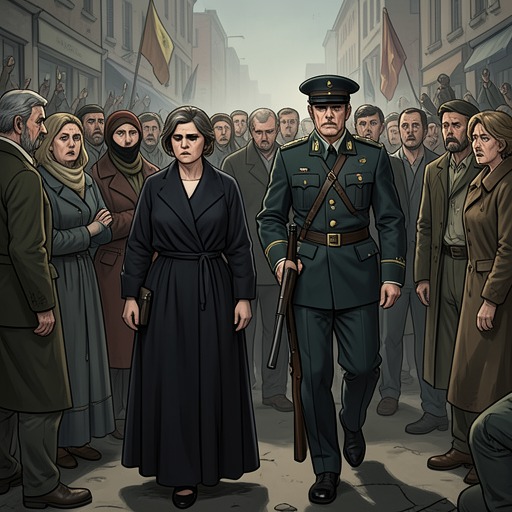
On the cold, clear morning of 1 January 1969, student protesters gathered outside City Hall in Donegall Square, Belfast. Their intended destination was Derry, about seventy miles away, and the journey was expected to take several days. They were protesting the unequal treatment of Catholics in Northern Ireland, where discrimination was not merely a matter of communal feeling but was reflected in access to work, housing, and political power.
Northern Ireland had a population of roughly one million Protestants and half a million Catholics. Although Catholics were the majority on the island as a whole, they were a minority in the six counties and faced exclusion from desirable jobs and housing. The devolved government at Stormont had existed for half a century without a Catholic holding executive office. Catholics were also shut out of shipbuilding and other attractive professions, and many emigrated in search of work. Despite a Catholic birth rate approximately twice the Protestant rate, the Catholic population had remained virtually static during the three decades before the march, as emigration drained the community.
Partition had left both communities with a sense of vulnerability, though their positions within Northern Ireland were unequal. Protestants were the local majority but a minority on the island; Catholics were the island-wide majority but lacked equivalent power in Northern Ireland. The march challenged discrimination while offering a way to recast the conflict: its participants could understand themselves not simply as Catholics confronting Protestants, but as young people confronting an older political order.
The Route and Its Opposition
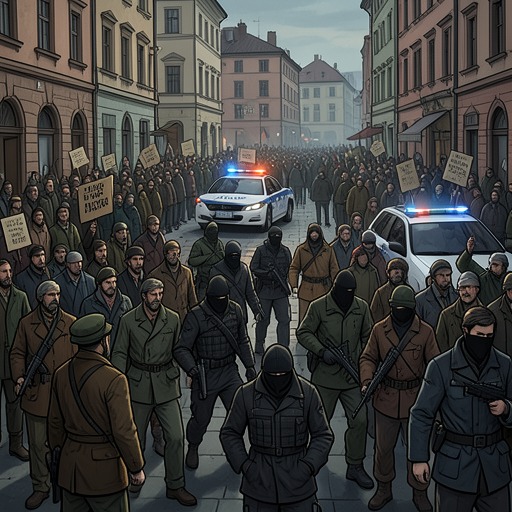
As the march moved through the countryside, it repeatedly encountered Protestant villages that were unionist strongholds. Local men appeared with sticks to block the students’ passage, while police accompanying the march directed it around the villages. Men associated with Major Bunting walked alongside the protesters and taunted them. One carried a Lambeg drum, whose pounding summoned other counterprotesters from nearby homes and gave the procession’s passage an increasingly menacing accompaniment.
Some marchers believed that a violent confrontation might expose the injustice they opposed. The televised response to the Selma march in the United States had offered an example of how a crackdown on peaceful protesters could provoke wider change. In 1969, amid a sense that young people elsewhere were challenging established authority, some hoped that a comparable spectacle might shift opinion in Northern Ireland. Their expectation was not that violence was harmless, but that an overreaction to peaceful resistance might make entrenched injustice impossible to ignore.
On the fourth and final day, at a crossroads ten miles outside Derry, hundreds of marchers filled the road. A speaker warned through a megaphone that stones might be thrown and asked whether they were prepared to risk being hurt. The marchers answered together that they were. Their response expressed both solidarity and an awareness that the final stretch might bring danger; it did not prevent the attack that followed at Burntollet Bridge.
Burntollet Bridge and the Turning Point
The assault at Burntollet Bridge marked the march’s decisive reversal from a demonstration of peaceful resistance to an experience of violent confrontation. The available account emphasizes the contrast between the protesters’ stated willingness to risk injury and the attack they encountered. For Dolours Price, the experience became a direct challenge to her belief that peaceful protest could overcome injustice. She concluded that marching would not convert those opposing change and later treated her decision to join the Irish Republican Army as a return to her family’s republican tradition.
The impact extended to Marian Price as well. Their father later said that both sisters had been changed by the Burntollet experience and were never the same after returning to Belfast. The march therefore mattered not only as a collective protest but as a personal turning point: it helped redirect two young participants from faith in peaceful action toward armed republican activity. In 1971, Dolours joined the IRA, and Marian joined the Provisionals too.
Consequences and Significance
The march exposed the difficulty of maintaining a peaceful protest when local hostility and the threat of violence shaped the route. Its participants had hoped that a confrontation might clarify the injustice they opposed; for the Price sisters, the actual violence instead weakened their confidence that peaceful resistance could produce the necessary political change. The march did not by itself account for their later choices, but the book presents Burntollet Bridge as a crucial experience in the sequence that led them toward the IRA.
Its significance thus lies in the gap between the march’s method and its aftermath. The procession began as a claim for civil rights and as an effort to redraw political divisions around youth and change. The assault at its end helped return the sisters to a starkly different interpretation of the struggle. In that sense, Burntollet Bridge became more than a hostile interruption to a march: it was a hinge in the narrative from nonviolent protest to armed commitment.