Clonard Monastery
Say NothingClonard Monastery was more than a religious landmark in Belfast: standing across a fault line in the city’s divided geography, it became a place where Father Alec Reid witnessed the conflict at close range and cultivated contacts that would later support secret peace initiatives. Its location made the work of mediation inseparable from the realities of the Troubles.
Setting and Position
Built in the late nineteenth century, Clonard Monastery is a large Gothic structure positioned between the republican Falls Road and the loyalist Shankill. Its founder reportedly came to regret acquiring so troublesome a site, but the monastery’s position gave Reid, who moved to Belfast in the early 1960s, an unusually direct view of the conflict as it unfolded around the city’s communities.
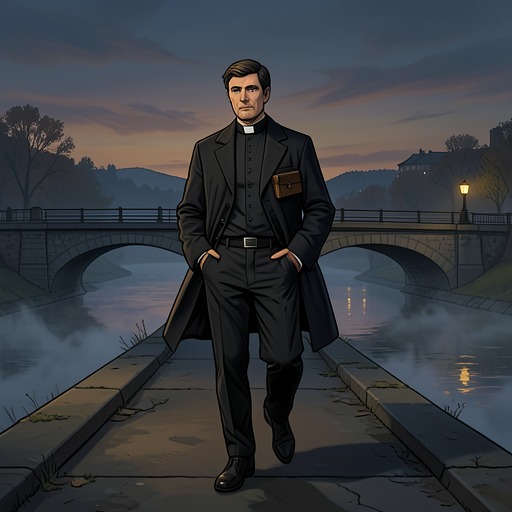
Reid had joined the Redemptorists as a teenager; the order’s work was dedicated to the poor and abandoned. At Clonard, he took that commitment beyond the sanctuary. Rather than keeping apart from disputes in the surrounding neighborhoods, he became a priest who mediated quietly in the streets and sometimes found himself caught between paramilitary factions. The monastery’s boundary location thus shaped both his proximity to danger and his role as an intermediary.
A discreet forum for peace
By the late 1980s, Clonard Monastery had become more than a vantage point from which Father Alec Reid observed the conflict: it was a discreet meeting place for people who could scarcely be seen speaking together. Reid had developed close ties with Gerry Adams and Brendan Hughes through regular visits to Long Kesh in the 1970s. After Adams was released while Hughes and other comrades remained imprisoned, Reid carried messages between them. Hughes called the priest “Behind the Scenes,” a nickname for his recurring role in the movement’s private dealings, though Reid’s proximity to republican leaders did not mean that he condoned their violence.
Reid came to believe that persuading the IRA to end its campaign was essential to ending the conflict. He approached Adams and found him receptive, then wrote to John Hume, leader of the Social Democratic and Labour Party, proposing that the IRA could be persuaded to stop if the situation were handled properly. Hume had publicly condemned republican violence and regarded the movement’s combination of armed action and electoral politics with deep suspicion. The proposed dialogue therefore depended on a relationship of trust that neither man could acknowledge openly: contact with Adams carried political risks for Hume, while Adams could be accused within the IRA of abandoning armed struggle.
On 11 January 1988, Hume and Adams met at Clonard. Their discussions led to an exchange of documents setting out the positions of their respective organisations and the possible terms of a peace initiative. The monastery’s part in the process was practical as well as symbolic. In Belfast’s atmosphere of surveillance and suspicion, Reid served as a trusted intermediary, carrying a Sinn Féin position paper from a requiem Mass to Hume in Derry. The brown envelope became stained with blood when Reid ministered to two murdered British corporals; he returned to Clonard, placed the papers in a clean envelope, and continued his journey. A document intended to make political conversation possible thus passed through a scene of lethal violence before reaching its recipient.
A Place Within Contested Memory
Clonard’s role as a meeting place did not make the peace process a clean break with the past. The conflict ended in a stalemate, and the Good Friday Agreement established power-sharing without creating a formal process for deciding how the Troubles should be understood or commemorated. Gerry Adams’s continued refusal to acknowledge IRA membership sharpened that uncertainty: public denial could make it seem unsafe for others to speak openly about their own roles. The secret conversations associated with Clonard thus belong to a history in which efforts to move toward peace unfolded alongside continuing silences about the conflict.
The later Belfast described in the book holds progress and division together. A Troubles tour presents former flashpoints as distant history, while more than 90 per cent of children still attend segregated primary schools and peace walls remain part of the city’s landscape. Against that contrast, Clonard’s significance rests not on a claim that dialogue settled the past, but on its concrete place in an attempt to make political conversation possible across entrenched divisions. The monastery stands in the narrative where mediation meets the unresolved struggle over who may speak, and what the city will remember.
The Church as an intermediary
Clonard’s importance also rested on the institutional standing that Reid believed a church-based initiative could command. He saw his work not as service to one party but as speaking for people already killed and those who might be killed if the conflict continued. Adams, in turn, told him that only the Church had the credibility, status and communication channels to bring the relevant parties together. The peace strategy they discussed therefore depended on more than private access: it was to join republican representatives with the nonviolent nationalists of the Social Democratic and Labour Party and the government of the Republic of Ireland. Clonard’s role in this proposed arrangement grew from its position between divided communities and from Reid’s ability to move among people who otherwise had little reason to trust one another.