Eamonn McCann
Say NothingEamonn McCann was a Derry socialist and civil-rights activist who became one of Dolours Price’s closest friends and a persistent critic of her turn to armed struggle. He argued that Protestant working people were not Catholics’ enemies, and that peaceful protest could unite people against the structures that kept them poor and politically powerless. Price came to believe the opposite: after the violence at Burntollet Bridge, she abandoned nonviolence and joined the IRA. Their friendship survived that divide, but it never erased it. At Price’s funeral, McCann described both her devotion to revolutionary ideals and the way those ideals had kept her imprisoned.
A Socialist at the Head of the March
On 1 January 1969, McCann was among the leaders of a student protest march from Belfast to Derry, a journey of roughly seventy miles intended to expose discrimination against Catholics in Northern Ireland. Catholics were often shut out of good jobs and housing, had little political power, and had never held executive office in the devolved government at Stormont. For McCann, however, the injustice could not be answered by treating Protestant workers as a single hostile bloc. He was a young socialist from Derry, articulate and direct, and he urged the marchers to see working-class Protestants as people harmed by the same system rather than as their natural enemies.
McCann insisted that Protestant workers were not exploiters in expensive suits, but men in overalls who had been misled by landed and industrialist unionists. His argument offered a different political map from the sectarian division that organized everyday life: the relevant divide, he suggested, was between ordinary people and those who benefited from the system. He believed that working people on both sides might recognize their shared interests, and that a united, socialist Ireland could make that recognition politically possible. During the march, he became fast friends with Price, who was also drawn to socialist ideas and initially shared his hope that the old divisions could be overcome.
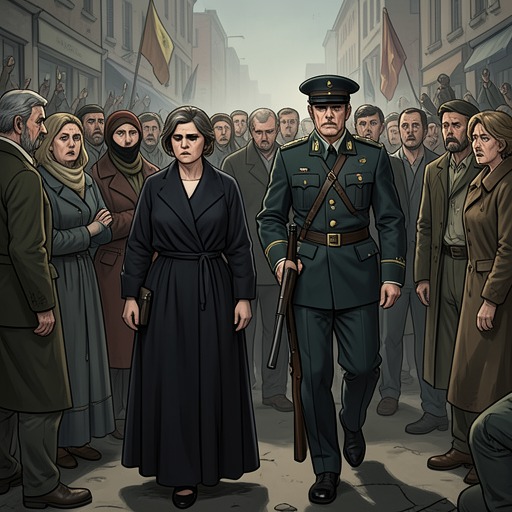
The march’s nonviolent commitment was tested as it travelled through unionist villages, where counterprotesters blocked the route, taunted the students, and prepared stones for an ambush. McCann reminded Price and the other protesters that they had promised to march peacefully. At Burntollet Bridge, the marchers were hemmed into a narrow road as attackers appeared on the high ground and behind the hedges, hurling stones, bricks, and milk bottles. The violence did not confirm McCann’s hopes for what protest could achieve; it became the experience that Price later identified as the point when she lost faith in peaceful resistance.
A Friendship Divided by Armed Struggle
McCann wanted revolutionary change, but he was convinced that violence could not deliver a result proportionate to the suffering it caused. When Price and other friends joined the armed struggle, he was dismayed. He warned that nothing that came out of the campaign could match the pain being put into it. Price, by contrast, increasingly saw armed action as the only way to achieve the national liberation for which her family had fought. In 1971 she joined the IRA; Marian Price joined as well. McCann knew that Dolours had entered the organization, although she never explicitly told him.
The divergence between them was not a simple break in contact. McCann continued to see Price from time to time and remained struck by her glamour and presence. He remembered the Price sisters as unlike the stern, pious republican women he had known growing up: they were elegant, self-possessed, and smiling, rather than visibly grim or doctrinaire. That vivid impression coexisted with his disapproval of their political course. To him, their appearance did not make the violence less consequential; it sharpened the contrast between the people he knew and the armed movement they had chosen.
The consequences of the conflict deepened the disagreement. On Bloody Sunday, McCann and a large crowd of peaceful protesters had assembled in Derry when British paratroopers opened fire, killing thirteen men and wounding fifteen. The soldiers claimed they had been attacked and had shot only people carrying weapons; neither claim proved true. The massacre galvanized Irish republicanism, and Price and Marian, then in Dundalk, heard reports of it with overwhelming anger. The book places McCann’s presence at a peaceful protest alongside the sisters’ response: the same political crisis intensified their resolve in opposite directions. The violence strengthened Price’s conviction that nonviolent resistance had failed, while McCann’s opposition to armed struggle remained grounded in the human cost he believed it could never justify.
Friendship Through Peace and Memory
McCann and Price stayed in touch for decades, and in her later years she spoke to him once a week. She often wanted to return to the events of her youth; he tried to guide their conversations elsewhere. When she considered writing about her IRA days, he urged her to write about her childhood instead. His resistance was not a denial that her past mattered. It reflected his concern about her repeated immersion in experiences that had left her troubled and that she struggled to reconcile with the political settlement that followed.
The Good Friday Agreement felt to Price like a personal betrayal. She had planted bombs, robbed banks, lost friends, and nearly died in the expectation that the struggle would achieve national liberation. She resented the political turn led by Gerry Adams, once her commanding officer, because she believed it disowned the armed campaign and the people who had carried it out. McCann understood the depth of that grievance. He recalled that the agreement affected her more intensely than it did many others, and he remained a friend even as he had long rejected the means by which she had tried to reach her political ends.
That closeness did not make him an uncritical confidant. As Price reached for journalists to speak about her past, McCann warned her that doing so could be hazardous. He challenged her impulse to testify and tried to redirect her away from recounting the IRA years. His recurring effort to turn the conversation toward her childhood shows both the persistence of their friendship and the limits of his ability to protect her from the past she wanted to confront. Price’s desire to put her experiences on record continued despite his cautions.
The Funeral Oration
At Price’s funeral in 2013, McCann delivered one of the graveside orations. He said he had loved her for forty years and described her as someone who had lived out, with unusual urgency, ideals to which many others claimed to be committed. His words held together the admiration and the criticism that had marked their relationship: Price had been a liberator, he said, but had never managed to liberate herself from those ideas. He concluded, “Sometimes,” McCann said, “we are imprisoned within ideals.”
The phrase gave their long political disagreement a final shape. McCann had argued from the beginning that solidarity across the sectarian divide offered a path away from violence; Price had come to see armed struggle as an obligation, then found the peace settlement that followed impossible to accept as a sufficient answer to what she had done and endured. At her funeral, McCann did not reduce her to either her militancy or her suffering. He remembered a friend whose ideals had been intensely lived, and whose devotion to them had also become a form of confinement.