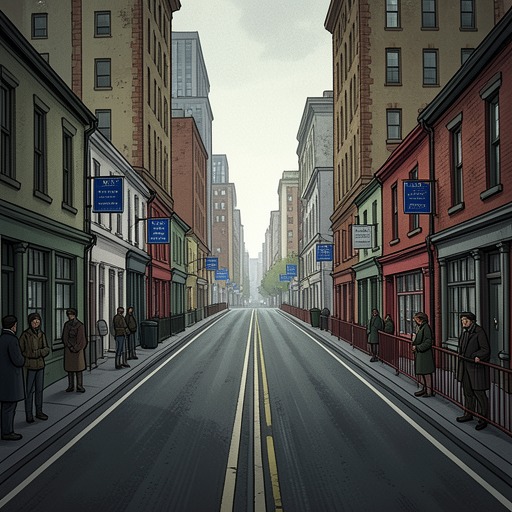
Falls Road
Say NothingFalls Road was a principal artery of West Belfast, but during the Troubles it became more than a route through the city: it marked a boundary, a refuge and a contested centre of power. Its history in the book runs from families forced to move through streets divided by sectarian violence to British Army operations, Provisional IRA activity and Sinn Féin’s later political presence. The road’s changing uses show how Belfast’s geography could make the ordinary business of finding a home, travelling safely or seeking redress inseparable from the conflict.
Setting and Sectarian Geography
The Falls Road ran roughly parallel to Shankill Road, the Protestant stronghold, as both arteries moved towards central Belfast. They drew closer without meeting. Narrow cross streets linked them at right angles, lined with rows of similar terraced houses; somewhere along each street, Catholic territory gave way to Protestant territory. In 1969, barricades formalised that divided geography. They were eventually replaced by peace walls: taller barriers separating communities whose borders were also watched by paramilitaries and teenage sentries.
The road’s importance lay partly in this contrast between physical proximity and separation. Falls Road and Shankill Road were close enough for neighbouring streets to become frontiers, yet the barricades and later walls made those frontiers tangible. The book presents the city’s political division not as an abstraction but as a condition of movement: who could live where, which streets felt safe, and how residents responded when violence turned familiar neighbourhoods into exposed territory.
Displacement and the Search for Shelter
For the McConville family, the violence around Falls Road meant repeated upheaval. A taxi driver, afraid of the chaos, would take Jean McConville and her children no farther than the road; they had to carry their belongings on foot to rejoin Arthur at his mother’s house. That arrangement offered little security. The house had only one bedroom, Jean and her mother-in-law did not get along, gun battles were frequent, and the family feared a fire in the timber yard behind the house might spread to them.
They moved again, this time into a Catholic school converted into temporary shelter, where they slept on a classroom floor. The family’s experience belonged to a wider displacement: Belfast’s housing authority was building temporary accommodation for thousands of people made refugees within their own city. Yet even a new shelter did not guarantee a home. When the McConvilles arrived at one newly built chalet, another family had already occupied it and refused to leave. The same thing happened at a second chalet. On Divis Street, Arthur stayed with the workmen building the next one until construction was finished, so that no one else could move in first.
The chalet had four rooms and an outside toilet, but it was the family’s first place they could legitimately call their own. Jean went out to buy fabric for curtains. They remained there until February 1970, when they were offered accommodation in Divis Flats, a new complex that had been under construction for several years and now loomed over the surrounding neighbourhood. The sequence of temporary shelter, contested occupancy and eventual relocation gives Falls Road’s setting a domestic history as well as a military one: the pressures of conflict shaped where families could sleep and what counted as a home.
Military Search and Curfew
In July 1970, British soldiers entered the alleys around Balkan Street, off Falls Road, looking for hidden weapons. In one house they found fifteen pistols, a rifle and a Schmeisser sub-machine gun. As the soldiers prepared to leave in armoured vehicles, local people confronted them and threw stones. A vehicle reversed into the crowd, crushing a man; the resulting anger intensified the confrontation. Another company of troops arrived, and soldiers fired tear-gas canisters into the crowd.
The military presence escalated into a large operation. Three thousand soldiers converged on the Lower Falls, breaking into houses in a search officially directed at weapons. They overturned beds, cut open sofas, lifted linoleum and floorboards, and pulled out gas and water pipes. At night, a helicopter hovered above Falls Road and announced that a curfew was being imposed: residents had to remain indoors or risk arrest. Soldiers laid concertina wire across the streets to seal off the Lower Falls and patrolled in body armour with riot shields. From their windows, residents watched with undisguised contempt. The operation made the road and its surrounding streets both a place of enforced confinement and a visible confrontation between residents and the state.
Danger continued inside the homes. Michael McConville remembered that when gun battles broke out at night, Arthur shouted for the children to get down. They dragged their mattresses to the middle of the flat and slept huddled together, sometimes on the floor more often than in their beds. Michael listened to bullets ricochet off the concrete outside. The death of nine-year-old Patrick Rooney, killed by a police bullet that pierced the walls of his family’s flat, made that danger concrete. Continuing volleys initially kept an ambulance from crossing Falls Road; men eventually carried the boy out, waving a white shirt to signal for help. He died shortly afterwards. For children growing up in Divis, the violence was not a distant battle elsewhere in Belfast but a threat that entered the flat through its walls.
An Armed Movement and Political Centre
As the Troubles intensified, Andersonstown, above Falls Road, became part of a neighbourhood network shaped by raids, displacement and resistance. Children stopped going to school because the journey was unsafe, and two of Dolours Price’s aunts moved into the area after being burned out of their homes elsewhere. The British Army searched local houses for IRA suspects and weapons; one house served as a clandestine bomb school for Provisional IRA recruits. Residents used the noise of metal dustbin lids struck against paving stones to warn of approaching raids, while children on street corners signalled danger with whistles. The road’s surrounding community was thus both a setting for armed organisation and a civilian network reacting to military incursions.
The Falls Road also became a base for the Provisional IRA’s Belfast operations. Brendan Hughes, who joined the organisation in early 1970, commanded D Company in territory that included the Falls Road, the Grosvenor Road and the old Pound Loney area. The company was initially only twelve people, known as the Dirty Dozen. Its operations formed part of the road’s wartime life, though the evidence places them across a wider West Belfast territory rather than on the road alone.
That operational role remained visible in later episodes. In July 1973, Gerry Adams was heading to a call house on Falls Road for a meeting with Hughes and Tom Cahill. A man posing as a businessman was conducting surveillance, and British troops had secretly gathered around the house. After Adams entered, the soldiers moved in; Hughes and Adams tried to escape through the back but found troops waiting in the yard. The three men were taken to a police station and beaten and interrogated. The episode turns a familiar residential street into a site of surveillance and capture, where a routine meeting place had been compromised before its occupants understood the danger.
Political Memory and Public Life
Falls Road’s later political identity grew from the same ground as its history of armed struggle. Sinn Féin’s headquarters occupied a ramshackle building on the road, used as a political office where Adams gave press interviews and met constituents. Outside, colourful murals showed masked IRA gunmen carrying rifles. The setting concentrated a central tension in Adams’s public persona: a political organisation presenting itself through community activity while the armed movement remained visually and historically present on the walls around it.
The party’s public work also took place at street level. Adams walked through the neighbourhood, speaking with constituents about matters such as litter and disputes with the Housing Executive, while an aide recorded their concerns and promised follow-up. Sinn Féin opened advice centres to help people with practical issues such as welfare claims. This local service work accompanied a broader attempt to refashion the organisation as a political outfit; it did not erase the road’s association with paramilitary power or the contradictions that accompanied that transition.
In 2014, after Adams was arrested in connection with the Jean McConville case, artists painted a new mural on Falls Road showing him beside the words PEACEMAKER, LEADER, VISIONARY. At a rally to demand his release, Martin McGuinness called the arrest politically biased and blamed an embittered rump of the old Royal Ulster Constabulary. Supporters held placards defending the peace process, while Bobby Storey stood beside McGuinness and later warned that the movement had not gone away. The words deliberately echoed Adams’s earlier response to a heckler. Michael McConville heard the echo as a threat, particularly because the McConville children had been seeking access to the Boston College tapes and had welcomed Adams’s arrest.
Graffiti around Belfast sharpened that atmosphere: the words BOSTON COLLEGE TOUTS appeared on buildings, and reporting about the Belfast Project named additional people who were said to have given interviews. Anthony McIntyre told his children not to answer knocks at the door and began checking beneath his car for an explosive device. In this late episode, Falls Road’s murals and rally are not merely background to a political dispute. They show how the road continued to serve as a public stage on which competing accounts of the IRA, the peace process and the past could be asserted—and how those assertions could feel menacing to people seeking answers about a disappearance.