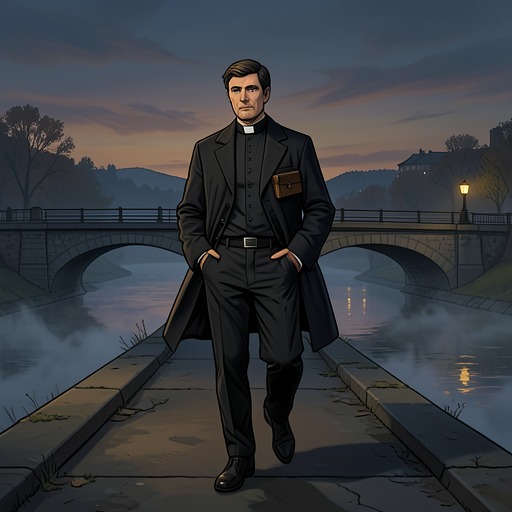
Father Alec Reid
Say NothingFather Alec Reid was a Redemptorist priest whose life at Clonard Monastery placed him close to the divided streets of Belfast and whose commitment to dialogue made him an intermediary across political lines. He witnessed the Troubles at intimate range, ministered to people killed in its violence, and worked behind the scenes to open a path from armed conflict toward peace.
Identity and Ministry
Reid was fifty-six when the book introduces him at a funeral in 1988: a priest with a long, lined face and small, hooded eyes. He had grown up in County Tipperary and joined the Redemptorists while still a teenager; the order dedicated itself to the salvation of the poor and abandoned. Before the Troubles began, he moved to Belfast in the early 1960s and joined Clonard Monastery, a nineteenth-century Gothic building straddling the boundary between the republican Falls Road and the loyalist Shankill. Its position, which the monastery’s founder reportedly regretted as troublesome, gave Reid a vantage point from which to encounter the conflict not as distant political argument but as a daily human reality.
Reid did not confine his work to the church. He saw some clergymen retreat behind scripture, whereas he described himself as a priest “on the streets”: a quiet mediator who entered disputes and, at times, paramilitary feuds. When another priest questioned the danger of involving himself, Reid answered, “In for a penny, in for a pound.” His faith in dialogue was practical as well as pastoral: he believed that getting antagonists to speak might allow them to find common ground.
Intermediary Between Prison and Street
During regular visits to Long Kesh in the 1970s, Reid grew close to Brendan Hughes and Gerry Adams. Adams had lived near Clonard and gone there weekly for religious instruction; after his release from prison, Reid carried messages between him and comrades such as Hughes, who remained incarcerated. His recurring presence in private political exchanges earned him the nickname Behind the Scenes from Hughes. The name captured a practical role: Reid could move between prison and the streets, and between men whose political choices were becoming increasingly consequential.
That role brought him into the violence itself. At Milltown Cemetery, as mourners gathered for the funeral of Mairéad Farrell and her two associates, Reid was beginning a prayer when he noticed a man in a dark anorak approach the crowd. The object the man hurled looked at first like a smooth black stone; it was a grenade. After a second explosion, the attacker drew a pistol and fired as mourners pursued him among the tombstones. The gunman, Michael Stone, had come hoping to kill Gerry Adams and other leading republicans. He killed three mourners and wounded more than sixty. Reid’s position at the graveside made him a witness not only to the desecration of a funeral but to the way a ritual of mourning could be turned into another scene of political violence.
In the same spring, Reid’s ministry brought him face to face with the dead on opposing sides. After two British corporals were murdered, he administered the last rites to both, without knowing whether either was Catholic. His response was pastoral rather than partisan: he ministered to the men even as the crowd around them posed a danger. The image of the priest kneeling beside a murdered soldier became an enduring record of that act. Reid said that people had had enough and needed to listen to one another; he described physical force as a sign of the poor’s desperation. Yet his response to violence was not limited to public words or last rites. Even as he ministered to the dead, he was working secretly toward a political alternative.
The Work of Peace
Reid’s turn toward secret diplomacy grew out of years spent urging both paramilitaries and ordinary people to reject violence. He came to believe that ending the conflict required persuading the IRA to stop fighting, and he raised the possibility with Gerry Adams. Adams was receptive, though the book leaves open what lay behind that response: a changed political vision, a recognition that electoral politics and armed struggle could work against one another, or exhaustion. Reid was later credited with coaxing Adams toward peace, but Brendan Hughes, who knew both men, remembered the relationship differently: he believed Adams had been managing Reid from the beginning. That disagreement matters. Reid could create a channel and carry its messages; it did not mean he controlled the political destination.
The channel took practical form in secret contacts between Adams and John Hume. On 11 January 1988, they met at Clonard Monastery, where the danger ran both ways: Hume risked being seen negotiating with the IRA, while Adams risked appearing to have abandoned armed struggle. They agreed to exchange documents setting out their organisations’ positions and the possible limits of a peace agreement. The arrangement depended on secrecy and intermediaries. At the funeral Mass for Kevin Brady, Reid received a brown envelope containing Sinn Féin’s position paper, then carried it out of the church and into an altogether different scene.
When two British corporals were murdered, Reid ministered to them and delivered the last rites. The paper remained in his pocket; blood from his hands smudged the envelope as he gave the men mouth-to-mouth. He returned to Clonard, transferred the documents into a clean envelope, and travelled to Derry to deliver them personally to Hume. In the stained paper, the book brings the physical cost of the conflict into contact with the fragile mechanics of negotiation: the same priest who attended the dead carried a proposal between adversaries. His role was not a public declaration of reconciliation but a sequence of discreet acts—meeting, receiving, protecting, and delivering—that allowed dialogue to continue.
Reid’s peace work also belonged to a wider struggle over what could be said about the past. The Good Friday Agreement looked toward a shared political future but established no general truth-and-reconciliation process for the violence that preceded it. Later, there was no settled mechanism for resolving old cases or ensuring equal accountability; investigations proceeded piecemeal amid disputes over fairness. The book also connects Reid with the effort to address the fate of the disappeared, whose families endured uncertainty and pressed for answers. His commitment to dialogue thus extended beyond securing a ceasefire: it placed him among those trying to make speech possible where fear, secrecy, and unresolved loss had kept people silent.
Peace and the Unsettled Past
Reid’s work for dialogue opened a route away from armed conflict, but it could not by itself settle what the conflict had left behind. The Good Friday Agreement concentrated on a shared political future and provided for the release of paramilitary prisoners; it did not establish a general truth-and-reconciliation process. Nor did it create a broad exchange of testimony for legal immunity. Because the Troubles had never been formally declared a war, killings by paramilitaries and soldiers remained subject to ordinary criminal law rather than a framework for prosecuting war crimes. The unresolved cases therefore remained open, and former combatants and soldiers could still face prosecution.
There was one limited exception. Legislation passed in 1999 to help recover the bodies of the disappeared offered a form of amnesty to people who voluntarily gave authorities information about those cases. That narrow provision underscored the distance between finding the missing and accounting for the wider history of violence. Families continued to endure trauma, rumours, and uncertainty, while pressing for answers and for graves they could visit. The book connects Reid with the fate of the disappeared, placing his commitment to dialogue alongside the human cost that a political settlement had not erased.
The absence of a common process left accountability uneven and contested. In the McConville case, prosecutors judged allegations against Gerry Adams uncorroborated, while an oral history could still be used against a speaker who implicated himself. More broadly, the legacy of the conflict was handled through inquests, police investigations, and special inquiries rather than a settled mechanism; the Police Service of Northern Ireland’s legacy unit faced a backlog of nearly a thousand cases. Reid’s discreet diplomacy could help adversaries speak to one another, but the later struggle over evidence, responsibility, and remembrance showed how much remained unsaid. The peace he helped make imaginable was not the same as agreement about the past.