Irish Republican Army
Say NothingThe Irish Republican Army entered the crisis of 1969 diminished, short of weapons, and divided over whether armed struggle still had a place in Irish politics. Its inability to protect Catholic neighbourhoods from attack helped prompt a breakaway movement committed to armed resistance. The organization’s history in the book is therefore also a history of changing political conditions: from the pressures of street protest and communal violence, through a formal split and women’s entry as full members, to an electoral strategy that challenged the movement’s suspicion of parliamentary politics.
A Movement Under Pressure
By the late 1960s, the Irish Republican Army had little strength to draw on. Its border campaign of the 1950s and early 1960s had failed to win substantial community support. Some leaders in Dublin were questioning the usefulness of the gun and moving toward Marxist ideas and peaceful political resistance. The organization had dwindled so far that, when the riots began in 1969, Belfast had only about a hundred members. Many were veterans of earlier campaigns, including Albert Price, but they were getting older. The organization was also conspicuously short of weapons: in 1968 it had sold some of its remaining arms to the Free Wales Army, while its experience with improvised explosives carried a reputation for devices that sometimes killed their makers rather than their intended targets.
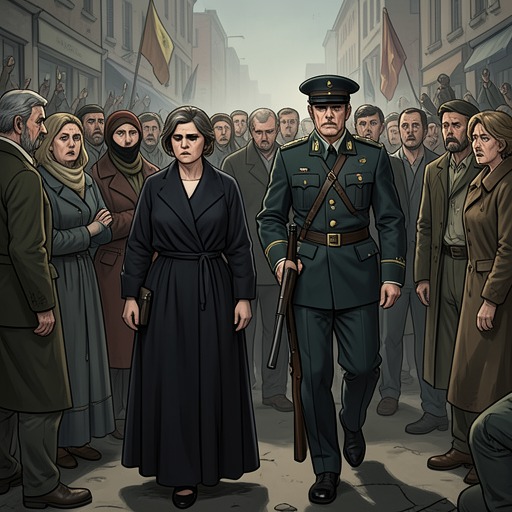
The surrounding political geography sharpened the consequences of that weakness. The Falls Road and the Shankill Road ran roughly parallel through Belfast, Catholic and Protestant strongholds separated by narrow cross streets where one community’s territory gave way to the other’s. Partition had left Catholics a minority in Northern Ireland, where they faced discrimination in employment, housing, and political power; Catholics were often excluded from attractive professions and left in search of work. In this setting, the IRA had traditionally been looked to for protection during sectarian violence. Yet in 1969 it could not prevent loyalist mobs from driving Catholic families out of their homes. The resulting accusation that the initials IRA meant that it had run away captured the depth of the organization’s loss of standing.
The Split and the Return to Armed Resistance
A faction in Belfast wanted the Irish Republican Army to take a more forceful role. In September 1969, commander Liam McMillen convened a leadership meeting in a room on Cyprus Street. Twenty-one armed men burst in, led by Billy McKee, a veteran street fighter who had joined the organization’s youth wing at fifteen and spent time in prison in every decade since. McKee confronted McMillen over the organization’s failure to protect the community and challenged his leadership. The confrontation reflected a wider argument: whether republican politics should move toward peaceful resistance or restore armed force as an instrument of change.
By early 1970, a breakaway organization known as the Provisional IRA had formed, explicitly committed to armed resistance; the older organization became the Official Irish Republican Army. In Belfast, the rival wings were commonly distinguished as the Provos and the Stickies. Their different Easter Lily emblems offered a visible sign of the divide: the Officials supposedly wore commemorative lilies attached with adhesive, while the Provisionals wore paper ones pinned to their shirts. The split did not end the violence between republican factions. As both wings fought loyalist groups, the Royal Ulster Constabulary, and the British Army, they also began a bloody conflict with one another.
The new barricades made the sectarian division of neighbourhoods more formal. In time, barricades gave way to peace walls, while paramilitaries policed their respective enclaves and teenage sentries watched boundary lines. The pressure of raids and communal danger also changed daily life in places such as Andersonstown. Residents collaborated in warning of approaching authorities: women and children struck dustbin lids against the pavement, and children on street corners whistled when trouble appeared. Such participation made the organization’s fortunes part of a broader experience of siege and local solidarity, not simply a matter of its leaders’ decisions.
Membership and the Place of Women
The movement’s return to armed resistance brought young people into its ranks. In 1971, Dolours Price approached a local commander and asked to join. Her induction took place in the front room of her family home: she raised her right hand, pledged to promote the organization’s objectives, and vowed to obey orders from a superior officer. Her mother sat in the next room, apparently acting as though she did not know what was happening. Marian Price joined the Provos as well; the sisters continued to attend school while disappearing at night, within a culture of secrecy in which parents might not ask where a young person had been.
Dolours Price sought membership as a fighting soldier, not a supporting role. When Seán Mac Stíofáin proposed that she join Cumann na mBan, the women’s auxiliary, she objected to being assigned duties such as making tea or tending the wounded. A special meeting of the Provisionals’ Army Council then decided that women could join the organization as full members for the first time. The book links this change in part to Price’s ambition and republican family background, while also recording her speculation that the mass imprisonment of men may have made the organization more willing to admit women. Formal inclusion did not spare her from menial work: after her swearing-in, she was ordered to scrub a heap of dirty, mismatched, rusty bullets with steel wool. She disliked the task but carried it out, having promised to obey orders.
Armed Struggle and Electoral Politics
The movement’s commitment to armed resistance sat alongside a longstanding suspicion of electoral politics. Abstentionism—the refusal to participate in parliamentary institutions—had helped shape the split between the Official Irish Republican Army and the Provisionals, amid fears that political participation would dilute revolutionary purpose and lead to accommodation. The hunger strike later brought that tension into public view. After Frank Maguire’s death created a by-election in Fermanagh and South Tyrone, republicans proposed that Bobby Sands run for the seat from prison. The candidacy was intended to draw attention to the hunger strike and would test whether the British government could treat a prisoner as a political protester while he also sought election to Parliament.
By 1983, the book shows a further turn toward electoral activity. Gerry Adams, formerly Dolours Price’s commanding officer, sought a seat at Westminster representing West Belfast. He promised to boycott Parliament if elected, retaining a gesture toward republican abstentionism while campaigning for office. Price canvassed for him and drove voters to polling stations; Adams won. Her participation demonstrates how a former member of the armed movement could support an electoral strategy without abandoning republicanism. The shift did not erase the earlier history of force; it made the relationship between armed struggle and political action a continuing question.
Boundaries and Aftermath
The ceasefires and the Good Friday Agreement did not dissolve Belfast’s social divisions. Nearly two decades after the agreement, peace walls still separated Catholic and Protestant neighbourhoods, and there were more of them than at the height of the Troubles. More than 90 per cent of children in Northern Ireland continued to attend segregated primary schools. In some areas, people walked farther to wait at a bus stop where they would not fear being harassed. Union Jacks remained prominent in Protestant neighbourhoods; Catholic areas displayed the Irish tricolour and, at times, Palestinian flags, expressing solidarity and the continuing republican sense of occupation.
These details place the organization’s development within a conflict whose physical and social boundaries outlasted its most intense violence. The early inability of the Irish Republican Army to protect Catholic residents, the Provisional IRA’s emergence as an armed alternative, and later republican engagement with elections mark successive responses to a divided political landscape. The movement changed its methods and political emphasis, but the walls, segregated institutions, and contested emblems show why the transition from armed resistance to political participation did not by itself settle the divisions that had shaped its rise.