Irish unity
Say NothingIrish unity is the aspiration to bring Northern Ireland and the rest of Ireland into a single political arrangement. In the book, it is not a fixed programme with an unchanging method: it moves from a demand shaped by partition and unequal power, through the turn from civil-rights protest to armed struggle, and into electoral politics and a peace process that leaves the question of eventual unity open. That shifting relationship between an enduring objective and changing means forms one of the central tests of the political legacy of Gerry Adams and the cost of the conflict.
Partition, Discrimination, and the Demand for Change
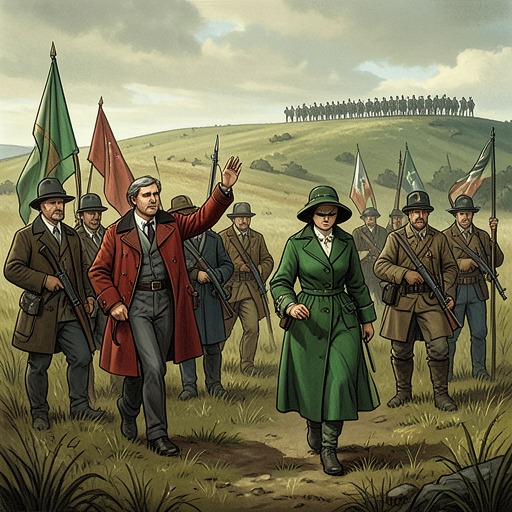
The march from Belfast to Derry on 1 January 1969 took place against the constitutional divisions created by partition. Protesters were demonstrating systemic discrimination against Catholics in Northern Ireland, where a Catholic population of roughly half a million lived alongside a Protestant population of about one million. Catholics were frequently shut out of good jobs and housing and lacked political power to improve their conditions. At Stormont, the devolved political system had existed for half a century without a Catholic holding executive office.
The imbalance was not only political. Catholics were excluded from shipbuilding and other attractive professions, and many emigrated to England, America, or Australia in search of work. Although the Catholic birth rate was approximately twice the Protestant rate, the Catholic population remained nearly static through the three decades before the march because so many people left. The book places the demand for Irish unity within this combination of constitutional division, material exclusion, and population movement, while also describing the fears on both sides: Protestants were a majority in Northern Ireland but a minority on the island as a whole, while Catholics were a majority on the island but a minority in the North.
The marchers’ action expressed a hope that peaceful protest could alter those conditions and redraw political divisions. As the procession moved through unionist strongholds, local men blocked its path and police escorted it around villages. Some protesters were prepared for the possibility of violence, but the movement also imagined a division less defined by Catholic and Protestant, republican and loyalist, than by young and old. The prospect that nonviolent protest might change an entrenched order was part of the historical possibility that Irish unity, or a more just Ireland, could be pursued without a renewed armed campaign.
From Protest to Armed Struggle
For Dolours Price, that possibility narrowed after the march and the events at Burntollet Bridge. In 1971 she approached a local commander and joined the Irish Republican Army, taking an oath in the front room of the Price family home on Slievegallion Drive. She later understood the decision as a return to her family’s republican convictions. In her view, marching could not convert those resisting change, and peaceful resistance would not bring the change Ireland needed.
The manner of her admission also connected the national objective to a challenge over who could fight for it. Seán Mac Stíofáin initially proposed that Price join Cumann na mBan, the women’s auxiliary. Price rejected a supporting role and insisted on full participation as a fighting soldier. A special meeting of the Army Council then determined that women could join as full members for the first time. The book suggests that Price’s ambition and republican family background helped drive the decision, while she also considered whether the mass imprisonment of men had made the organization more willing to admit women. Her induction did not bring exemption from routine duties: after she swore to obey orders, she was given rusty, mismatched bullets and steel wool and told to clean them. The scene makes the route from national aspiration to military organization concrete, while showing that membership also involved submission to the organization’s authority.
Electoral Politics and a Changed Strategy
A political opening during the 1981 hunger strike helped make electoral action more central to the movement. Four days after Bobby Sands stopped eating, the death of Frank Maguire created a vacancy in the Fermanagh and South Tyrone seat in the British House of Commons. Republicans urged that Sands run from prison. His candidacy joined the protest’s immediate demand for attention and support to a parliamentary contest, even though it challenged a long republican tradition of abstentionism and suspicion of electoral politics.
The book connects Sands’s electoral success to the later adoption of the Armalite and ballot box strategy. Gerry Adams entered electoral politics in 1983, seeking a Westminster seat for West Belfast while promising, if elected, to boycott Parliament. Price supported the campaign: she canvassed, urged voters to choose Adams, and drove voters to polling stations on election day. Adams won. Her role marks a striking change from her earlier participation in armed action: she continued to support Irish unity while working through electoral politics rather than violence, at least in her own case.
Peace, Brexit, and the Unresolved Question
Adams continued to insist after the Good Friday Agreement that Irish unity remained a republican aspiration, though the means of pursuing it had changed. The book contrasts his strategic turn with the sense of abandonment expressed by Brendan Hughes, who compared the armed struggle to a boat launched by many people that sailed away while its launchers were left behind. The political transition could carry forward capital accumulated through armed struggle, even as those who had borne its costs felt excluded from what followed. At the same time, the narrative presents the end of the conflict and the establishment of an enduring, if brittle, peace as a consequential achievement.
The prospect of unity remains distinct from a prediction that it will happen soon. The book notes estimates that Catholics might outnumber Protestants in Northern Ireland by 2021, but observes that this would not automatically bring an end to British rule. After the 2008 fiscal crisis and recession in Dublin, some polls found that most Catholics in the North preferred to remain part of the United Kingdom. Adams himself dismissed demographic growth alone as an adequate political strategy. The changing border after the Good Friday Agreement had seemed almost to disappear: soldiers and sandbagged checkpoints were gone, and people and goods crossed daily. Brexit threatened to complicate Northern Ireland’s position between the United Kingdom and Europe, making its divided constitutional identity newly consequential. Adams responded that Irish unity had become more prominent in public debate and said he wanted a new referendum within five years.
The book leaves the aspiration unresolved rather than treating it as the inevitable reward of either armed struggle or demographic change. It considers the irony that Brexit might contribute to an outcome that three decades of violence and roughly 3,500 deaths had failed to achieve. Adams had once made his justification of political violence depend on whether his people could genuinely prosper; in 2010, asked whether he had blood on his hands, he said he was at peace. That assurance stands against the anguished retrospect associated with Price and Hughes. The question hanging over his legacy is whether Irish unity might have come eventually without the IRA’s violence, and whether any eventual political outcome can settle the moral dispute over the means used to pursue it.