Long Kesh
Say NothingLong Kesh was a prison camp on a former air force site about twelve miles outside Belfast, built to hold large numbers of detainees. It became much more than a place of confinement: its open camp, later H Blocks, and the protests staged inside it concentrated disputes over whether Irish republican prisoners were political combatants or ordinary criminals. In the lives of Gerry Adams and Brendan Hughes, it was at once a prison, a school of comradeship and strategy, and a lasting emblem in the republican imagination.
Setting and Establishment
The camp’s construction was already a sign of what the authorities were preparing. In late July, the army conducted searches and arrests that seemed to Brendan Hughes to be an effort to gather information; he correctly understood that this was a preparatory exercise, helping the army update the addresses on its lists. Meanwhile, a large new facility was rising on a former air force base outside Belfast. The operation that followed did not come without warning to those watching closely: the camp itself suggested that mass internment was imminent.
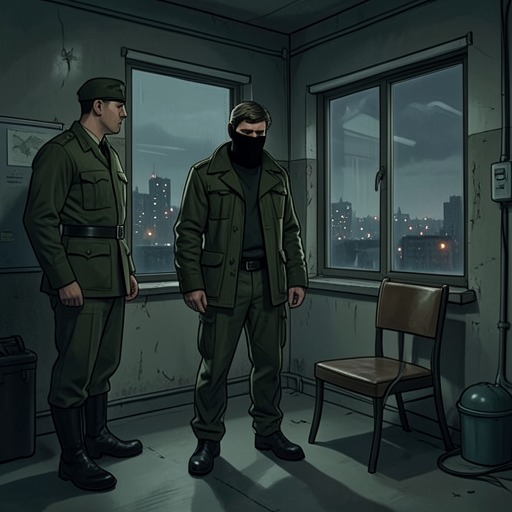
After Adams had been held aboard the Maidstone, British authorities closed the ship and transferred him by helicopter to the new facility. The camp’s design gave physical form to its purpose. Corrugated steel huts stood on a bleak, windswept plain, enclosed by barbed wire and watched by floodlights and sentry towers. Republican prisoners, who rejected the idea that they were criminals, called the place a concentration camp. That name expressed a political claim as well as a response to the stark architecture: the prisoners understood their confinement as part of a conflict, not as ordinary criminal punishment.
Long Kesh quickly assumed a vivid place in the Irish republican imagination. But the camp did not hold every prominent prisoner for the same length of time. Adams was released in June 1972, only a couple of months after his arrival. When he came out, Dolours Price and Marian Price were waiting with a car; they drove him into Andersonstown to meet other republican leaders. The briefness of that imprisonment did not diminish the place’s later importance in his life or in the movement’s collective memory.
Prisoner Community and Political Bonds
The camp’s wire enclosures around the Nissen huts were called cages. In Cage 11, Hughes and Adams shared close quarters after Hughes returned to Long Kesh and Adams was still serving time. Their relationship had been close before imprisonment, but life together in the confines of a hut tightened the bond. The enclosure made the experience of imprisonment collective: it was also where political leaders and younger prisoners encountered one another in the rhythms of daily confinement.
Hughes’s arrival with Adams on a later occasion became a defining scene of prisoner solidarity. They were transported in a Saracen to a helicopter, flown to Long Kesh, and marched into the prison handcuffed. As they entered, prisoners across the camp erupted in a cheer. To the men inside, Adams and Hughes were celebrated republican figures; the reception turned their arrival in custody into a public welcome. Hughes later remembered being bruised, manacled, and carried into the prison on that wave of enthusiasm as one of the greatest moments of his life. The welcome reversed the ordinary meaning of imprisonment: capture did not erase status within the prisoner community, and confinement could make that status more visible.
Long Kesh also held the beginnings of friendships and rivalries that would shape later political histories. Anthony McIntyre was sixteen when he first met Hughes there. Hughes, already famous and about a decade older, took a liking to him, and they became close. Years later, McIntyre’s interviews with former paramilitaries drew on the trust and personal knowledge formed inside the camp. Ivor Bell and Adams, meanwhile, had been allies in the early years: they worked closely together in the Belfast Brigade, spent time at Long Kesh, and Bell insisted that Adams be released so the 1972 peace talks could proceed. The prison was thus not only a site of separation from the outside world; it was also a place where political relationships were made and carried forward.
Escape, Routine, and Confinement
The prison’s daily routine could seem deliberately numbing, but its repetitive systems also created openings. Thomas Valliday, a Long Kesh prisoner employed as an orderly, made rounds in the rubbish lorry, collecting refuse from the camp. Prisoners sometimes left soiled or damaged mattresses outside the wire cages with the rubbish. On a Saturday morning in December 1973, Valliday found one mattress unusually heavy. He knew why: wrapped inside it was Hughes. The disguise depended on an ordinary object being mistaken for discarded waste and on Valliday’s routine work carrying it away.
The escape plan had to account for the guards’ searches. The rubbish lorry made two rounds each day before leaving for the dump, and prisoners had heard that guards used spears to stab rubbish bags before allowing the vehicle out, checking that no one was hidden inside. The Irish Republican Army had developed an intelligence network inside the prison; information from it indicated that guards had recently stopped making those checks. That change in routine created the opportunity for Hughes to be carried out concealed in the mattress. The episode makes Long Kesh’s security and its vulnerabilities part of the same story: the camp’s procedures could be studied from within, and small variations in enforcement mattered.
The system of confinement changed when internment ended toward the close of 1975. Previously, internees were generally allowed to wear their own clothes and associate freely with paramilitary colleagues, even though they could be detained without charge or trial. The new approach treated those convicted of paramilitary activity as ordinary criminals. At Long Kesh, they were placed in individual cells in the H Blocks, issued prison uniforms, and separated from the communal life of the earlier camp. The change was not merely a matter of clothing or accommodation. It challenged the prisoners’ claim to political status by making their treatment indistinguishable from that of common criminals.
Protest and the Body as a Political Claim
The refusal to accept that classification shaped the protests at Long Kesh. Hughes and other prisoners went without clothes and lived in filthy cells; in the dirty protest, they smeared the walls with their own waste, forming patterns described as van Gogh moons. The cells became so squalid that maggots appeared and disease threatened. Prison staff removed prisoners, hosed them down, and cleaned the cells with water and disinfectant, but a freshly cleaned cell could soon be soiled again. The bodily acts that the authorities treated as disorder were part of a sustained refusal of the prison’s terms.
The protest’s conditions exposed the cost of that refusal. A visiting priest compared the prisoners to people living in sewer pipes in the slums of Calcutta. Yet the filth did not simply mark the prisoners as degraded; it made the struggle over status impossible to keep abstract. Uniforms and isolated cells imposed the government’s criminal classification on the body, while the prisoners’ resistance turned the conditions of their bodies and cells into a continuing challenge to it.
In the autumn of 1980, Hughes announced a hunger strike and asked for volunteers. A hundred or more prisoners came forward, and a group of seven was selected. Hughes chose to lead the strike himself, unwilling to ask a subordinate to undertake what he would not. During the last week of October, the men began refusing food. As Hughes weakened, the prison doctor, David Ross, brought him a flask of fresh spring water each morning, explaining that it was better than the prison’s tap water. Their interaction offered a small, concrete human detail within a confrontation otherwise defined by institutions and political demands. The hunger strike extended the dispute over prisoner status from the cell and uniform to the life of the body itself.
Memory Beyond the Wire
Long Kesh continued to matter after individual prisoners left it. Hughes was released in 1986 after nearly thirteen years inside and initially lived with Adams and his family in West Belfast. He returned to active service but increasingly felt estranged from a movement becoming more focused on formal politics. The difference between the soldier he understood himself to be and the political direction of the organization made the camp’s history part of a continuing argument about what the struggle had become.
That argument also shaped how former prisoners spoke about the past. McIntyre’s later interviews began from his memory of meeting Hughes at Long Kesh, where the famous older prisoner had become his friend. Decades of silence could make it difficult for interviewees to begin, but once they did, war stories, frightening experiences, jokes, and grievances could pour out. The prison therefore survived in the narrative not simply as a remembered landscape, but as the setting in which some of the relationships behind those later testimonies had first formed.
The book sets that remembered place against a Belfast that could appear cosmopolitan and peaceful, with a Troubles Tour guiding visitors through murals and former flashpoints. Such tourism could make the conflict seem like distant history, even as disagreements over the meaning of republican armed struggle remained alive. Long Kesh’s importance lies in this double life: it was a guarded camp and a site of daily material hardship, but also a place where political identity, solidarity, and later recollection were contested and made. Its story connects the conditions of imprisonment to the larger struggle over who could define the past.