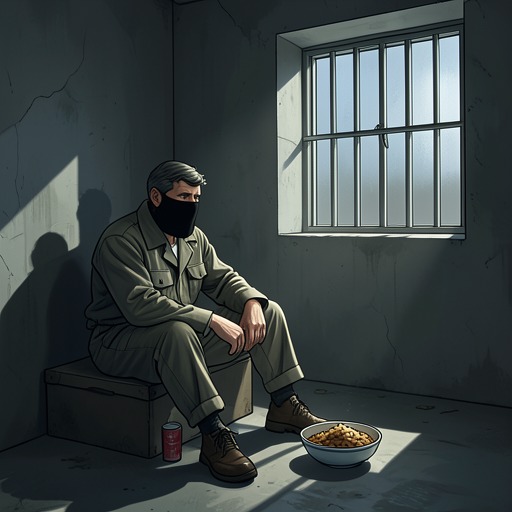
Long Kesh blanket protest
Say NothingThe Long Kesh blanket protest began in the autumn of 1976, when republican prisoners refused to wear prison-issued uniforms in the H Blocks. What appeared to be a dispute about clothing expressed a larger refusal to be classified as ordinary criminals: the prisoners sought recognition as political combatants, while the authorities rejected that claim. As guards and prisoners answered one another’s actions with further restrictions and defiance, the protest escalated into the dirty protest, making the prison itself a visible site of the conflict over status.
Causes and Stakes
Internment officially ended towards the close of 1975. Paramilitary suspects would now be charged and imprisoned as ordinary criminals rather than detained indefinitely as political prisoners. The distinction mattered to republican identity: if Irish Republican Army volunteers were criminals, the political basis on which they had taken up arms was being denied. Internment had allowed prisoners to wear their own clothes and associate freely with colleagues, despite its own severe injustice of detention without charge or trial. The new system at Long Kesh instead placed convicted prisoners in individual cells and issued them uniforms indistinguishable from those worn by common thieves.
In the autumn of 1976, prisoners refused those clothes and wrapped themselves naked in blankets. Their demand was Special Category Status, which would effectively recognise them as prisoners of war. The protest therefore challenged more than prison dress. The uniform made the government’s classification tangible; refusing it made the prisoners’ competing account of themselves equally visible. A song sung by the protesters rejected the convict’s uniform and the meek acceptance of a sentence, giving their refusal a collective voice.
From Blanket Protest to Dirty Protest
At first, the prisoners still left their cells to shower and use the toilet. Guards sometimes beat them on those trips and restricted their access to towels, which they needed to cover and dry themselves. The prisoners responded by refusing to leave their cells at all. The practical consequences of that decision changed the form of the protest: guards had to collect and empty chamber pots, but prisoners began tipping them so that urine ran beneath the doors and into the corridors. What had started as a refusal to wear prison clothes became a no-wash protest, then the dirty protest.
Brendan Hughes, the prisoners’ commanding officer, was consulted about what to do with their faeces. He suggested smearing it on the walls. The prisoners, naked and unwashed, began spreading their waste into patterns across the cells. The account describes maggots, the growing threat of disease, and guards hauling prisoners out to hose them down while other staff scrubbed the rooms with water and disinfectant. Moving a prisoner to a clean cell did not end the protest: the space could be defiled again. The bodily and material conditions of the prison thus became part of the confrontation, and each attempt to restore order was met by renewed refusal.
Prison Precedents and Escalation
The Long Kesh protest had a precedent in the Price sisters’ imprisonment after their conviction at Winchester Castle. At Brixton Prison, Dolours Price and Marian Price were the only women in an overcrowded, overwhelmingly male facility. They refused food except water and sought repatriation to serve their sentences as political prisoners in Northern Ireland. They had also used blankets after their arrest in London. Their case showed that refusal of prison clothing and refusal of food could make political status a matter of bodily endurance; it also differed from Long Kesh, where prisoners’ central demand was Special Category Status and the protest developed into a collective confrontation over prison conditions.
The sisters’ hunger strike exposed another consequence of such defiance. On 3 December, after more than two weeks without food, officials restrained Dolours Price and force-fed her through a tube. She later told Marian about the ordeal and said she did not think she could endure it again; Marian told her she could leave the strike. This episode does not describe the Long Kesh protest itself, but it underscores the coercive choices that could arise when prisoners used their bodies to resist the state’s terms.
Political Meaning and Afterlife
The prisoners’ immediate demands were specific: the right not to wear the uniform, to associate freely with other prisoners, and to receive mail. Yet the escalating protest did not produce an easy resolution. The authorities refused Special Category Status, and each side’s actions hardened the other’s resolve. The prisoners’ treatment as criminals and their own insistence that they were political actors remained in direct conflict, expressed first through clothing and then through the degrading conditions of the cells.
The book places this prison struggle within a wider contest over how the conflict would be remembered. The epigraph frames war as something fought both on the battlefield and later in memory. After the Good Friday Agreement, Gerry Adams’s refusal to acknowledge IRA membership and Sinn Féin’s control over its account of republican armed struggle are presented as part of an unresolved politics of silence and historical interpretation. The Long Kesh protest belongs to that continuing argument not as a settled origin of later developments, but as a stark example of how political identity, state classification, and the memory of armed conflict remained entangled.