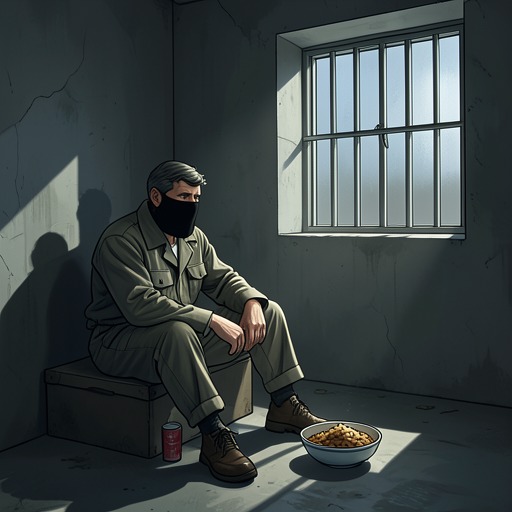
Long Kesh dirty protest
Say NothingThe Long Kesh dirty protest grew out of prisoners’ refusal to accept ordinary prison discipline while seeking recognition as political detainees. What began as a protest against wearing prison uniforms escalated through restrictions on washing and sanitation into a sustained confrontation over dignity, control, and the prisoners’ demands. The process turned the cells themselves into the means of protest, making the dispute impossible to keep at a distance from either prisoners or guards.
Background and Demands
The prisoners wanted special category status, which would effectively classify them as prisoners of war. The authorities refused. Inside Long Kesh, relations between inmates and guards deteriorated into mutual escalation. The prisoners initially left their cells to shower and use the toilet, despite refusing to wear prison clothes. Guards sometimes beat them on these trips and restricted their access to towels, leaving them with fewer ways to cover or dry themselves.
The demands behind the protest were specific: the right not to wear prison uniform, to associate freely with other prisoners, and to receive mail. The conflict therefore concerned more than clothing. The prisoners were contesting the authorities’ effort to treat them as ordinary inmates, while the authorities resisted concessions that could confer a different status.
From Blanket Protest to Dirty Protest
After beatings and restrictions on towels, the prisoners began refusing to leave their cells at all. Guards had to go from cell to cell to collect chamber pots. The prisoners then tipped the pots, sending urine beneath the doors and into the corridor. The blanket protest, already a no-wash protest, had become the dirty protest: a tide of urine spread through the prison, and the guards were left to clean it.
The remaining problem was what to do with solid waste. When the prisoners raised it with Brendan Hughes, the commanding officer inside the prison, he suggested smearing it on the walls. Hughes and the men under his command were naked, filthy, bearded, and unwashed. They painted the walls with their own excrement, swirling it into patterns the account compares to van Gogh moons. The cell walls, ordinarily instruments of confinement, became surfaces on which the prisoners made their refusal visible.
Conditions and Escalation
The cells became squalid, with maggots appearing and disease becoming a threat. Guards entered the encrusted rooms and dragged the gaunt prisoners out; one group hosed the men down while another cleaned the cells with water and disinfectant. Moving a protesting prisoner into a fresh cell did not resolve the problem. Within a single metabolic cycle, the prisoner could soil it again.
A visiting priest compared the men to people living in sewer pipes in the slums of Calcutta. The account presents the protest as grotesque, even as a kind of theatre of the absurd, but insists that beneath its shocking physical form lay a familiar contest of brinkmanship. Each escalation intensified the pressure without bringing either side closer to yielding.
Significance
The dirty protest made the conflict over political status and prison discipline bodily and inescapable. Its progression—from refusing uniforms, to refusing the journey to showers and toilets, to spilling urine into the corridors and covering cell walls with excrement—registered both the prisoners’ resistance and the worsening conditions in which they were held. The authorities’ response, including beatings, restricted towels, forced removals, and repeated cleaning, became part of the same cycle.
The account does not present the protest as a resolution: it leaves the central question open, asking which side would yield first. Its grotesque spectacle therefore does not displace the political stakes. Instead, the squalor exposes how a dispute over status and basic rights had become a contest in which every act of resistance and every attempt to contain it deepened the confrontation.