Margaret Thatcher
Say NothingMargaret Thatcher became the central government voice of an uncompromising policy toward Irish republicanism during the Northern Ireland conflict. Her refusal to recognize political status for republican prisoners shaped the confrontation around the 1981 hunger strike, while her correspondence about Dolours Price exposed a more complicated boundary between principle and practical concession: she permitted Price’s release on medical grounds but later insisted that she could not remain in England. Thatcher’s public language was categorical; the decisions made in its shadow were not always so simple.
Political inheritance and Northern Ireland
Thatcher entered Downing Street in 1979 as leader of the Conservative Party, already associated with fierce resolve. The book links her understanding of Northern Ireland partly to her wartime childhood in Grantham, which had been bombed during the Second World War, and to the influence of her Northern Ireland adviser, Airey Neave. A former prisoner of war who had escaped from Colditz Castle, Neave helped frame the conflict for Thatcher through an analogy with the Sudetenland: the passage presents this as part of the way she came to regard Northern Ireland, rather than as a straightforward dispute over civil rights.
The political atmosphere she inherited had grown out of a markedly different expectation. On 1 January 1969, student protesters assembled at Donegall Square in Belfast to begin a several-day, seventy-mile march to Derry against discrimination against Catholics. Some hoped that peaceful protest might make visible the injustice and provoke change; they imagined political divisions giving way to a generational contest between young and old. By the late 1970s, however, the conflict had moved far beyond that moment of hopeful street politics. The distinction between a political prisoner and a criminal had become a central struggle over the legitimacy of republican armed action.
Neave’s assassination hardened the context in which Thatcher took office. On 30 March 1979, a bomb beneath the driver’s seat of his car exploded as he left an underground car park at the House of Commons. The Irish National Liberation Army claimed responsibility; the Provisional IRA had not carried out the attack. Thatcher described Neave as “one of freedom’s warriors: courageous, staunch and true.” His killing, less than two months before she became prime minister, set the stage for her uncompromising posture toward Irish republicanism.
Criminalization and the prison protest
The policy dispute over prisoners had deep roots in the transition away from internment. Toward the end of 1975, internment officially ended, and paramilitary suspects were to be charged as ordinary criminals rather than held indefinitely as political prisoners. For republicans, this was not merely a change in classification: they understood themselves as soldiers and sought the standing of prisoners of war. In 1976, Northern Ireland Secretary Roy Mason had ended special category status and called IRA prisoners “thugs and gangsters.” When Thatcher later took up the issue, she adopted a similarly categorical public position.
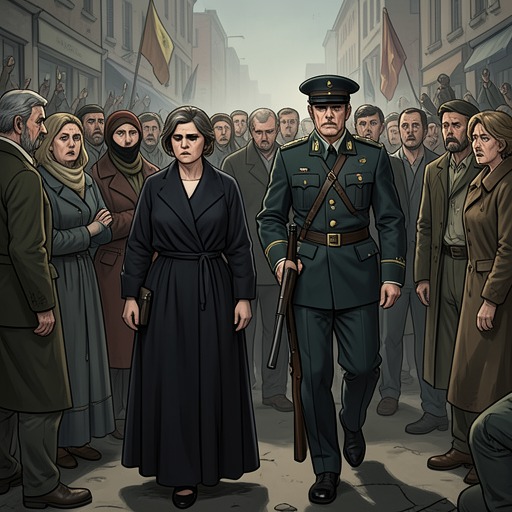
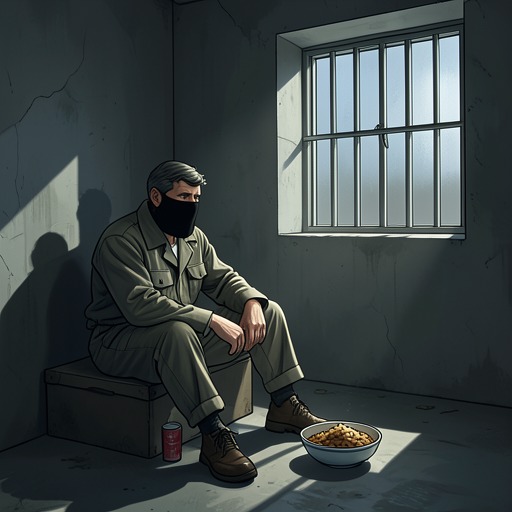
By the time she became prime minister, several hundred prisoners at Long Kesh were participating in the dirty protest. They refused ordinary prison clothing and hygiene routines in a campaign against criminalization, enduring conditions that brought filth, infestations, and the risk of disease. Prison tensions were also intensified by the Provisional IRA’s killing of off-duty prison officers. Thatcher nevertheless rejected political status. She declared, “There is no such thing as political murder, political bombing, or political violence,” and insisted there would be no compromise. Her compact formulation, “Crime is crime is crime,” turned a complex contest over law, identity, and recognition into an unyielding public rule.
The 1981 hunger strike and Sands
The hunger strike brought that rule into a crisis visible far beyond the prison. Four days after Bobby Sands began his strike, the death of nationalist MP Frank Maguire created a by-election in Fermanagh and South Tyrone. Republicans persuaded Maguire’s brother not to stand and put forward Sands, still imprisoned, as a candidate. The election transformed the strike into a direct political challenge: on 10 April 1981, after forty-one days without food, Sands was elected to Parliament. His demands were still not met, and Thatcher now faced a crisis as his health deteriorated.
Sands died on 5 May, the sixty-sixth day of his strike. His death prompted a vast response: around one hundred thousand people lined the streets of Belfast as his coffin was carried to the cemetery, and support for the republican cause surged on both sides of the border. Thatcher showed no remorse. She described Sands as a convicted criminal who had chosen to take his own life, adding that his organization had not permitted that choice to many of its victims. The contrast between the scale of public mourning and her insistence on criminal responsibility made the political stakes of her position unmistakable.
A later account by prison negotiator Ricky O’Rawe complicates the record of the strike. O’Rawe said that, in the summer of 1981, after Sands and three other hunger strikers had died, the prisoners received a secret offer from Thatcher that would have allowed them to wear their own clothes and granted other key concessions. O’Rawe and another negotiator sent a message to the Provisional IRA leadership indicating that they were inclined to accept the offer and end the strike. According to his account, Gerry Adams responded from outside that the offer was not enough and the strikers should continue. The episode is presented as O’Rawe’s account of the negotiations, not as an uncontested explanation of the strike’s outcome.
Dolours Price: release and return
Thatcher’s correspondence about Dolours Price placed her policy under a different kind of pressure. In October 1980, Fenner Brockway appealed on Price’s behalf, saying that she had come to reject violence. Thatcher questioned whether Brockway had too readily accepted the Price sisters’ assurances. She had made enquiries about Dolours’s health and recorded that doctors considered her “a much tougher personality than her sister.” In a handwritten remark, she wondered why Marian visited so rarely and called that “disturbing for a twin”—a mistaken understanding that nevertheless registered the sisters’ closeness.
Thatcher also appealed to Tomás Ó Fiaich, but told him she had no intention of releasing Price and that her condition would be closely watched. In mid-April 1981, Price was transferred from Armagh to the secure ward at Musgrave Park Hospital. She weighed seventy-six pounds. Two weeks before Sands died, Thatcher’s government released her on medical grounds and remitted the remaining portion of her twenty-year sentence. The stated reason was that she faced “imminent danger of sudden collapse and death.” The decision was a significant exception to the surrounding rhetoric of firmness, made when Price’s physical condition had become critical.
Release did not settle where Price could live. She returned to London in breach of the conditions attached to her release and was living in Maida Vale with her husband, Stephen Rea. Officials considered changing the terms to permit her to remain in England, noting that imprisonment could provoke an adverse Catholic response and might lead Price to stop eating again. Thatcher refused. She maintained that Price had been transferred to Northern Ireland on conditions and that she and Rea could live there together; she added, “If she were still in England she would be in prison.” The case showed how medical necessity could qualify the government’s immediate course without changing Thatcher’s insistence on the conditions of release.
Political change and the limits of resolve
Price’s subsequent trajectory made the political landscape less fixed than Thatcher’s public language suggested. Price abandoned violence as a means of pursuing Irish unity, while retaining her republican commitments. She canvassed for a Sinn Féin candidate for Belfast City Council and adapted to electoral politics and the strategy of the Armalite and the ballot box. Gerry Adams, once Price’s commanding officer, also entered electoral politics, seeking a Westminster seat for West Belfast in 1983. The movement’s turn toward elections did not erase the violence or settle the arguments over its past, but it changed the forms through which republican politics operated.
The 1984 Brighton bombing offered a stark counterpoint. Thatcher survived the attack, which was carried out during the Conservative Party conference. Adams defended it as a blow for democracy and described its fatalities as symptoms of the British presence in Ireland. Thatcher was shaken; in private, she came to believe that the Provisional IRA might eventually succeed, saying, “They’ll probably get me in the end,” though she did not want to make that easy for them. The remark stands beside, rather than replaces, her public certainty. Across the prison protests, Sands’s death, Price’s conditional release, and the bombing, Thatcher’s defining political posture remained refusal to recognize republican violence as political. Yet the consequences of that refusal repeatedly forced the government into decisions shaped by bodies, public reaction, and the possibility that an apparently settled policy could not simply end the conflict.