Michael Mansfield
Say NothingMichael Mansfield entered the story first as a witness to the destruction of the Old Bailey, then as the barrister willing to defend Dolours Price and Marian Price, the sisters accused of bombing it. His choice brought together the questions that had drawn him to law—authoritarian power and resistance—and a case in which the violence under examination had destroyed his own car. He was not a detached observer of the proceedings: he had been in the building when the bomb exploded, and he chose to represent the people charged with planting it.
A radical barrister
At thirty-two, Mansfield was an ambitious, slightly flamboyant English lawyer, known for floppy hair and a sonorous voice. His political radicalism had taken shape as a student, and he was drawn to cases that raised questions about the nature of authoritarian power and resistance. He had already achieved a major legal success in the months-long trial of the Angry Brigade, a group of British anarchists who had planted bombs in the homes of Conservative ministers. His client, Angela Weir, was acquitted after Mansfield’s examination discredited the government’s handwriting experts. The fee from that case paid for a secondhand Triumph 2000, a purchase that would give the next bombing a personal, material cost. Mansfield drove to work because of a rail strike. Running late and concerned about parking, he found restrictions had been waived and secured a space near the Old Bailey’s main entrance, not far from a green Ford Cortina. He was sitting in the library on the building’s top floor when the bomb detonated outside. The blast echoed through the building and showered him with broken glass. He was not seriously injured, but the Triumph was ripped apart. The lawyer who had built his reputation by questioning evidence of political violence had suddenly become its nearby casualty.
Choosing the Price sisters’ defence
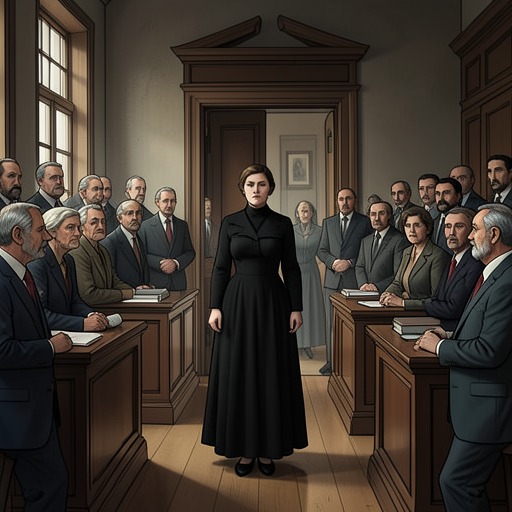
Not long after the bombing, Mansfield was asked to represent the Price sisters and their fellow accused. Many established lawyers refused the case, regarding the attack on London as too deep an affront to defend its perpetrators. Taking on notorious clients could bring attention to a practice, but Mansfield’s decision was not presented simply as professional opportunity: he was curious to meet the sisters and to understand the intensity of their commitment. When they met, Dolours and Marian sat curled up on plastic chairs, their knees drawn to their chests. They told him about the treatment of Catholics in the North, internment, Bloody Sunday and the attack on civil-rights marchers at Burntollet Bridge, where they had been beaten by a loyalist mob. Mansfield was not much older than they were. He took pride in his own radical politics, but had chosen law, a comparatively conventional means of pursuing them. The sisters, as he saw them, had chosen a life genuinely on the edge. The encounter placed their political account alongside the charge they faced: they were not only defendants in a bombing case, but young women whose experience and convictions Mansfield understood as part of what had brought them there. The sisters and eight others were charged with conspiring to cause an explosion likely to endanger life. The Old Bailey would ordinarily have been the obvious venue, but it remained under repair after the bombing. The government also wanted the proceedings fast-tracked, and trying defendants there for seeking to destroy the same courthouse risked appearing prejudicial. When the trial began in autumn 1973, it was held instead in the imposing Great Hall at Winchester Castle, a medieval chamber with stone, marble columns and stained glass. For Mansfield, the change of venue did not erase the original scene: the case was being tried elsewhere because the building in which he had been bombed was still damaged.
Evidence and the limits of a familiar skill
During the ten-week trial, the defendants—apart from William McLarnon, who pleaded guilty on the first day—maintained their innocence. Dolours said she had flown to London with Marian and Hugh Feeney for a short holiday, using the name Una Devlin because her republican family background brought unwanted attention from the authorities. The sisters could appear carefree in court; they chuckled when the prosecution showed a photograph of Mansfield’s wrecked Triumph. He was less amused, and pointed out that he could have been inside it. The prosecution’s case included circumstantial evidence connecting the defendants to the bombing. When Dolours had been stopped at Heathrow, she carried a black canvas shopping bag containing, among other things, two screwdrivers and a spiral-bound notebook. The notebook held ordinary jottings, including religious reflections and calorie counts, but pages had been torn out. A forensic witness demonstrated that writing on a missing page had left indentations on the blank pages beneath it. Those impressions disclosed a diagram of a bomb’s timing device. This was a difficult turn for Mansfield’s defence. Although he had previously succeeded in discrediting handwriting experts, he could not blunt the force of the notebook evidence. His earlier triumph could not simply be repeated: the incriminating material here was not an expert’s attribution of handwriting but a physical impression preserved on the paper. The defence also faced the decision of Roisin McNearney, the youngest member of the team, to cooperate. Initially she had denied belonging to the republican movement and said she was in London on holiday. Under questioning, she distinguished her support for Irish unity from support for violence and eventually said she feared being shot if she told the police everything. Mansfield thus confronted not only a material exhibit but a fracture in the defendants’ shared position. The account gives no detailed description of a particular defence tactic in response; it records instead the mounting difficulties against which his representation had to operate.
The courtroom and its pressures
The trial’s atmosphere was shaped by both its setting and its security. On the day the verdict was due, Mansfield thought the precautions had been designed to establish an atmosphere of guilt. Everyone entering the courthouse was searched; fifteen prison officers crowded behind the defendants in the dock; a bodyguard who had previously sat out of sight behind Judge Sebag Shaw was now openly beside him. Bomb scares at nearby department stores and a crowded gallery of Irish supporters heightened the tension. Plainclothes detectives filed in behind the all-male jury, and guards bolted the courtroom doors before proceedings began. The verdict sequence made the human cost of cooperation visible inside that guarded room. Judge Shaw announced that McNearney was acquitted and warned her against becoming involved in murderous enterprises. As officers escorted her out, the other defendants hummed Handel’s “The Dead March” from Saul. Hugh Feeney threw a coin after her and called it blood money; McNearney rushed from the hall sobbing. Mansfield’s perspective on the security and the scene registers the trial not as an abstract contest over charges but as a proceeding where accusation, loyalty and fear were enacted before the jury and the public. The evidence here establishes McNearney’s acquittal and the reaction to it, rather than the eventual outcome for Mansfield’s other clients.
Law, resistance and narrative significance
Mansfield’s significance lies in the contrast between his chosen instrument and his clients’ chosen struggle. He shared an attraction to radical questions, but pursued them through courtroom argument; the sisters had committed themselves to a life of armed action. Their accounts of discrimination and political violence helped him understand that commitment, without making the destroyed car or the notebook’s bomb diagram any less consequential. His defence therefore occupied an unsettled space between political sympathy and legal representation, and between the defendants’ stated objectives and the lethal means charged against them. The trial also places his earlier achievement in perspective. In the Angry Brigade case he had discredited handwriting evidence; in the Price sisters’ case, a forensic examination of the notebook revealed a diagram through the indentations left on blank paper, and he could not neutralize it. That reversal gives his role a particular force: legal skill does not make evidence disappear, and a lawyer’s prior success cannot guarantee another. Mansfield is introduced through the blast that destroyed his car and defined the immediate stakes of the case, then shown choosing to stand beside those accused of causing it. The narrative uses that proximity to make the trial’s central tension concrete: resistance can be argued as politics, but it is also examined as evidence and answered in court.