Nonviolent resistance
Say NothingNonviolent resistance in the book is not a settled creed so much as a strategy placed under pressure: young protesters believed peaceful action might expose injustice and reshape political loyalties, but the attack on the Belfast–Derry march would lead Dolours Price to regard that faith as naïve. Its significance lies in this reversal, and in the contrast between the marchers’ discipline and the violence they encountered.
Origins in civil-rights protest
The march began against a background of institutional discrimination in Northern Ireland. Catholics, then roughly half a million in a population of one and a half million, were often excluded from desirable employment and housing and lacked the political power to change those conditions. The devolved government at Stormont had been in place for half a century without a Catholic holding executive office. Although the Catholic birth rate was approximately twice the Protestant rate, the Catholic population had remained nearly static over the previous three decades, as people left to seek work in England, America, or Australia. The protesters understood these inequalities within a divided society in which both communities could experience themselves as embattled minorities, though Catholics in Northern Ireland faced systematic disadvantage.
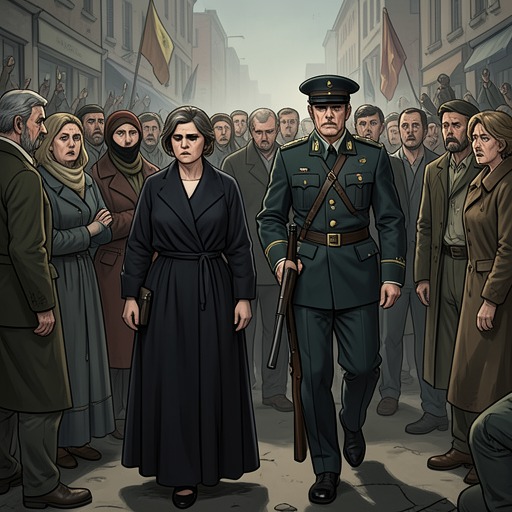
On 1 January 1969, students assembled at Donegall Square in Belfast to begin a roughly seventy-mile march to Derry. They had studied the 1965 Selma-to-Montgomery march led by Martin Luther King and other civil-rights leaders, and adopted the American movement as an explicit model. Arm in arm and bundled in duffel coats, they carried civil-rights placards and sang “We Shall Overcome.” The song and the linked arms made the method visible: the marchers presented themselves as a disciplined collective, not an armed force, and sought to make the denial of rights—and the response to their protest—publicly legible.
Dolours Price, eighteen, joined with her younger sister, Marian Price. She was also attending meetings of People’s Democracy at Queen’s University Belfast, where she embraced a socialist interpretation of the conflict. In her view, sectarian division diverted attention from shared working-class hardship. Protestant residents of Shankill Road, she reasoned, could also live in poor housing without indoor toilets; they were not necessarily the marchers’ enemies. Eamonn McCann, whom Dolours befriended on the walk, likewise urged protesters not to demonise Protestant workers, describing them as victims of a system rather than its beneficiaries. The political possibility they imagined was a united, socialist Ireland in which class solidarity might undo the division between Catholics and Protestants.
The marchers’ commitment to nonviolence was therefore connected to a belief about how political change could occur. The violence against demonstrators at Selma had helped draw attention to the civil-rights cause; some of the Belfast marchers thought a comparable spectacle of overreaction might force change at home. As hostility gathered along the route, they prepared for the possibility of injury without abandoning their pledge. On the fourth day, with hundreds now filling the road, they were asked whether they would accept the possibility of being hurt. They answered yes.
Burntollet and the collapse of confidence
The march’s discipline was tested on its fourth day, at Burntollet Bridge, ten miles outside Derry. The night before, Ronald Bunting had gathered loyalist supporters at the Guildhall in Derry for a meeting billed as a prayer meeting. As the procession approached the bridge, hundreds of marchers were on the road, including young people who had joined along the way. They had already been harried by counterprotesters and forced to detour around unionist villages where crowds of men with sticks blocked their passage. The marchers knew violence was possible, but the pledge they had made was not to resist it.
At the bridge, attackers beat marchers as they fled into fields, kicking some until they lost consciousness. A young woman was struck on the head with a spade; two newspaper photographers were beaten and stoned, and their film was seized. Bunting moved among the violence, swinging his arms like a conductor, his coat sleeves marked with blood. A banner was taken from the protesters and set alight. The scene was precisely the kind of public assault that some marchers had thought might expose injustice, but its immediate force was not a political spectacle safely observed from a distance: it was bodies being beaten and driven into the river.
Dolours Price did not fight back. Surrounded by young people with gashes on their faces, she splashed into the icy water as marchers were pushed from the bridge. There she met the gaze of an attacker carrying a club. His eyes, glazed with hate, became a memory she returned to throughout her life; in them, she saw nothing. The Royal Ulster Constabulary eventually waded into the river to break up the attack, and Dolours clung to an officer’s coat as he helped her reach safety. Yet the rescue sharpened rather than dispelled her alarm: dozens of officers had been present, but most had done little to intervene. It was later alleged that attackers wore white armbands so police allies could distinguish them from the protesters; many of Bunting’s men were members of the police auxiliary, the B-Specials.
On the way to Altnagelvin Hospital in Derry, Dolours cried, caught between relief, frustration, and disappointment. Bruised and battered, she and Marian eventually returned to their home on Slievegallion Drive. Their mother, Chrissie Price, listened to their account and asked, “Why did you not fight back?” The question marked the distance between the sisters’ commitment to nonviolence and the older republican generation’s expectation of resistance. The attack had not merely injured the marchers; for Dolours it damaged the premise that peaceful protest could persuade those who wielded violence or relied on its protection.
From protest to armed struggle
After the march, Dolours returned to school, but the attack had altered how she understood peaceful resistance. She had hoped that protest might persuade people and change Ireland; after meeting the attacker’s hateful gaze at Burntollet Bridge, she concluded that no amount of marching would bring the change she believed Ireland needed. She later described joining the Irish Republican Army as a return, a homecoming to the convictions on which her family’s republican legacy rested. The shift was not immediate escape from ordinary life: disappointed at not gaining admission to art school, she enrolled at St Mary’s Teacher Training College in 1970 to study education. Her father, Albert Price, meanwhile helped obtain guns and eventually went on the run across the border in the Republic of Ireland. He later said that after the march both daughters were changed and “they were never the same.”
In 1971, Dolours approached a local commander and said, “I want to join.” Her induction took place in the front room of the family home on Slievegallion Drive. She raised her right hand and promised to promote the organisation’s objectives and obey orders from a superior officer. Her mother sat in the next room with a cup of tea, apparently unaware of the ceremony. Marian joined as well; by day the sisters continued their studies, while their nighttime absences went largely unquestioned in a community where secrecy was essential and families often avoided asking where young people had been.
Dolours’s entry also challenged the organisation’s gender hierarchy. Seán Mac Stíofáin initially proposed that she join Cumann na mBan, the women’s auxiliary in which her mother and Aunt Bridie had served. Dolours refused a supporting role: “I wanted to fight, not make tea or roll bandages,” she recalled, insisting on being a “fighting soldier.” A special meeting of the Provisional IRA’s Army Council then determined that women could join as full members for the first time. The book presents Dolours’s ambition and republican family background as likely influences, while noting her own speculation that mass arrests of men had also made the change necessary.
Full membership did not spare her from menial assignments or tests of obedience. Soon after swearing in, she was summoned to a house in West Belfast and handed a heap of filthy, mismatched, rusty bullets dug from an arms dump, along with steel wool, and told to clean them. She suspected the task was meant to humble her and wondered whether the bullets were even usable. Though tempted to reject the order, she had pledged obedience and began scrubbing. The scene condensed the tension in her new position: she had demanded equal status as a soldier, but entry meant accepting the same chain of command and its rituals of discipline.
By 1972, reports about the Price sisters circulated among British troops and visiting correspondents, casting them as glamorous, dangerous women who carried rifles concealed in their clothing. Dolours helped project that image, teasing a reporter with an invitation to see the sisters’ bomb factory and noting that Paris Match had photographed it. Yet the reputation did not erase the political disagreement behind her turn to armed action. Eamonn McCann, her friend from the march, wanted revolutionary change but rejected violence, warning that it would not produce an outcome commensurate with the pain it caused. The contrast between the sisters’ public glamour and McCann’s grave misgiving left the central question of nonviolent resistance unresolved: the march had failed to protect its participants, but the alternative Dolours chose promised its own suffering.
From protest to politics and the unfinished past
The later turn toward electoral politics did not make the earlier choice between peaceful protest and armed action disappear; it changed the arena in which that tension played out. Four days after Bobby Sands began his 1981 hunger strike, nationalist MP Frank Maguire died, creating a by-election in Fermanagh and South Tyrone. Sands’s candidacy, launched from prison, connected a prisoner’s protest to the ballot box and brought the hunger strike into electoral politics. The result helped shift the Provisional IRA toward a strategy that combined political participation with armed struggle, rather than treating parliamentary politics only as a threat to republican commitment.
Dolours Price later worked within that changed strategy. Though she had abandoned violence as a means of fighting for a united Ireland, she had not abandoned republicanism: she canvassed for Sinn Féin and supported Gerry Adams’s 1983 campaign for West Belfast. She ferried voters to polling stations, and Adams won while pledging not to take his seat at Westminster. Her campaigning marked a further change in the forms available to her, from street protest to armed membership and then electoral work. It did not settle whether peaceful methods could achieve the political transformation she sought; it showed that resistance could move between methods as circumstances and political opportunities changed.
The unresolved question of how to confront violence also persisted after the Good Friday Agreement. The agreement provided for the release of paramilitary prisoners and capped at two years any future sentence for Troubles-related crimes, but it established no truth-and-reconciliation process or general exchange of testimony for legal immunity. A limited amnesty was created under 1999 legislation for people who voluntarily provided information to help recover the remains of the disappeared. In 2012, David Cameron acknowledged shocking levels of state collusion, while the many unsolved killings remained open criminal cases. With no agreed mechanism for dealing with the past, investigations proceeded case by case; a legacy unit faced a backlog of nearly a thousand cases, and the question of whether all sides would be treated equally remained contentious. The book thus places the marchers’ faith in public, nonviolent witness within a longer, unsettled history: exposing violence could make injustice visible, but visibility alone did not determine how the past would be judged or repaired.