Palace Barracks
Say NothingPalace Barracks was a British Army base outside Belfast whose role in the conflict extended beyond housing soldiers: it became a centre for covert intelligence work against the Provisional IRA. From the barracks, soldiers could hear bombs exploding in the city at night, while within its walls the army assembled surveillance images and managed informants whose work brought the conflict into the streets of West Belfast.
Setting and distance from Belfast
Many British soldiers were stationed at Palace Barracks, outside the city. At night, explosions in Belfast could be heard from there, and the windowpanes would shudder. The barracks thus stood at once apart from the neighborhoods where the fighting took place and close enough for its violence to register physically. In particular, the army’s attention focused on West Belfast, where Brendan Hughes and the Provisional IRA D Company operated. Soldiers regarded the area as dangerous territory, while the local population’s silence made identifying IRA members difficult.
A centre for surveillance
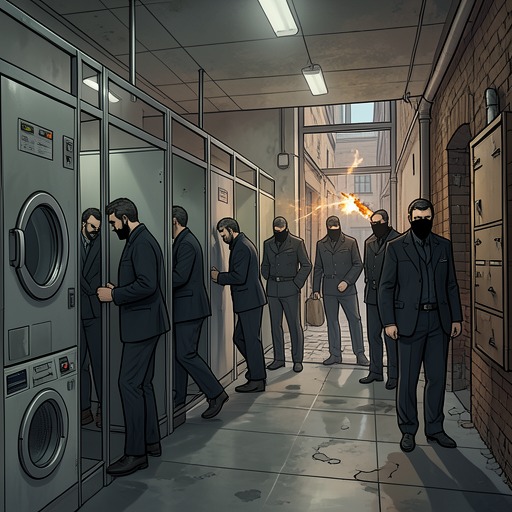
Inside a secret briefing room at Palace Barracks, the Military Reaction Force (MRF) maintained surveillance photographs of people it considered leading figures in the Provisional IRA. A former MRF member recalled that the walls displayed images of Brendan Hughes, Gerry Adams, and Dolours Price and Marian Price. The photographs made the barracks a place where intelligence was gathered and targets were made visible to operatives. The MRF’s surveillance developed alongside a covert catalogue of people its members were authorized to shoot on sight.
The informant compound
Palace Barracks also contained a secret compound where the army housed informants. Seamus Wright described an operation that recruited and managed both republican and loyalist informants, including people trained to identify suspects from funeral footage and surveillance photographs. Some were taken in an armoured personnel carrier into the Falls and asked to identify pedestrians through its gun slits. The MRF called this group the Freds. The compound was segregated, limiting what Wright could learn about the other people held there, but he recognized Kevin McKee, a young Provisional IRA member, as one of them.
Narrative significance
The barracks links two forms of military power: the visible presence of soldiers stationed outside Belfast and the hidden work of surveillance, recruitment, and target selection. Its distance from West Belfast did not mean detachment from the conflict; the bombs could be heard within it, and informants carried knowledge from the barracks back into the city. The contrast between the shuddering windows and the photographs fixed to the briefing-room walls gives the location a particular significance: violence was both an audible event and an intelligence problem to be mapped.