People's Democracy
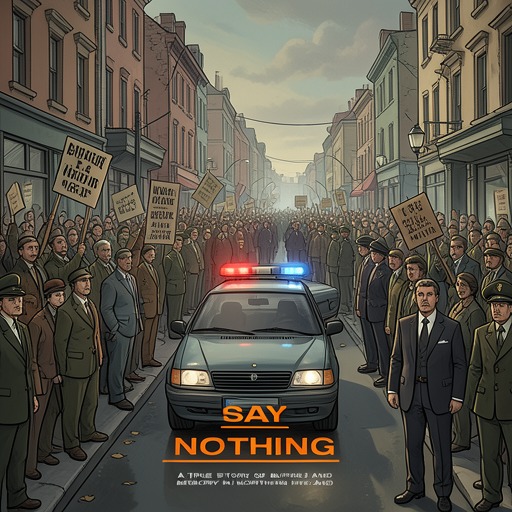
Say NothingPeople's Democracy is linked in the account to the student-led march from Belfast to Derry in January 1969, a protest against discrimination against Catholics in Northern Ireland. The march brought grievances over political representation, employment, and housing into public view. Its course also tested an ambitious hope: that peaceful collective action might redraw the conflict's divisions, before violence at Burntollet Bridge helped turn some participants toward armed struggle.
Political Setting and Grievances
On the clear morning of 1 January 1969, student protesters assembled outside City Hall in Donegall Square, Belfast, intending to walk roughly seventy miles to Derry over several days. Their protest addressed systemic discrimination against Catholics. Northern Ireland had about one million Protestants and half a million Catholics, but the Catholic minority within the six counties faced exclusion from good jobs and housing and lacked the political power to improve its circumstances. At Stormont, the devolved government had operated for half a century without a Catholic holding executive office.
The economic pressures reinforced that political exclusion. Catholics were often shut out of shipbuilding and other desirable professions and emigrated to England, America, or Australia to find work. Although the Catholic birth rate was approximately twice the Protestant rate, the Catholic population remained nearly static in the three decades before the march because so many people left. The march therefore gave visible form to grievances rooted in both discrimination at home and the resulting displacement.
The March and Its Challenge
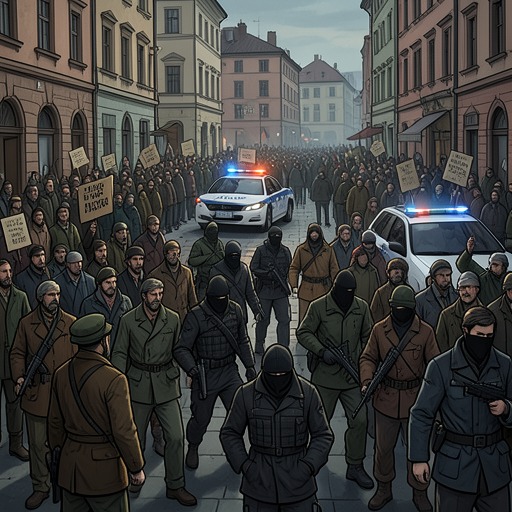
As the march crossed the countryside, it encountered Protestant villages that were unionist strongholds. Local men carrying sticks blocked the marchers, while police accompanying the procession diverted it around the villages. Men associated with Major Bunting walked alongside and taunted the students; one carried a Lambeg drum whose pounding summoned further counterprotesters from the surrounding communities. The march proceeded through a landscape where the organizers' appeal to peaceful protest met organized hostility and intimidation.
The students were prepared for a violent confrontation, and some welcomed the possibility that a crackdown might expose injustice to a wider public. The example of the Selma march in the United States encouraged the belief that televised police overreaction could help bring change. In 1969, the marchers could imagine a political division different from Catholics against Protestants or republicans against loyalists: young people aligned with the future against an older order. On the fourth and final day, with hundreds now filling the road, a speaker warned of the possibility of stones and asked whether they were prepared to be hurt. The marchers answered yes.
Burntollet Bridge and the Limits of Peaceful Protest
The march's passage ended in violence at Burntollet Bridge, an experience that became decisive in Dolours Price's political development. She had once believed in peaceful resistance, but after the attack she concluded that marching would not convert opponents or bring the change she thought Ireland needed. She later regarded joining the IRA in 1971 as a return to her family's republican convictions. Her sister Marian joined as well.
The change was personal, but it also marks the widening gulf between the march's hope of nonviolent mobilization and the armed campaign that followed. Price's account of her decision makes Burntollet a turning point: the march had offered the prospect of confronting injustice through peaceful collective action, while the violence surrounding it helped persuade her that this route had failed.
Significance in the Narrative
People's Democracy's significance here is conveyed through the march and the political possibility it represented. The procession challenged discrimination by making Catholic exclusion visible, while its encounters with hostile crowds exposed how difficult it was to sustain a peaceful, cross-generational vision amid entrenched communal divisions. The marchers' willingness to accept injury testified to their expectation that public witness could force change; the subsequent violence, and its effect on Dolours Price, showed how that expectation could collapse into a case for armed action.
The episode thus connects a civil-rights protest to the later growth of republican militancy without treating the transition as inevitable. It presents the march as a moment when a different alignment still seemed possible, then follows how the violence at Burntollet Bridge altered the choices of at least one participant.