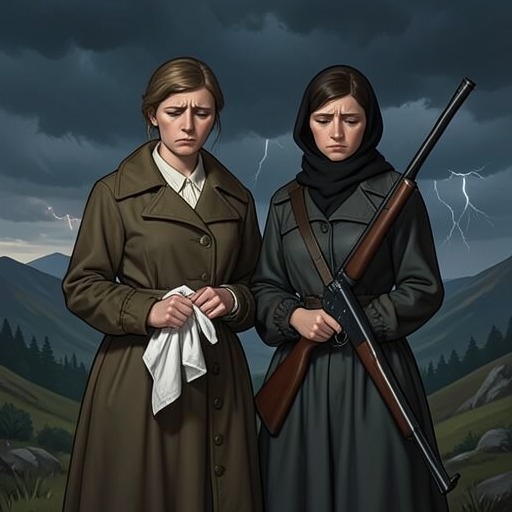
Price sisters’ 206-day hunger strike
Say NothingThe Price sisters’ 206-day hunger strike was a confrontation over who controlled the prisoners’ bodies, their political identity, and where they would serve their sentences. Dolours Price and Marian Price refused food after their conviction at Winchester Castle, demanding political-prisoner status and transfer to Northern Ireland. Their protest became an ordeal of repeated force-feeding and deliberate resistance; it ended only after the British government assured them they would be transferred, and even then their return was not immediate.
Background and Demands
After their conviction, the sisters announced that they would refuse food until they were recognised as political prisoners and sent to Northern Ireland to serve their sentences. They were taken to Brixton Prison, an all-male institution where they were treated as an exceptional security risk. The prison assigned Dolours the number 286185, an administrative identity that stood in stark contrast to the political identity she and her sister were asserting. They had no intention of remaining in prison for the lengthy sentences imposed on them; both were prepared to continue the strike until death if necessary.
Their demand was not simply to leave Brixton. They insisted that their actions belonged to a political struggle, not ordinary criminality, and that this distinction should determine their treatment and place of imprisonment. Hugh Feeney and Gerry Kelly, held in other prisons, joined the protest. The sisters’ strike thus became a collective demand, while their transfer to Northern Ireland remained its specific objective.
The action drew on a long Irish tradition of fasting as protest. For Dolours, the prison was where an Irish Republican Army volunteer’s allegiance to the cause was tested, and she regarded the possibility of dying in Brixton as an extension of the deaths of volunteers on the streets. She connected the sisters’ imprisonment to the memory of Terence MacSwiney, who had died on hunger strike, and to the wider history of Irish suffering under British rule. In her political framing, the body itself could become a weapon: the prisoners had little physical power against the state, but their threatened deaths could make the authorities answer publicly for what happened to them.
Force-Feeding at Brixton
The British government faced the prospect that a prisoner’s death would provoke a political crisis and feared the possibility of retaliatory violence. It nevertheless refused, at first, to meet the sisters’ demands. On 3 December, after Dolours had been on strike for about two and a half weeks, prison doctors and nurses took her from her cell and strapped her to a chair bolted to the floor. They forced open her mouth, placed a wooden gag-like device between her jaws, and pushed a rubber tube down her throat. A blended mixture of raw eggs, orange juice, and liquid Complan was poured through the tube. Dolours vomited soon after the feeding, but the intervention was repeated.
Two days later, Marian was force-fed as well. The procedure became a daily ritual: at ten each morning, doctors and nurses entered the sisters’ cells, restrained them, and fed them through tubes. They were weak from refusing food, and sometimes vomited while the tube was still in place, nearly choking. The process was not only an attempt to keep them alive; it subjected their bodies to an imposed routine that they had not chosen. The sisters faced that coercion while continuing to reject the food and the political terms represented by their imprisonment.
Their letters reached the press, prompting public criticism of force-feeding. The Home Office initially defended the practice as an effort to prevent prisoners from killing themselves. The sisters, however, did not regard survival under compulsion as a resolution of their protest. Their determination to remain on strike, alongside the physical risks of the procedure, turned the prison’s attempt to preserve their lives into an increasingly dangerous contest.
Resistance and the End of Feeding
In May, the government stopped force-feeding the sisters after doctors could no longer safely continue. By then, the doctors had artificially fed them for 167 days. The end came not because the sisters had withdrawn their demands, but after they changed how they confronted the procedure. Rather than endure it with as little outward resistance as possible, they struggled forcefully as staff tried to restrain them and insert the tubes. Dolours described the encounters as involving clamps, restraint, and screaming; the sisters made clear that an attempt to feed them could result in the doctors killing them.
Their resistance made the procedure difficult and dangerous to perform. After several such encounters, the doctors refused to continue. The decision was clinical rather than political: the minimum cooperation needed to carry out artificial feeding had been withdrawn. Roy Jenkins, responsible for explaining the change in policy, publicly attributed the cessation to the sisters’ refusal to cooperate and criticized their parents, Albert Price and Chrissie Price, for encouraging them. The episode exposed the limits of the government’s chosen response: feeding could keep the sisters alive, but it could not make them accept the state’s terms, and the attempt to impose it carried its own risk of death.
Settlement and Delayed Transfer
On 8 June, after 206 days on hunger strike, Dolours and Marian issued a statement with Gerry Kelly and Hugh Feeney announcing that they would end the protest. They said that Roy Jenkins had assured them they would be returned to Northern Ireland. Their statement presented the decision as conditional on that assurance and maintained that the strike had not been intended as suicide, but as a means of securing what they regarded as modest demands. The end of the fast was therefore a negotiated pause in a political confrontation, not a renunciation of its purpose.
The promised transfer did not happen at once. Instead, the sisters were moved to the women’s wing at Durham Prison. In March 1975, the prison governor summoned them to their cells and told them they were being sent to Armagh Prison. Dolours had begun packing before the announcement, sensing that a move might be imminent; when told the destination, she accepted it as near enough to home. The distance between the assurance that ended the strike and the eventual transfer gives the ending its qualification: the protest secured a commitment, but the sisters remained in English custody for months afterward.
Significance
The strike made the dispute over political status visible through a conflict over physical control. Brixton’s prisoner numbers, locked cells, restraints, and feeding tubes placed the sisters under institutional power; their continued refusal and later struggles asserted a form of agency within that confinement. The government could keep them alive by force, but could not thereby resolve the political demand that had led them to stop eating.
The episode also brought together personal solidarity and a wider political tradition. Dolours refused Marian’s offer to come off the strike alone, insisting that they would end it together or not at all. Their shared position made the protest more than two parallel refusals: each sister’s fate was bound to the other’s. Its eventual conclusion, after an assurance of transfer and a prolonged delay before they reached Armagh, preserved that tension between collective resolve and the state’s control over the conditions of imprisonment.