Republican prisoners' blanket protest
Say NothingThe Republican prisoners' blanket protest was a prison resistance campaign against the British government's treatment of convicted republicans as ordinary criminals. Beginning in the autumn of 1976 at Long Kesh, it challenged the imposed uniform and the loss of privileges prisoners associated with political status. Its escalation from naked protest to cells daubed with human waste made a political dispute over classification physically unavoidable: the prisoners rejected the identity assigned to them, while the prison authorities sought to make that identity govern their daily lives.
From internment to criminalisation
Internment officially ended towards the end of 1975. Paramilitary suspects would now be charged and convicted under ordinary criminal law rather than detained indefinitely as political prisoners. For the Irish Republican Army, this was not a minor administrative change. Its volunteers regarded themselves as soldiers in a war, and expected to be treated as prisoners of war if captured. The British government refused to recognize the conflict as a war, and the new system made the disagreement tangible inside the prison.
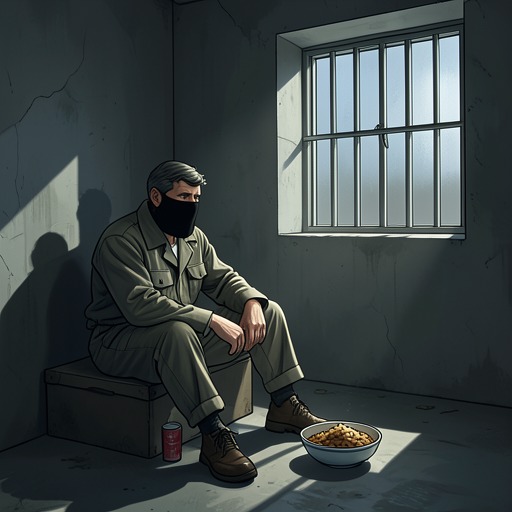
Under internment, detainees had generally been allowed to wear their own clothes and associate freely with paramilitary colleagues. In the Long Kesh H Blocks, prisoners convicted of paramilitary activity were instead placed in individual cells and issued prison uniforms, identical to those worn by ordinary thieves. Clothing thus became a visible instrument of the policy: the uniform presented the state’s classification on the prisoner’s body, while wearing it would have meant accepting that classification in daily practice.
The protest had a precedent in the resistance of Dolours Price and Marian Price after their convictions at Winchester Castle. At Brixton Prison, where the sisters were the only women held, they had worn blankets rather than prison clothes. Their circumstances were not identical to those of the prisoners at Long Kesh: they were also on hunger strike and demanded repatriation to serve their sentences as political prisoners in Northern Ireland. But the earlier protest showed how refusing prison clothing could turn a dispute about status into a visible refusal of institutional control.
Refusing the uniform
In the autumn of 1976, republican prisoners rebelled against the clothes issued by the prison. They stripped and wrapped themselves in blankets, refusing to wear what they regarded as a convict’s uniform. A protest song set the refusal against the long history of British rule and Ireland’s struggle; the point was not simply to avoid a particular garment, but to resist the implication that the struggle itself was criminal.
The prisoners sought Special Category Status, which would in effect recognize them as political prisoners or prisoners of war. The authorities refused. Their demands also included the right not to wear prison clothes, to associate freely with other prisoners and to receive mail. These were concrete conditions of prison life, but together they expressed a larger claim: that conviction should not erase the prisoners’ collective identity or sever the political meaning they attached to their actions.
The standoff made routine activities part of the contest. At first, prisoners would leave their cells to shower and use the toilet. Guards sometimes beat them on these trips and restricted the towels they could use to cover and dry themselves. The prisoners then refused to leave their cells at all. When guards came to collect chamber pots, some prisoners tipped them, sending urine beneath the cell doors into the corridors. The refusal to wear a uniform had become a refusal to cooperate with the prison’s ordinary regime.
From blanket protest to dirty protest
As the protest intensified, the prisoners’ refusal to leave their cells created a problem of waste that the blankets alone could not contain. Brendan Hughes, the prisoners’ commanding officer, proposed that they smear their faeces on the walls. The blanket protest had become a no-wash protest and then a dirty protest, its escalating forms linked by the same refusal to submit to the conditions imposed on the prisoners.
The resulting cells were described as filthy and grotesque. Naked, unwashed men with long, matted hair and beards spread waste across the walls in swirling patterns. Maggots appeared and disease became a threat. Guards hauled prisoners from the cells and hosed them down while other staff scrubbed the rooms with water and disinfectant; moving a prisoner into a clean cell could not end the protest, because the same conditions soon returned. A priest who visited compared the men’s circumstances to people living in sewer pipes in the slums of Calcutta.
The scenes could appear absurd in their extremity, but the underlying contest was over who would yield. The prisoners’ actions forced the authorities to confront the bodily consequences of the policy they were enforcing; the authorities’ response, in turn, made the prisoners’ refusal more costly and exposed. Neither the filth nor its removal settled the political question. Each side’s attempt to compel the other instead produced another turn in the escalation.
The body as a site of resistance
The comparison with the Price sisters makes plain how the protest’s politics could be imposed on the body. In Brixton, the government feared that a death during the sisters’ hunger strike would bring disaster and provoke retaliatory violence. On 3 December, after the strike had lasted two and a half weeks, doctors and nurses restrained Dolours Price in a chair bolted to the floor and force-fed her through a rubber tube. The food was a blended mixture of raw eggs, orange juice and liquid Complan. She vomited it up, then told Marian Price in the exercise yard that she did not think she could endure the procedure again. Marian told her she could leave the strike.
That episode was distinct from the later protest at Long Kesh, but it shows the stakes of refusing the institution’s terms. The prisoners’ nakedness and use of bodily waste were not detached from prison power: their bodies were already subject to confinement, surveillance and punishment. The blanket refusal turned that imposed intimacy into a confrontation over recognition. The prison could prescribe the clothes, restrict movement and determine the conditions of cleanliness; the protest made those controls visible by refusing the conduct expected of compliant inmates.
Political meaning and contested memory
The campaign’s meaning extended beyond the cells. The demand for Special Category Status challenged the government’s effort to criminalise paramilitary prisoners, while the government’s refusal preserved that distinction as a matter of policy. The prisoners’ protest did not erase the realities of their confinement or resolve the dispute over political status. It made the dispute persist in the most immediate terms available to people whose movement, clothing and contact with one another were controlled.
The book places this prison struggle within a wider conflict over who could define republican history. After the Good Friday Agreement, Gerry Adams continued to deny that he had ever been in the Irish Republican Army, while Sinn Féin’s leadership maintained a particular account of the conflict and peace process. The party’s control of that account could marginalise republican critics as opponents of the peace process. Against this background, the blanket protest appears not only as a refusal inside a prison, but as one episode in a longer contest over political identity and the authority to describe the struggle.
The protest also clarifies the uneasy legacy of paramilitary organisation after ceasefires. A report discussed in the book argued that the cohesion and authority of republican and loyalist groups helped restrain members and support the transition from extreme violence to political progress. For Brendan Hughes, Dolours Price, Marian Price and Anthony McIntyre, the same discipline could look self-interested and cruel. The blanket protest’s history holds these possibilities together: collective discipline could sustain a political claim, but it could also expose individuals to punishing conditions. Its progression from a withheld uniform to a transformed cell preserves the cost of that unresolved struggle in material form.