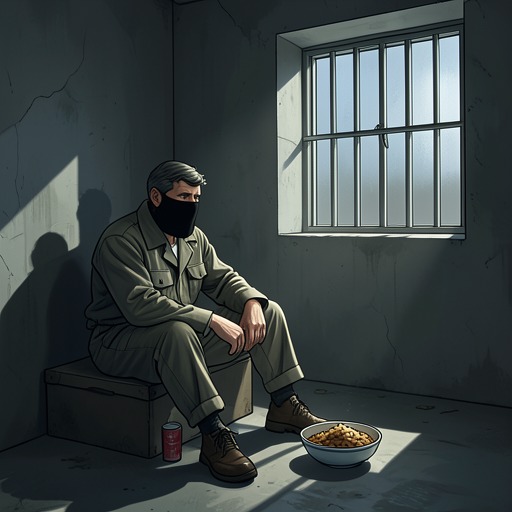
Survivor's guilt
Say NothingSurvivor's guilt is presented through Brendan Hughes’s repeated reckoning with decisions made during the hunger strikes and the deaths that followed. His account connects the arithmetic of possible lives saved to lasting physical injury, suicidal thoughts, and memories that returned after years of silence.
Counterfactuals and the first strike
Hughes returned in interviews to the initial, abortive hunger strike, which he had called off after the young striker Sean McKenna slipped into a coma. He wondered whether allowing McKenna to die might have prevented the second strike altogether, and whether that in turn could have saved the lives of ten men. The questions formed a calculation he repeatedly ran in his head, but no answer could settle it; the possible alternatives only deepened the burden.
Years later, Hughes encountered McKenna in Dundalk. McKenna had brain damage, and the strike had permanently affected his eyesight. He told Hughes, ‘Fuck you, Dark. You should have let me die.’ The encounter gave Hughes’s counterfactual a living voice: the decision he revisited was not merely a point in a political sequence, but something McKenna himself confronted him with.
Physical scars and the window
Hughes sometimes thought about killing himself. The hunger strike had left physical scars, and his eyesight eventually began to fail. He took to wearing an eye patch, a visible reminder of the damage that remained after the strike had ended.
Carrie Twomey, the wife of interviewer Mackers, recalled Hughes sitting for hours at his flat window, chain-smoking and looking across the city’s jagged lines, schoolyards, church steeples, and the distant shipyards where the Titanic had been built. She felt that he was caught between ending his life and beginning to live again. The window became an image of that suspended condition: Hughes neither acted on the thought of suicide nor seemed able to move fully beyond it.
Memory, silence, and testimony
Hughes described a recurring memory of the prison hospital during the hunger strike. He associated it with the smell of death, which he said seemed to hang over the hospital and could still return to him. For years he had put the experience out of his mind and felt unable to speak about it. Its recurrence shows the past arriving not as a settled recollection but as something that continued to intrude, even after a long period of suppression.
His eventual account makes the act of speaking part of the subject. Hughes explained that he could be candid with Mackers because he knew the interviews would remain sealed until his death. That condition offered a protected space for testimony about experiences he had not been able to discuss openly. The guilt remains unresolved in the account: it is carried through remembered decisions, bodily consequences, and a memory that could be withheld for years but not finally kept away.