United States
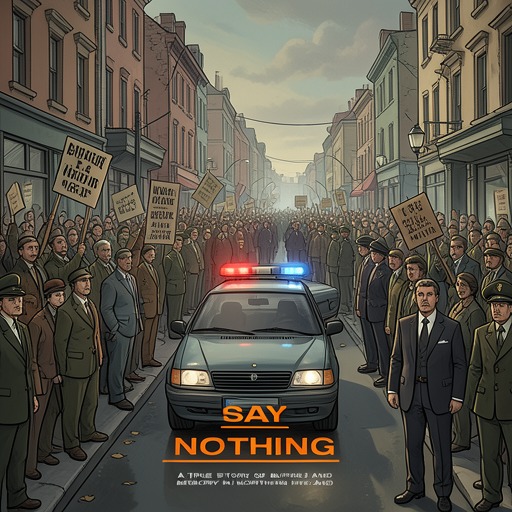
Say NothingThe United States became the crucial setting for the Belfast Project not because the conflict it documented had taken place there, but because Boston College housed the interviews and American courts were asked to protect—or compel the disclosure of—them. What had been conceived as a sealed archive for future researchers became entangled in criminal investigations: recordings gathered under promises of secrecy were sought by British authorities, and the safeguards around them proved far less secure than participants had been led to believe.
Boston and the Project’s American Setting
The project emerged from a gap in the Good Friday Agreement. The accord enabled the release of paramilitary prisoners and established power sharing, but offered no truth-and-reconciliation process through which people could recount the violence of the preceding decades. Unlike the South African process, which offered legal immunity in exchange for truthful testimony, the Northern Ireland settlement supplied no comparable mechanism for accounting for the past. The conflict had ended in stalemate, without a victor or a formal means of deciding how its history should be understood and commemorated.
Boston College offered a place to collect testimony outside Northern Ireland’s immediate political and legal pressures. The project was funded by a $200,000 grant from an Irish American businessman and designed to include former paramilitaries from republican and loyalist backgrounds. Ed Moloney recruited Anthony McIntyre, a former IRA member who could speak both the language of the academy and the street, and Wilson McArthur, who had connections in loyalist circles. From the outset, the participants treated secrecy as essential. The archive was expected to remain closed until interviewees had died, when scholars might study the testimony.
Boston also appears as a distinct Irish-American setting in the book’s account of its author’s relationship to the conflict. The author describes growing up there in the 1980s in a community where support for the IRA could be ambient even as the organization carried out devastating attacks. In a local Irish pub, a man solicited money for the IRA; a black wreath commemorated its dead. Yet the author recalls approaching Northern Ireland’s conflict with detachment, despite family roots in Ireland. That distance sits beside the emotional investment of Irish Americans who felt connected to a country some had never visited.
The Archive Meets American Law
The confidentiality arrangements were not supported by the legal review participants were led to expect. When Moloney prepared the contracts in 2001, he suggested that Boston College’s lawyers review the proposed language. The director of the Burns Library said he would send the wording to university counsel, but the agreements were apparently never reviewed. They contained no qualification warning that confidentiality might not withstand a court order. Despite this, McArthur assured interviewees that the promise was ironclad and that Boston College’s legal counsel had vetted it.
The conflict became immediate when the United States Department of Justice transmitted a request under a mutual legal assistance treaty with the United Kingdom. The request originated with the Police Service of Northern Ireland and sought the original recordings of interviews with Brendan Hughes and Dolours Price in connection with an alleged murder. Boston College handed over Hughes’s recordings and transcripts after his death, relying in part on the fact that much of his account had already appeared in Ed Moloney’s book. The material supplied was unredacted, unlike the carefully edited published account, leaving Moloney alarmed that authorities now had information on which they could act.
A second subpoena sought recordings relating to the abduction and death of Jean McConville. A federal judge ordered Boston College to submit tapes and transcripts for judicial review. The university did not appeal that ruling, prompting Moloney and McIntyre to hire their own lawyers. They lost before the United States Court of Appeals for the First Circuit, but obtained a stay preventing the university from surrendering the interviews while they appealed. The Supreme Court of the United States declined to hear the case in 2013.
Secrecy, Advocacy, and Disclosure
The court’s review turned on the content of the interviews, but the archive’s coding system made that content difficult to connect to people. Participants’ names were kept apart from their recordings and transcripts, which used alphabetic codes. The judge read the republican transcripts himself and found that six participants had mentioned McConville, although one did so only in passing. He authorized the release of recordings associated with five participants.
Dolours Price’s case revealed how a technically accurate public statement could conceal a crucial distinction. Moloney and McIntyre had said that Price did not mention McConville in her recorded conversations with McIntyre. Those interviews lasted about fifteen hours, and she did not discuss McConville in them. But a separate set of recordings existed: Moloney had interviewed Price himself after the Belfast Project’s formal interviews had ended. She agreed that the conversation would remain sealed until her death, and spoke with him at St Patrick’s Hospital and later in a rented flat. In those interviews, she discussed McConville’s disappearance in detail. The distinction between interviewer and interview series became decisive when the court identified tapes for review.
The litigation unfolded alongside a political campaign. Moloney and McIntyre argued that the subpoenas threatened academic freedom and the peace process. A Massachusetts branch of the American Civil Liberties Union opposed them in a friend-of-the-court brief, while a United States senator from Massachusetts urged the Secretary of State to work with British authorities. But Boston College faculty support was limited. Many had not known the secret project existed; some objected that its interviewers lacked extensive oral-history experience and had close ideological or personal ties to interviewees. The archive’s secrecy had protected participants from scrutiny while it was being assembled, but it also left the project isolated when its confidentiality was challenged.
Evidence, History, and the Limits of the Record
The American legal battle altered the intended life of the tapes. They had been imagined as testimony held in reserve, available to scholars after the participants’ deaths. Instead, they became potential criminal evidence and a political weapon. The book’s author reports receiving the complete, unredacted transcript of Hughes’s Boston College interview from Moloney when research began in 2014, but not the interviews of Price, Ivor Bell, or other participants. No one involved in the project shared those oral histories; some conversations could be reconstructed through interviews with McIntyre. The recordings were therefore both consequential and inaccessible: used in legal proceedings, yet unlikely to become available to researchers as a complete archive.
Their evidentiary significance remained contested. In Ivor Bell’s prosecution, his lawyer argued that the tapes were unreliable, subjective, and inadmissible, and challenged whether the coded interviewee identified as Z could be proved to be Bell. Boston College had lost the form that linked Z to the participant’s real identity. A voice analyst later judged that Z was likely Bell, but the dispute over identity and meaning persisted. Bell’s defence maintained that the recording denied involvement in McConville’s murder; a Police Service of Northern Ireland detective interpreted it as acknowledging a critical role in the killing. The case sharpened the distinction between what an oral history might suggest about events and what could be established to a criminal standard.
The wider legal setting was similarly unresolved. The Good Friday Agreement provided for prisoner releases and capped future sentences for Troubles-related crimes at two years, but created no general exchange of testimony for amnesty. A limited amnesty applied to information voluntarily supplied to help recover the disappeared, while unsolved killings otherwise remained open criminal cases. The American custody and disclosure of the Belfast Project recordings could not fill that political gap. It instead exposed its consequences: a historical archive was drawn into prosecution without a settled process for truth-telling, immunity, or comprehensive accountability.